When an Australian Dies in America, Two Legal Systems Collide — and the Family Is Left to Connect Them
A hospital social worker calls from a US area code you don't recognise. A county medical examiner you've never heard of has taken custody of your family member's body. Your travel insurer's emergency line puts you on hold. The Australian consulate tells you they can help with general guidance but cannot pay for anything, organise a repatriation, or act on your behalf.
You are now operating across two sovereign legal systems, up to 18 hours of time zone difference, and a tangle of US county-level regulations that change depending on which of thousands of jurisdictions the death occurred in. Every decision you make in the next 72 hours — which funeral home to engage, which death certificate format to order, whether to cremate or repatriate — locks you into a logistical and financial path that is expensive to reverse.
The Cross-Border Corridor Guide maps the entire US-to-Australia death corridor in a single, sequential workflow — connecting US county procedures to Australian banking rules, superannuation claim requirements, and probate filing standards so you know exactly how each decision on the American side affects your timeline and costs back home.
What's Inside the Guide
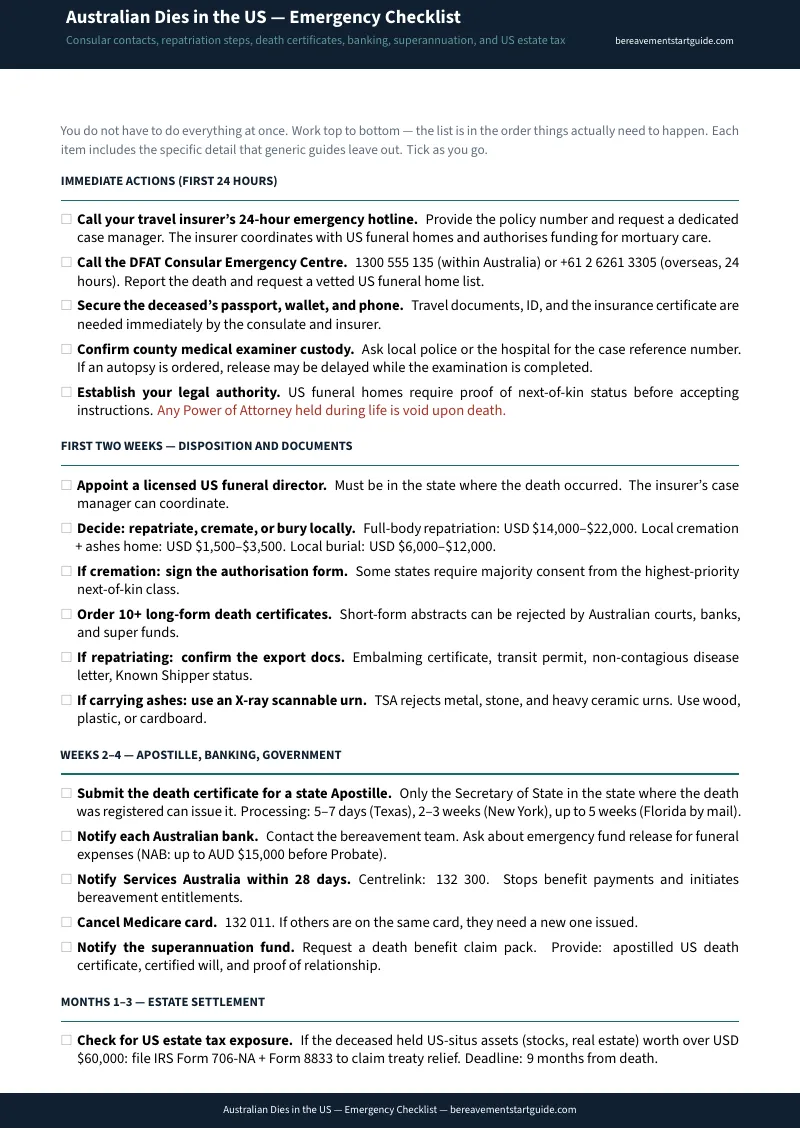
- The first-hours protocol — who to call and in what order, starting with your travel insurer's 24-hour emergency line (not the consulate), so you don't pay out of pocket for services the insurer would have covered and then fight a retroactive reimbursement claim for months
- County medical examiner procedures — what happens when local law enforcement and the county coroner take custody, why you cannot override an autopsy, and how daily mortuary storage fees accumulate while you wait for the body to be released
- The disposition decision with worked cost examples — a clear cost and timeline comparison of full-body repatriation (USD $8,000–$20,000+), US cremation with ashes repatriation, and local burial, so the family can make this decision with facts instead of pressure from a commercial funeral home
- Full-body repatriation logistics — the mandatory embalming requirement, hermetically sealed zinc-lined container specifications, Qantas Q-GO Priority cargo booking, and the DAFF biosecurity clearance package you must submit at least 48 hours before the flight lands in Australia
- TSA and airline rules for carrying ashes — the X-ray transparency requirement that means your brass urn will be rejected at the security checkpoint, carry-on vs checked baggage rules on Qantas and Jetstar, and the exact documents you need at the gate
- State-by-state death certificate and apostille workflows — why you must order the long-form certificate (the short-form abstract will halt your Australian probate and superannuation claims), and the specific Secretary of State process for every state, including walk-in vs mail-in timelines and fees
- Australian bank account freeze procedures — the instant hard freeze that hits the moment a bank is notified, the probate-free release thresholds at NAB (up to AUD $15,000 for funeral costs), CBA, and Westpac, and how to access estate funds before a Grant of Probate is issued
- Superannuation death benefit claims — how to lodge a claim, the binding vs non-binding nomination trap, and the tax-dependant vs non-tax-dependant rules that can mean the difference between 0% and 32% tax on the payout
- The US federal estate tax trap — why non-resident aliens face a USD $60,000 exemption instead of the standard $13.61 million, how the Australia–US tax treaty modifies the calculation, and the IRS filing requirements most Australian families discover too late
- Travel insurance claims — what is actually covered, what is routinely excluded (medical tourism, pre-existing conditions, adventure activities), and how to avoid the retroactive reimbursement fight
- Services Australia notifications — Centrelink, Medicare, and ATO closure procedures, including lump sum bereavement payment eligibility
- Worksheets and planning tools — document tracker, notification contact log, repatriation vs cremation decision worksheet, apostille application tracker, and estate settlement checklist — all standalone printable PDFs
Who This Guide Is For
- Australian families who have just lost someone anywhere in the United States — whether the deceased was a tourist, an expat, a student, or a worker
- Named executors managing a cross-border estate from Australia
- Travel insurance case managers coordinating US repatriation claims
- Funeral directors handling international cases between the US and Australia
- Corporate HR directors or university coordinators supporting the family of a deceased Australian
Why Not Just Use Government Websites?
DFAT's Smartraveller tells you what the consulate can and cannot do. The US State Department's pages focus on Americans dying abroad, not foreign nationals dying in the US. Your state vital records office explains how to order a death certificate but not which format Australian courts will accept. Your bank's deceased estates page assumes the death happened locally.
The problem is not a lack of information — it is that every source covers its own system in isolation. Nobody maps how a decision at a US county office directly affects the timeline and success of your estate settlement, superannuation claim, or probate filing in Australia. That corridor-specific sequencing is what this guide provides.
The Guarantee
Full refund, no time limit. If the guide does not help your situation, email hello@bereavementstartguide.com and we will process your refund — no forms, no questions.
Start Here
Download the free emergency checklist to see every action item at a glance. When you need the full step-by-step workflows, state-by-state apostille procedures, and worked cost examples, the complete guide is available for immediate download — for less than a single day's mortuary storage fee.