The Gulf Corridor Crisis Protocol
When a Bangladeshi citizen dies in the UAE, Saudi Arabia, Qatar, Bahrain, Kuwait, or Oman, the family in Bangladesh inherits a cross-border administrative crisis that spans two legal systems, at least four government agencies, and a sponsor who may be working against their interests.
The embassy registers the death. The employer is legally required to pay for repatriation. The Wage Earners' Welfare Board owes the family up to 3 Lakh BDT. And the deceased's frozen bank accounts can only be unlocked with a court instrument most families don't know exists.
Every one of these facts is true. And not one of them happens automatically.
The Gulf Corridor Crisis Protocol is the chronological workflow that connects the Gulf administrative system to the Bangladeshi welfare and legal systems — so families enforce statutory rights instead of accepting whatever the employer offers.
What Free Information Gets Wrong
Government portals give you forms. Embassy websites list office hours. Expat forums give you someone else's experience from three years ago. None of them give you the sequence — the exact order in which documents must be obtained, attested, and presented to unlock each downstream step.
Skip the police NOC before requesting the embassy NOC? Blocked. Submit documents with the wrong legalisation chain? Rejected by every bank in Dhaka. File a Warishan Certificate when you needed a Succession Certificate? You just wasted three months. Accept the employer's burial offer without documenting their statutory liability? You forfeited the family's repatriation rights and potentially the End-of-Service Benefits.
This guide maps the dependencies. It tells you what to do, in what order, and exactly which document unlocks the next step — across all six GCC jurisdictions.
What's Inside
The First 48 Hours — Jurisdiction-Specific Protocols
Separate step-by-step workflows for the UAE, Saudi Arabia, Qatar, Bahrain, Kuwait, and Oman. How to report the death to the correct local authority, secure the police No Objection Certificate, activate the Bangladesh Embassy Welfare Wing, and prevent the sponsor from making irreversible decisions before the family can act.
Employer Liability Enforcement
The exact statutory citations — Article 40 of Saudi Arabia's Labor Law, Article 27 of Bahrain's LMRA Law, and equivalent UAE, Qatari, and Kuwaiti provisions — that mandate employers bear all repatriation costs. Written notice templates the family or their representative can present to the employer, citing the specific legal obligation. Documentation protocols so that if the employer refuses, the family has an enforceable record for the labour ministry.
The Cross-Border Power of Attorney
In Saudi Arabia, the embassy cannot issue its NOC without a notarised Power of Attorney from the next-of-kin in Bangladesh. Most families do not discover this requirement until days into the process. The guide includes the PoA drafting requirements, the notarisation process, and the courier options to get it to the embassy before cold-storage fees and administrative delays compound.
The Repatriation Pipeline
Government mortuary embalming requirements, zinc-lined coffin mandates, airline cargo booking procedures, and airport customs clearance at both ends. The UAE government mortuary package (itemised costs), Qatar's consolidated Humanitarian Services Office, and the Biman Bangladesh Airlines indigent worker programme. Separate workflows for body repatriation, local burial, and cremation (permitted in the UAE and Oman, for non-Muslims).
The Apostille Gap
Bangladesh joined the Hague Apostille Convention in 2024. Saudi Arabia ratified it in 2022. The UAE, Qatar, Bahrain, Kuwait, and Oman did not. For death certificates originating in non-Hague Gulf states, the family must complete a four-stage legalisation chain — local health authority, host-country MoFA, embassy consular attestation, and Dhaka MoFA authentication. The guide maps this chain for each GCC state so families execute the correct sequence the first time, instead of following outdated forum advice that references the old embassy legalisation process.
WEWB Welfare Claims
How to claim the immediate airport cash grant (80,000 BDT) and the WEWB death compensation grant (300,000 BDT). The exact documents required — original attested death certificate, cancelled passport, claimant's NID, Warishan certificate, BMET clearance record — and the District Employment and Manpower Office filing workflow. For workplace accident deaths, the mandatory insurance claim process (up to 1,000,000 BDT).
End-of-Service Benefits Recovery
How to calculate and claim the deceased worker's accumulated ESoB, which employers frequently attempt to withhold during the chaos of repatriation. The interplay between ESoB claims and the GOSI social insurance system in Saudi Arabia.
Estate Recovery — Warishan vs. Succession Certificate
The distinction that determines whether the family can access frozen bank accounts: the administrative Warishan Certificate (Union Parishad, 3–7 days, covers immovable property) versus the judicial Succession Certificate (Joint District Judge Court, 1.5–3 months, mandatory for bank deposits, shares, bonds, insurance claims, and ESoB). Court fee structure, petition filing checklist, and the errors that cause courts to dismiss petitions and force families to restart the 30-day public notice cycle.
The Undocumented Worker Track
When the deceased had overstayed their visa or fled their sponsor (Huroob status), the standard employer-funded pathway collapses. The guide covers the parallel administrative track — immigration-penalty clearance, alternative welfare pathways, and the embassy welfare wing's role for unregistered workers.
Who This Guide Is For
- Immediate next-of-kin in Bangladesh — spouse, eldest child, sibling, or parent — coordinating the crisis remotely while the body is in a Gulf mortuary
- Fellow workers and community members in the Gulf who need to stabilise the situation before the legal next-of-kin can act from Bangladesh
- Families facing employer pressure for local burial who need documented statutory citations to enforce repatriation rights
- Families of undocumented workers navigating immigration-penalty clearances that complicate repatriation
- Legal heirs who need to recover frozen bank deposits, unpaid wages, and End-of-Service Benefits through Bangladeshi civil courts
- Community welfare organisations and union representatives assisting migrant worker families
- Recruitment agencies and HR departments handling employer-side obligations
What This Guide Replaces
- Embassy websites list forms and office hours. They do not tell you the sequence. The guide connects every step in chronological order.
- Expat forum threads contain anecdotes from specific cases, often outdated. The guide covers all six GCC jurisdictions with current legal citations.
- Private coordination agents charge USD 2,000–4,000 to manage the process. The guide gives you the same workflow for a fraction of one agent's fee — and the knowledge to verify that your agent is not cutting corners.
- Legal practice blogs cover court procedures but skip the Gulf logistics phase entirely. The guide covers both sides of the border.
Satisfaction Guarantee
Full refund, no time limit. If this guide does not give you a clear, actionable workflow, email hello@bereavementstartguide.com and we will refund your purchase in full.
Your Files
- guide.pdf — 40-page corridor-specific manual covering all six GCC states, from first notification through Succession Certificate filing
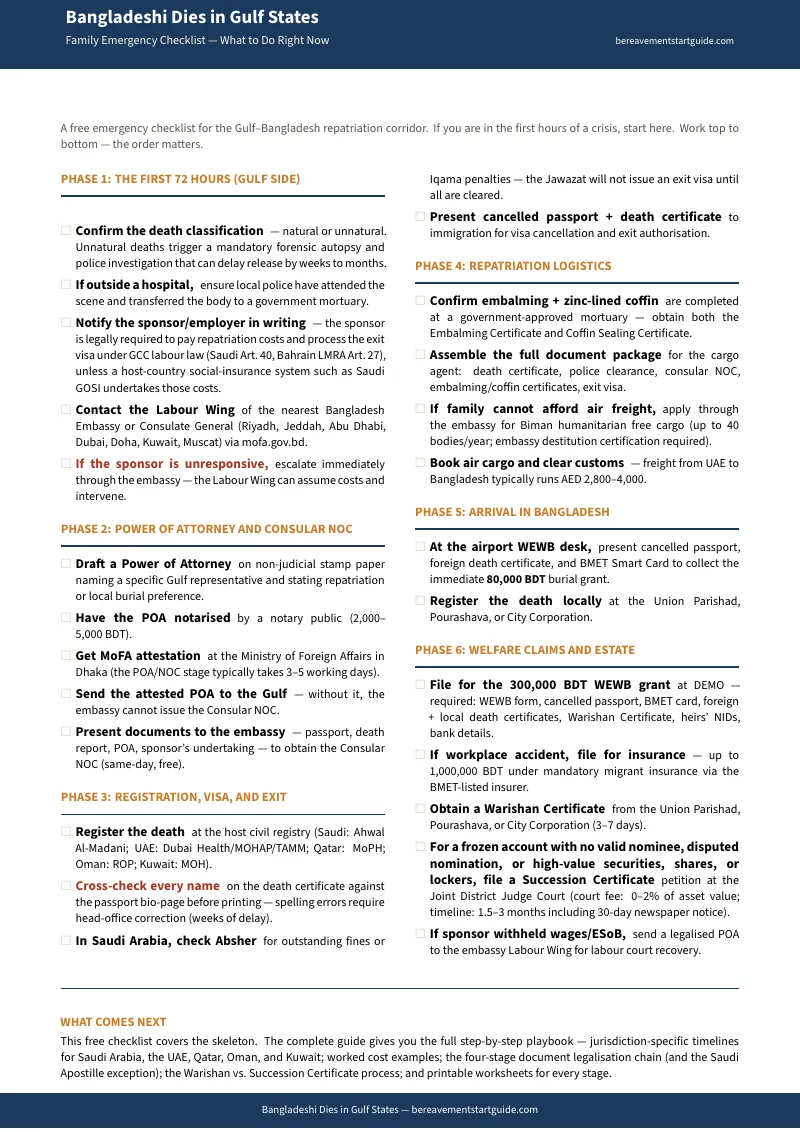
- checklist.pdf — Printable 2-page emergency checklist covering the critical first steps, document requirements, and welfare claim deadlines
- document-tracker.pdf — Log every certificate, stamp, and physical location
- agency-communication-log.pdf — Dated record of every call, visit, and promise
- cost-recovery-tracker.pdf — Sponsor-owed costs, WEWB grants, insurance, and ESoB
- repatriation-decision-worksheet.pdf — Repatriate, bury locally, or cremate — filled in before anyone consents
- wewb-claim-checklist.pdf — Airport 80,000 BDT grant, 300,000 BDT DEMO filing, and workplace insurance
- employer-liability-notice.pdf — Fillable statutory notice citing Article 40 / Article 27 and equivalent duties
- power-of-attorney-worksheet.pdf — Drafting fields, required clauses, and courier log for the Saudi NOC bottleneck
- legalisation-chain-tracker.pdf — Four-stage chain for non-Hague states plus the Saudi apostille route
- succession-petition-checklist.pdf — Joint District Judge filing packet and court-fee bands
- warishan-succession-decision-worksheet.pdf — Which instrument unlocks which asset
Instant download. All twelve files are printable and designed to be used during the crisis — not read cover-to-cover first.
Already have the free checklist? Get the full guide — it covers the how, not just the what.