You just got a phone call from a Dominican resort
Someone you love has died in the Dominican Republic. And now, from Canada, you are expected to coordinate with four separate Dominican institutions — a national police force, a forensic laboratory that performs a mandatory autopsy regardless of what you want, a civil registry office that will only issue the legal death certificate from the municipality where the death occurred, and a foreign affairs ministry whose apostille stamp is the only thing that makes any of this paperwork valid back home.
Most families learn the process by making mistakes they cannot undo. They engage a funeral home before calling their travel insurer — and void the repatriation coverage. They order a beautiful bronze urn that gets rejected at airport security because CATSA officers cannot X-ray through the metal. They assume the civil registry death certificate is the final document — but Canadian banks and Service Canada will not accept it without the MIREX Hague Apostille. And they discover, weeks into the process, that the mandatory INACIF autopsy has been quietly delaying everything because no one explained that it must happen before the civil registration can even begin.
The Emergency Corridor System
The Canadian Dies in the Dominican Republic — Family Emergency Guide is a 47-page crisis navigator built for the specific bureaucratic corridor between the Dominican Republic and Canada — a corridor defined by mandatory forensic procedures, a multi-stage document authentication chain, and a Canadian estate system that refuses to move until it receives the right paperwork in the right format.
This is not general advice about what to do when someone dies abroad. This guide maps the precise interaction between INACIF (the Dominican forensic authority that controls the autopsy timeline), the JCE civil registries (where the legal death certificate is issued), MIREX (the ministry that stamps the Hague Apostille), and the Canadian institutions — banks, Service Canada, CPP, provincial vital statistics offices — that will not release a dollar until they receive an apostilled, translated death certificate.
What's Inside
- The Notification Sequence — the correct order for contacting local police, your travel insurer, the Canadian Embassy in Santo Domingo, and the resort. Calling out of order can lock you into costs before you understand your coverage, or hand over authority to a funeral home whose pricing you have not verified.
- INACIF Mandatory Autopsy Decoded — Dominican law requires a forensic autopsy for any remains being repatriated and for all non-natural, sudden, or suspicious deaths. The guide explains what happens at the regional forensic laboratory, realistic processing times, and how the autopsy findings feed into the civil death registration — because nothing else can move until INACIF releases the body.
- The Document Procurement Pipeline — the four-stage chain from the preliminary forensic certificate through JCE civil registration, certified judicial translation, and the MIREX Hague Apostille, with realistic timelines and costs at each stage. Since Canada joined the Hague Convention in January 2024, a single apostille stamp now replaces the older multi-step consular legalization.
- Repatriation vs. Cremation Decision Matrix — an honest comparison of costs (approximately CAD 9,390–14,080 for full-body return vs. CAD 3,540–6,410 for local cremation and ashes transport), timelines, and the practical constraints on each path, including the documents and permits required before anything can leave the country.
- Ashes Transport Checklist — CATSA X-ray screening requirements, which urn materials clear airport security (plastic, cardboard, light wood) and which get rejected (metal, ceramic, stone), and why screening officers cannot open the container even with your permission.
- Air Cargo Coordination — Air Canada Cargo (AC Compassion) vs. WestJet Cargo (Compassionate) — booking requirements, fleet restrictions, surcharges, and tender timelines for both carriers on Caribbean-to-Canada routes.
- Canadian Estate Integration — Ontario vs. Quebec death registration differences, how to unlock frozen bank accounts before probate, suspending CPP and OAS payments to prevent retroactive clawbacks, and claiming the CPP death benefit (max $5,000).
- Communication Scripts — English-Spanish templates for INACIF forensic staff, JCE civil registrars, funeral homes, and airline cargo terminals.
Who It's For
- The family coordinator in Canada — a spouse, adult child, sibling, or named executor managing a death remotely across time zones and a language barrier, while four Dominican agencies operate on their own schedule.
- The travel companion at the resort — a friend or group member physically present in the Dominican Republic who needs clear, immediate steps while the family back home mobilizes.
- Travel insurance case managers — professionals encountering the Dominican forensic and civil registration system for the first time who need a structured reference for the corridor-specific documentation and logistics pipeline.
- Canadian funeral directors — receiving homes that need to understand the sending-side paperwork, CBSA customs clearance requirements, and the documentation that should accompany a hermetically sealed shipping casket from the Dominican Republic.
Why Free Resources Don't Cover This
Global Affairs Canada explains what consular services it can and cannot provide — but it does not give you a chronological workflow. Funeral homes in the Dominican Republic handle the logistics but will not help you navigate the JCE civil registry, the MIREX apostille chain, or the Canadian estate settlement sequence. Expat forums carry secondhand advice that confuses Dominican procedures with those of other Caribbean nations and routinely gets the apostille process wrong. Repatriation companies coordinate the air cargo but will not touch your frozen bank accounts, CPP death benefit claim, or provincial death registration.
The gap is not a lack of information — it is the lack of coordination. Families cobble together advice from five different sources written for five different contexts, and the pieces do not fit together. This guide eliminates that patchwork by mapping the entire corridor from the first phone call to the final benefit claim.
Full Refund, No Time Limit
If the guide does not help, email hello@bereavementstartguide.com for a full refund. No time limit, no conditions. We read every message.
Start With the Free Checklist
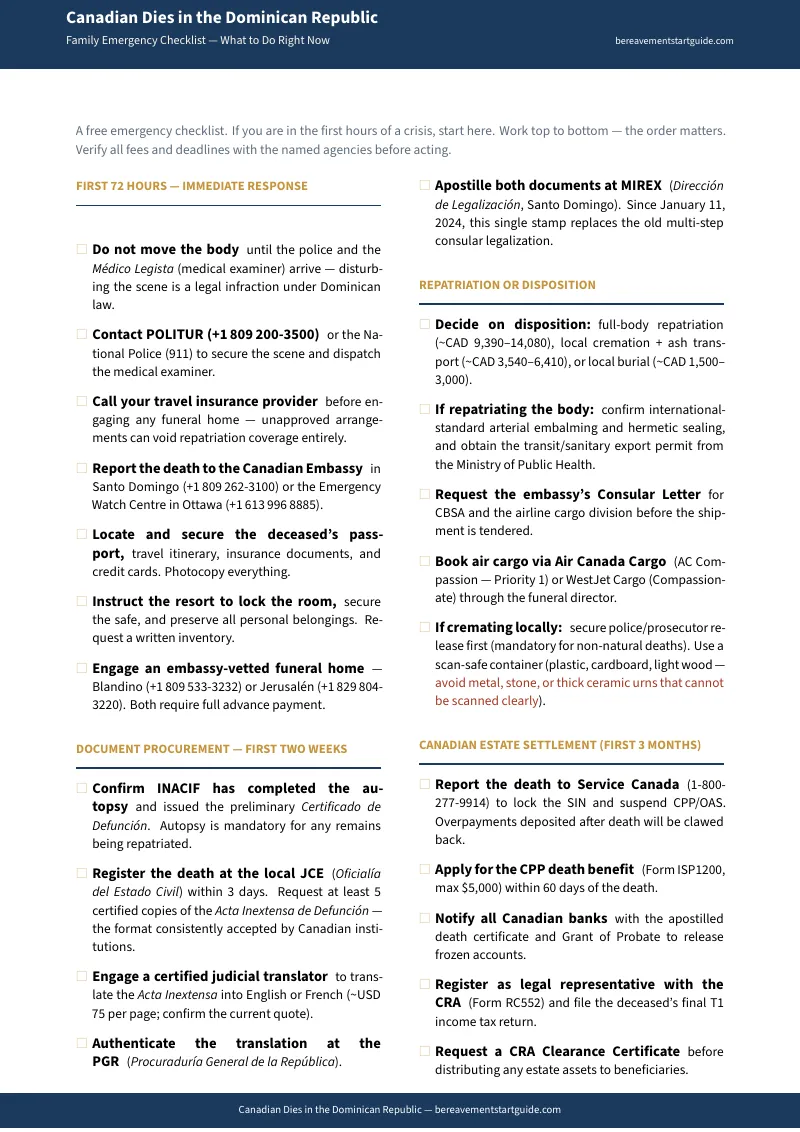
Download the 2-page emergency checklist covering the first 72 hours — who to call, what to secure, and the three paths for the remains. It is yours immediately, no purchase required.
When you are ready for the complete system — the INACIF autopsy timeline, the full document procurement pipeline, repatriation logistics, ashes transport rules, and the Canadian estate integration sequence — get the full guide for .