You just got a phone call no one prepares for
Someone you love has died in Mexico. And now, from thousands of kilometres away, you're expected to coordinate with Mexican funeral homes, forensic investigators, civil registrars, airline cargo divisions, Canadian banks, pension programs, and probate courts — across two languages, two legal systems, and a ticking clock on the remains.
Most families learn the process by making expensive mistakes. They translate the death certificate before it's apostilled — and pay for the translation twice. They engage a funeral director before calling their travel insurer — and void their reimbursement claim. They buy a ceramic urn that gets rejected at airport security. They discover, weeks later, that they ordered too few certified copies to satisfy every Canadian institution demanding one.
The Cross-Border Coordination System
The Canadian Dies in Mexico — Family Emergency Guide is a 42-page crisis navigator built for the specific bureaucratic corridor between Mexico and Canada. It sequences every decision — notifications, death registration, document legalisation, remains disposition, and Canadian estate settlement — in the exact order that prevents cascading delays.
This is not general advice about "what to do when someone dies abroad." This guide maps the precise interaction between Mexican municipal civil registries, state-level apostille offices, forensic custody chains, and the Canadian institutions (banks, Service Canada, CPP) that won't release a dollar until they receive the right paperwork in the right format.
What's Inside
- The Notification Sequence — the correct order for contacting emergency services, your travel insurer, Global Affairs Canada, and local funeral directors. Calling out of order can void insurance coverage or lock you into costs you didn't need to accept.
- Mexican Death Registration Decoded — how the Registro Civil, Ministerio Público, and SEMEFO divide authority over the remains, and what happens when a death is reclassified as non-natural mid-process.
- The Hague Apostille Workflow — Canada joined the Apostille Convention in January 2024. The guide covers the post-2024 state-by-state apostille process, including which Mexican authority handles federal vs. state documents, and the translation-before-apostille error that forces families to pay twice.
- Repatriation vs. Cremation Decision Matrix — an honest comparison of costs ($10,000–$20,000 CAD for full-body return vs. $3,000–$6,000 for local cremation and ashes transport), timelines, document requirements, and the Known Shipper airline cargo rules most families don't know about.
- Ashes Transport Checklist — CATSA and TSA X-ray screening requirements, which urn materials clear security (wood, plastic, cardboard) and which are rejected (metal, ceramic, stone), and carrier-specific policies for Air Canada and WestJet.
- Canadian Estate Integration — how to request direct payments from frozen bank accounts before probate, report the death to Service Canada, cancel the SIN, and claim the 2025/2026 CPP death benefit (basic $2,500 plus a potential $2,500 top-up).
- Bilingual Communication Scripts — Spanish-English templates for speaking with funeral directors, civil registrars, and forensic medical examiners, written so you can hand your phone to a bilingual intermediary or read directly.
- Document Tracker — a single-page log for recording every certificate, apostille, translation, and permit as it moves through the legalisation chain.
Who It's For
- The family coordinator in Canada — a spouse, adult child, sibling, or named executor managing a death remotely across time zones and language barriers.
- The Canadian snowbird community — retirees living in Lake Chapala, San Miguel de Allende, Puerto Vallarta, Mérida, or Mazatlán who want a pre-need plan that covers both the Mexican and Canadian sides.
- Travel insurance case managers — professionals who need a structured reference for the Mexico-specific documentation and logistics pipeline.
- Canadian funeral directors — receiving homes that need to understand the sending-side paperwork and prepare for customs clearance at the airport of arrival.
Why Free Resources Don't Cover This
Global Affairs Canada's factsheet on death in Mexico has been archived. Expat forums still reference the pre-2024 consular legalisation process that was replaced when Canada joined the Hague Apostille Convention. Repatriation companies handle the cargo logistics but won't touch your bank account freeze, CPP claim, or probate filing. And none of them connect the Mexican administrative side with the Canadian estate side in one sequenced workflow.
The gap is not a lack of information — it's the lack of coordination. Families cobble together advice from five different sources written for five different contexts, and the pieces don't fit together. The guide eliminates that patchwork by mapping the entire corridor end to end.
Full Refund, No Time Limit
If the guide doesn't help, email hello@bereavementstartguide.com for a full refund. No time limit, no conditions. We read every message.
Start With the Free Checklist
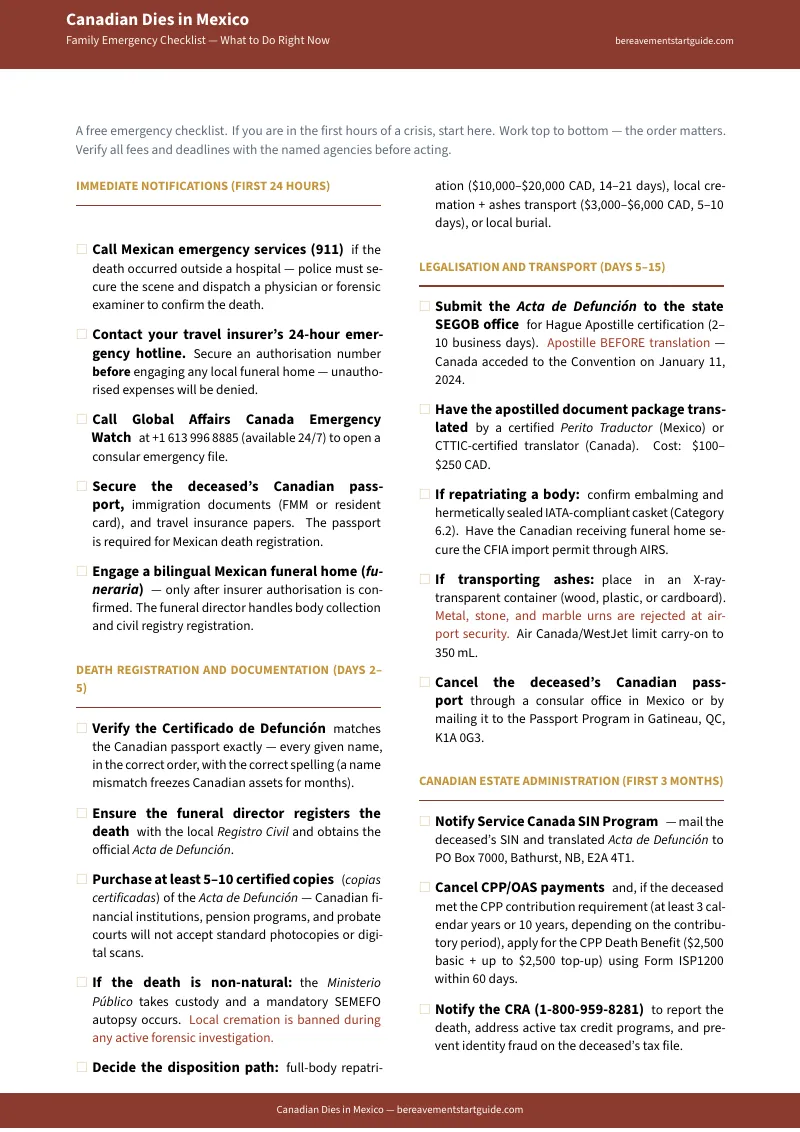
Download the 2-page emergency checklist covering the first 72 hours — who to call, what to secure, and the three paths for the remains. It's yours immediately, no purchase required.
When you're ready for the complete system — the apostille workflow, repatriation logistics, ashes transport rules, and the full Canadian estate integration sequence — get the full guide for .