The Phone Call That Splits Your Life Into Before and After
Your husband collapsed on a construction site in Johor. Your mother died in a Kuala Lumpur hospital while receiving cancer treatment. Your brother drowned at a beach resort in Langkawi. Within hours, you are trying to coordinate with a Malaysian hospital that will not release the body until bills are settled, a funeral director quoting RM 15,000 for repatriation, and a JPN office that closes at 4:30 PM — and you are doing this from a phone in East Java while struggling to understand what the caller is telling you in Malay, not Bahasa Indonesia.
You call the Indonesian Embassy expecting them to manage the crisis. They cancel the passport and issue a consular death statement. They do not pay for the repatriation. They do not coordinate with the Malaysian hospital. They do not tell you which office to visit next or in what order. And the internet is little help — government websites in both countries describe fragments of the process in formal legal language, community forums offer anecdotes from people who navigated different situations years ago, and funeral directors describe their own packages without explaining the six months of cross-border paperwork that follows the funeral.
The information exists. It is scattered across JPN registration rules, Wisma Putra attestation procedures, KBRI legalization requirements, airline cargo regulations, Disdukcapil Form F-2.01, BPJS Ketenagakerjaan claim portals, and heirship certificate protocols. Piecing it together while grieving takes 40+ hours of research across two legal systems. One missing step — one unauthenticated document, one overlooked deadline — means returning to Malaysia to process papers retroactively, or watching BPJS claims and bank-account releases stall for months.
The Two-Country Document Pipeline
This guide sequences every step of the Indonesia-Malaysia death corridor into one chronological manual. It is built around the specific regulatory reality that makes this corridor uniquely difficult: Malaysia is not a Hague Apostille Convention member. Malaysian public documents cannot be apostilled. Instead, every document must pass through a four-step consular legalization chain — sworn translation, Wisma Putra attestation, KBRI legalization, then Kemenkumham registration — before any Indonesian institution will accept it. Skip one link and the entire pipeline downstream freezes.
That single fact — no apostille — drives most of the cost, delay, and heartbreak in this corridor. The guide maps the legalization chain step by step, then connects it to the Indonesian-side procedures that depend on it: Disdukcapil registration, Kartu Keluarga updates, BPJS claims, bank-account releases, and property transfers.
The JPN Registration — Your First and Most Time-Sensitive Step
Malaysian hospitals issue a Medical Death Confirmation Letter. Families frequently mistake this for the death certificate and leave Malaysia. It is not. The legal death certificate — the Sijil Kematian — is issued only by the Jabatan Pendaftaran Negara (JPN) after the informant files Form JPN.LK01 with the hospital letter, the deceased's passport, and their own identification. Same-day walk-in registration. But if the passport has been retained by an employer or immigration authority — common with migrant workers — the process stalls until the document is recovered. The guide covers both scenarios.
The No-Apostille Legalization Chain
Once you have the JPN Sijil Kematian, it must go through four sequential steps before Indonesia will accept it: a Penerjemah Tersumpah produces the sworn Bahasa Indonesia translation (IDR 75,000–150,000 per page, 1–3 working days). Wisma Putra stamps the attestation seal (RM20, typically one working day at the Ministry of Foreign Affairs in Putrajaya). The KBRI or nearest KJRI stamps the consular legalization seal (RM80, 1–2 working days). Then Kemenkumham issues an Indonesian Apostille sticker through its online portal. The guide provides the exact documents, fees, office hours, and locations for each step — including KBRI Kuala Lumpur and the four KJRI branches in Penang, Johor Bahru, Kuching, and Kota Kinabalu.
The Name-Match Trap
Indonesian civil registries, BPJS, and banks verify names character by character. A single spelling discrepancy between the Malaysian Sijil Kematian and the deceased's Indonesian KTP or Kartu Keluarga — a common occurrence because Malaysian officials transliterate Indonesian names using Malay conventions — can halt estate probate, freeze bank accounts, and block insurance payouts for months. The guide explains exactly when to catch and correct name mismatches, before the legalization chain locks the spelling in.
What You Get
- The Complete Emergency Guide — 14 chapters covering crisis stabilisation, the JPN registration process, the four-step legalization chain, repatriation logistics (air cargo, land border, ferry, and local cremation), the Disdukcapil Form F-2.01 workflow, the Heirship Certificate process, BPJS Ketenagakerjaan claims, Malaysian-side estate resolution, and scenario-specific workflows for workplace deaths, undocumented workers, and coroner investigations
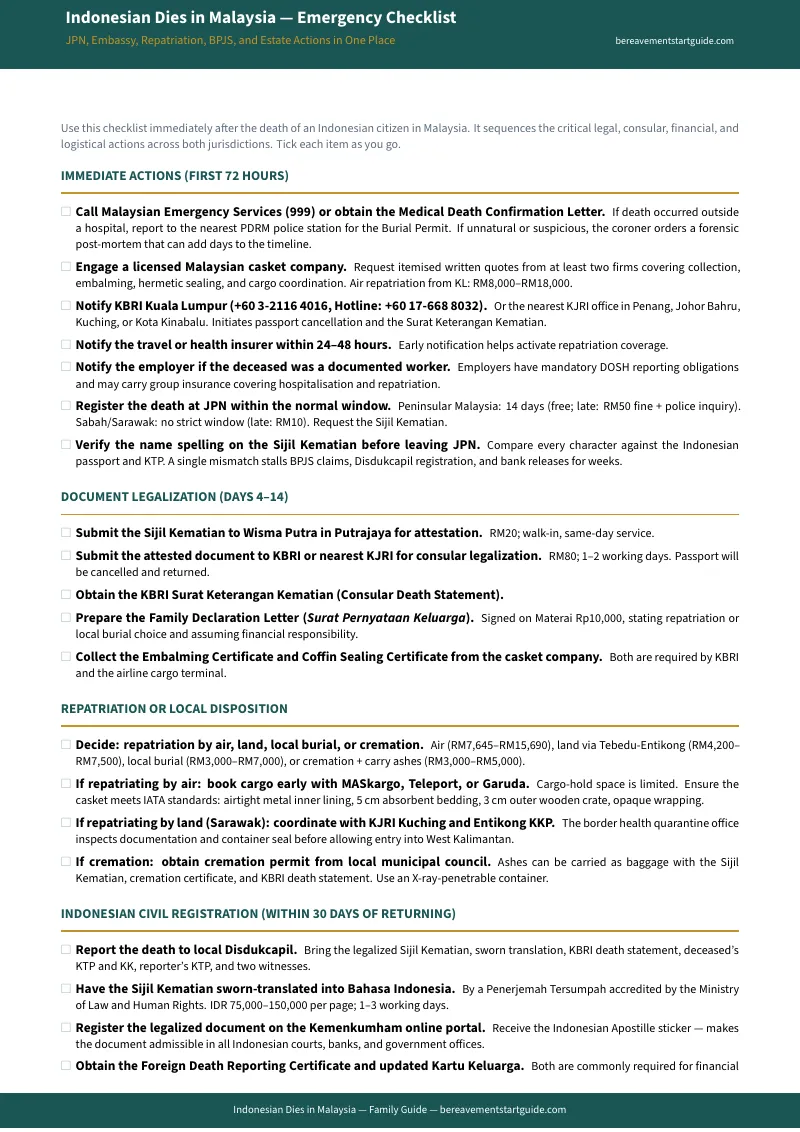
- Emergency Checklist — 24 action items across three time phases (0–72 hours, days 4–14, weeks 3–12) tracking both the Malaysian and Indonesian sides of the corridor
- Emergency First-72-Hours Checklist — the hospital, PDRM, KBRI, insurer, employer, casket-company, and JPN actions for the first three days
- Document Collection Tracker — every Malaysian and Indonesian original, stamp, and copy logged with dates and issuing offices
- Agency Communication Log — a dated record of every call, visit, and message with JPN, Wisma Putra, KBRI, PDRM, Disdukcapil, BPJS, and banks
- Legalization Pipeline Tracker — the four-step path from the JPN Sijil Kematian through sworn translation, Wisma Putra, KBRI, and Kemenkumham, with dates and fees
- Repatriation vs. Local Burial Decision Worksheet — air cargo from KL (RM 8,000–18,000) vs. land via Tebedu–Entikong vs. local burial or cremation, with guide figures and write-in quotes
- Funeral Director Evaluation Sheet — a vendor comparison checklist covering embalming standards, sealing certificates, casket specifications, and pricing transparency to prevent overcharging
- Indonesian Civil Registration Checklist — Form F-2.01 pack list, the 30-day countdown, and the two documents Disdukcapil issues
- BPJS Benefits Claim Worksheet — JKM (IDR 42 million) and JKK (IDR 85 million) document pack, filing channel, and benefit calculation
- Malaysian Estate Administration Tracker — Amanah Raya Berhad (movable assets ≤ RM 600,000) vs. High Court probate or letters of administration, with asset rows and the LHDN tax-clearance step
Who This Is For
- Families in Indonesia right now dealing with a death in Malaysia — whether it happened in KL, Johor, Penang, Sabah, or a palm oil plantation in rural Pahang — who need a clear sequence of steps before making any expensive decisions
- On-site family or coworkers in Malaysia trying to stabilise the situation, deal with the hospital and police, and hold off the funeral director until the family in Indonesia can make informed decisions
- Families of migrant workers who need to navigate BPJS Ketenagakerjaan claims, employer insurance, and the gap between what the employer covers and what falls on the family
- Families facing repatriation decisions who need to compare air cargo, land transport, ferry, and local cremation with the regulatory requirements and realistic costs for each
- Executors who need to resolve Malaysian-side bank accounts and assets through Amanah Raya Berhad or the High Court while simultaneously managing Disdukcapil registration and Indonesian inheritance proceedings
Why Free Information Falls Short
The KBRI website tells you what consular services are available. JPN's site explains death registration for Malaysians, with a passing mention of foreign nationals. Disdukcapil's site describes Form F-2.01 without explaining where the supporting documents come from. Funeral director websites quote repatriation packages but do not mention Wisma Putra attestation, the 30-day Disdukcapil deadline, or the months of Indonesian estate paperwork that follow the funeral.
The problem is not that the information does not exist. The problem is that it is split across JPN, Wisma Putra, KBRI Kuala Lumpur, four KJRI branches, Malaysian police, Disdukcapil, BPJS, airline cargo departments, and Amanah Raya — in two languages, across two legal systems, with no single source connecting the steps in the order you actually need them. One wrong sequence — attempting KBRI legalization before Wisma Putra attestation, or leaving Malaysia without the JPN certificate — costs weeks and thousands of Ringgit to fix.
— Less Than One Day's Mortuary Storage
A single administrative mistake in this corridor — leaving Malaysia without the JPN Sijil Kematian, skipping the Wisma Putra attestation step, letting a name mismatch pass uncorrected — costs hundreds to thousands of Ringgit to fix retroactively. If the guide prevents one rejected document, one unnecessary return trip to Malaysia, or one missed BPJS claim deadline, it has paid for itself before you finish the first chapter.
Every purchase includes a full refund guarantee, no time limit. If the guide does not give you the clarity and structure you need to navigate this crisis, email hello@bereavementstartguide.com for a full refund.
The free Emergency Checklist covers the 24 most critical action items across three time phases — the steps with hard deadlines and immediate financial consequences. The full guide covers every chapter in depth: the JPN registration process, the four-step legalization chain, repatriation logistics by route, the Disdukcapil workflow, BPJS claims, estate resolution, and the scenario-specific workflows for workplace deaths, coroner investigations, and undocumented workers.