Two countries. Four bureaucracies. Zero coordination between them.
When an Indian family member dies in the United States, you inherit a paperwork crisis that spans county vital records offices, state Secretaries of State, Indian consulates, airline cargo terminals, and eventually Indian district courts — and none of these agencies talk to each other. Miss one step and everything downstream stalls: a death certificate without the right state apostille is useless at an Indian bank. An urn made of the wrong material gets turned away at TSA. A consular NOC filed at the wrong jurisdiction comes back rejected. And a nominee listed on an Indian bank account discovers — months later — that nomination doesn't equal ownership under Indian succession law.
This is the Cross-Border Administration Roadmap — a single-document guide that maps the entire US-to-India corridor in the exact sequence things must happen, from the first call to the funeral home through estate settlement in Indian courts.
What's Inside
- First 72 Hours Emergency Protocol — the exact calls to make and documents to secure before anything else can move, whether the death happened in a hospital, at home, or involved a coroner investigation
- State-Level Apostille Navigation — how to authenticate a US death certificate for use in India, including the New York City exemplification trap, California's county-clerk authentication rules, and realistic timelines for mail vs. walk-in processing
- Consular eSEWA Registration — step-by-step walkthrough of the Indian consular portal, with fee breakdowns by citizenship status and the courier restrictions that vary between consulates (some reject FedEx; others require USPS Express Mail only)
- Full-Body Repatriation Pipeline — embalming requirements, zinc-lined casket specifications, airline cargo documentation, the 24-hour advance clearance to the receiving Indian airport, and India's eCARe portal for arrival
- TSA-Compliant Ash Transport — which urn materials pass x-ray screening, which get your loved one's ashes turned away at the checkpoint, and the practical reality of Indian customs enforcement at Delhi and Mumbai airports
- Repatriation vs. Local Disposition Decision Framework — side-by-side comparison of timelines, costs, and logistical complexity so you can make an informed choice under pressure
- Indian Estate Recovery — the difference between a Legal Heir Certificate and a Succession Certificate, why bank nominees are custodians not owners, how to apply for an Estate PAN card under the current form rules, and how to file EPFO and EDLI claims when the deceased's Indian records don't match the US death certificate
- FEMA Remittance Compliance — TDS rates on inherited property sales, the annual NRO repatriation limit, and how to file Form 15CA/15CB and Form 13 for a lower withholding certificate
- Religious Succession Law Guide — how intestate inheritance works differently under the Hindu Succession Act, Muslim Shariat Personal Law, and the Indian Succession Act, and why a US-drafted will may not hold over Indian assets
Who This Is For
- Adult children and surviving spouses managing a death across two countries, often while coordinating remotely across time zones
- Relatives in India who need to understand the US-side requirements before they can start estate proceedings
- US funeral directors handling their first international repatriation to India
- University coordinators and corporate HR managers dealing with a student or employee death
Why the consulate website isn't enough
Indian consulates publish clear instructions for their piece of the process — eSEWA registration, fee schedules, courier requirements. But they don't cover how to get a death certificate from a US county. They don't explain state-level apostille rules. They don't address airline cargo logistics, TSA urn requirements, or what happens when the coroner holds the body for investigation. And they say nothing about recovering assets from Indian banks, filing for succession certificates, or navigating the three different personal-law frameworks that govern inheritance depending on the deceased's religion. Each agency handles its silo. This guide connects the silos into one timeline.
Satisfaction Guarantee
Full refund, no time limit. If the guide doesn't help you navigate what you're facing, email hello@bereavementstartguide.com and we'll refund you in full.
Get Started
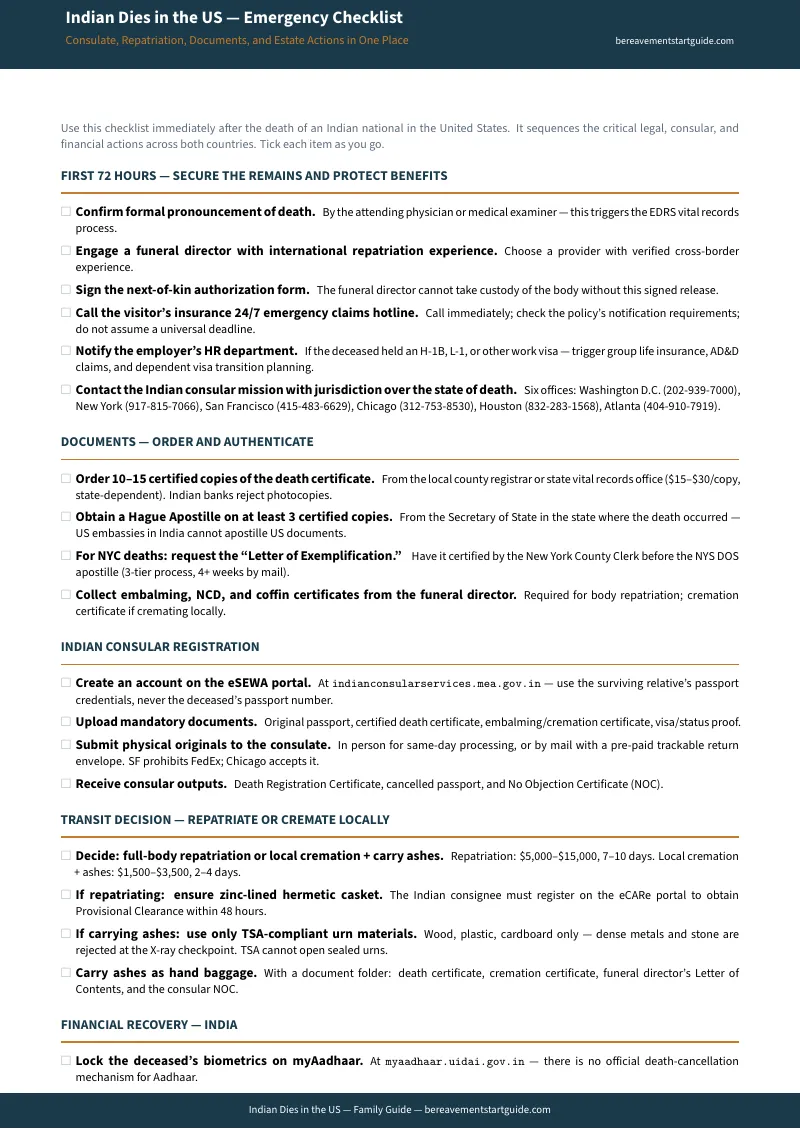
Download the free emergency checklist to see the critical first steps and deadlines. The full guide — — adds the complete document authentication pipeline, state-specific apostille procedures, repatriation logistics, Indian estate settlement across all three personal-law frameworks, and eight printable planning worksheets — emergency contacts, document tracker, insurance claims checklist, eSEWA consular checklist, bank transmission log, EPFO claims tracker, estate timeline planner, and agency communication log.