One wrong step in the first 48 hours can delay repatriation by months and cost your family thousands
When a Korean national dies in the Philippines, the family in Korea faces a crisis that spans two countries, two languages, and two legal systems — all while grieving. A misspelled name on the death certificate forces a correction that can take weeks. A cremation authorised before the police investigation closes can halt the entire process. A printed eApostille — the new digital-only document format launched in March 2026 — is legally invalid, and many Korean municipal offices don't know that yet.
Meanwhile, mortuaries charge daily cold-storage fees, airlines have limited cargo slots for human remains, and the one-month deadline for registering the death in South Korea's family registry is already running.
Free information exists — scattered across embassy pages in formal legal language, outdated expat forum threads, and commercial repatriation sites that quote vague price ranges. None of it is organised into a sequence you can follow from the hospital to the Gu-office.
The Corridor Emergency System — every step from the hospital to estate settlement, in order
This guide replaces weeks of frantic research with a single document that covers the entire Philippines-to-South Korea corridor. It is built around the specific friction points of this corridor: the decentralised Philippine civil registration system, the 2026 Fully Digital eApostille transition, the language barrier between Korean-speaking families and English-language Philippine bureaucracy, and the strict documentation requirements of South Korean municipal offices.
Every chapter follows a chronological sequence — what to do first, what can wait, what cannot be undone — so you make the right decisions in the right order, even when you're coordinating from 2,500 kilometres away.
What's inside
- First 48-Hour Action Plan — the six critical actions that prevent the most expensive mistakes, including who to call (Korean Embassy emergency hotline, hospital administration, Philippine National Police), how to secure the deceased's passport and personal property, and how to establish next-of-kin authority using Korean family documents that Philippine institutions cannot read
- Philippine Death Registration Walkthrough — how the Medical Certificate of Death becomes an official Local Civil Registrar record, the transmittal process to the Philippine Statistics Authority for the security-paper copy, standard processing timelines, and how to request expedited transmittal
- 2026 eApostille System Guide — because the March 2026 digital transition means older guides are now wrong. Step-by-step instructions for ordering a PSA death certificate online, completing the liveness check, handling the "Do Not Print" rule, and — critically — what to say when a Korean Gu-office rejects the digital document because they expect a physical stamp
- Repatriation vs. Cremation Decision Engine — a side-by-side cost comparison (PHP 350,000–650,000+ for full-body repatriation vs. PHP 80,000–150,000 for local cremation with ashes), with the document requirements, timelines, and logistical steps for each pathway
- Bilingual Communication Templates — pre-written English-Korean letters for hospitals, mortuaries, local civil registrars, airline cargo desks, and Korean municipal officers, so families don't need to translate legal terminology under pressure
- Korean Family Registry Integration — the one-month Samang Singo deadline, embassy filing vs. direct Dong-office filing, the sworn translation process, and what to do when the apostilled death certificate doesn't match the family registry spelling
- Insurance and Estate Claims Package — how to compile the exact document set that Korean travel insurers, life insurers, and pension administrators accept on first submission, including the police report, autopsy certificate, and apostilled death certificate
- Negotiation Scripts — because families without local pricing benchmarks are routinely overcharged by funeral operators and cargo handlers. These scripts help you request itemised billing and identify inflated line items
- 9 Printable Tools — document tracker, repatriation cost comparison, cost tracking log, agency communication log, filing deadline timeline, insurance claims checklist, emergency contact card, bilingual communication templates, and negotiation scripts with corridor pricing benchmarks
Who this guide is for
- Families of Korean nationals who died during tourism, retirement, business travel, missionary work, or study in the Philippines
- Relatives coordinating remotely from South Korea — the guide identifies what can be handled by phone and online vs. what requires someone physically present
- Travel companions, co-workers, or church leaders on the ground in the Philippines who need to manage immediate logistics before the family arrives
- Corporate HR and university international offices with duty-of-care obligations
- Travel insurance case managers handling Philippines-to-Korea repatriation claims
- Korean funeral directors receiving remains from the Philippines
Why free resources aren't enough for this corridor
The Korean Embassy in Manila provides referral lists and emergency contacts — but it cannot negotiate hospital bills, expedite civil registration, or guide you through the eApostille process step by step. Embassy pages are written in formal consular language and assume you already know which office to visit next.
Naver Café threads and expat Facebook groups offer real peer experiences — but the advice is anecdotal, often specific to one city, and most threads predate the March 2026 eApostille transition. Following outdated document authentication steps can add weeks of rework.
Commercial repatriation companies handle logistics — but their pricing is opaque, they have no incentive to share the DIY pathway, and their information often stops at the Philippine border. They don't cover what happens when the body or ashes arrive in Korea and the family registry, pension, and estate processes begin.
This guide is independent, covers both countries end to end, and is updated to reflect the 2026 digital document system that most other resources still haven't addressed.
Full refund, no time limit
If this guide doesn't help your family navigate the process, email hello@bereavementstartguide.com for a full refund. No time limit, no questions.
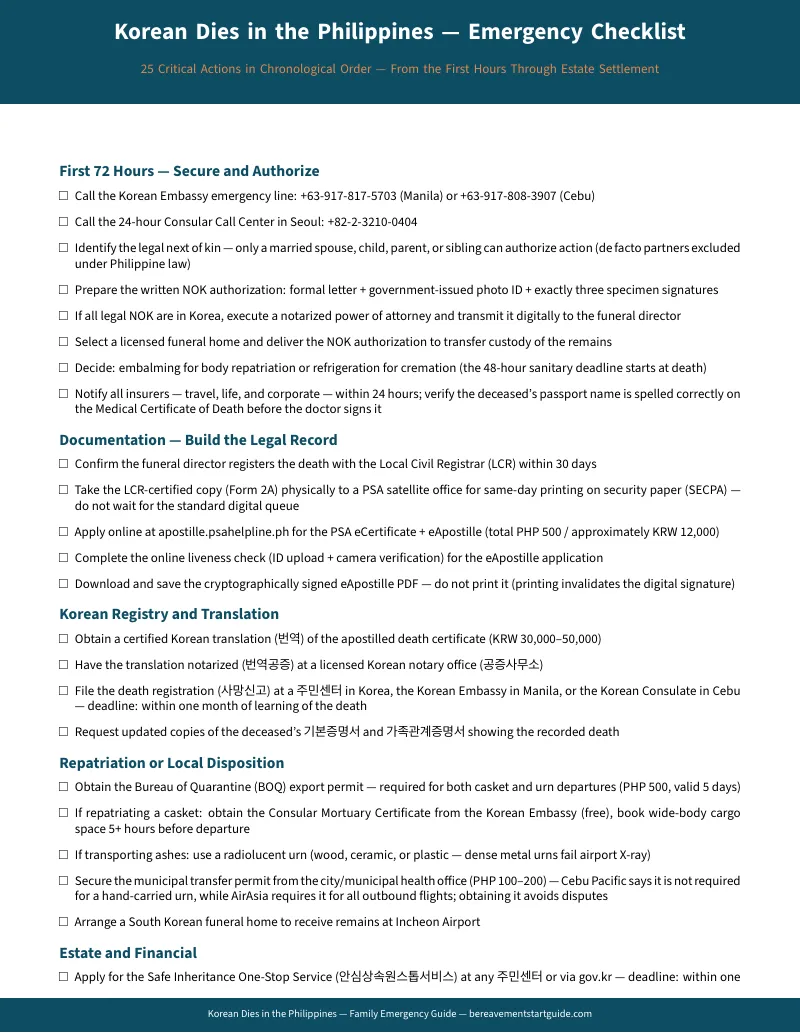
Get started now
Download the free emergency checklist to see the document sequence and timeline at a glance. When you're ready for the complete guide — with the eApostille walkthrough, negotiation scripts, bilingual templates, and estate integration instructions — get the full toolkit for .