
Your family member just died in Saudi Arabia. You have 72 hours before the system starts making decisions for you.
The hospital report needs to reach Civil Affairs before the electronic notification window closes. The embalming department only accepts remains before 3:00 PM on Wednesdays — miss it by an hour, and the repatriation timeline extends by four days. The sponsor is calling with paperwork to sign, and you don't know whether signing it forfeits your right to compensation worth hundreds of thousands of riyals.
Meanwhile, you're in Pakistan — or a third country — trying to coordinate all of this remotely, across time zones, in a legal system you've never navigated, during the worst week of your life.
The Cross-Border Repatriation Roadmap: a single document that sequences every step across both jurisdictions
This isn't a collection of government links or a translation of embassy brochures. The Pakistani Dies in Saudi Arabia — Family Guide maps the exact order of operations from the moment you receive the phone call to the day you close the NADRA succession certificate in Pakistan — with the specific documents, fees, contacts, and deadlines at every stage.
The guide was built around the operational reality that most families discover too late: Saudi Arabia's civil clearance system is sequential, not parallel. A missing stamp from one department blocks every department downstream. One wrong turn at the hospital stage can cost your family months and hundreds of thousands of riyals in lost compensation.
What's inside the guide
- The 72-hour notification protocol — who to call first (it's not who you think), how to establish your Wakeel-e-Sharaye before any government file is opened, and how to contact the Welfare Wing's 24/7 gate-duty officers after hours
- The dual legalisation corridor — the exact sequence of stamps, translations, and attestations that move a Saudi death certificate from Al-Ahwal Al-Madaniyyah to MOFA KSA to the Pakistani Embassy and back, including the Apostille shortcut and when it actually works
- The repatriation-vs-burial decision matrix — a side-by-side comparison with real costs: the 5,000 SAR embalming fee, the 2,125–2,175 SAR cargo handling rates from the three approved Jeddah operators, PIA's free air freight conditions, and the cost of local burial (essentially zero)
- The Wednesday 3:00 PM rule — Tib-e-Sharayee does not accept remains on Thursday or Friday, so missing Wednesday afternoon pushes your entire timeline back by four days minimum. The guide sequences your paperwork so you don't hit this wall
- The employer obligation breakdown — what the Kafeel legally owes under Saudi Labour Law Article 40 (end-of-service benefits calculated at half a month per year for the first five years, a full month per year after), what GOSI pays for occupational deaths (up to 330,000 SAR), and the specific document that prevents the sponsor from reclassifying a workplace death as natural
- Diyat recovery through the Shariat Court — who files, how the percentage-of-liability allocation works, the current compensation scales (300,000 SAR for accidental death, 400,000 SAR for semi-intentional), and how to execute a Special Power of Attorney from Pakistan to authorize your Community Welfare Attaché
- The NADRA succession certificate process — the digital application, biometric verification at Pakistani missions in Riyadh and Jeddah (no travel back to Pakistan required), the 14-day public notice period, and the fee structure based on estate value
- OPF grants and airport facilitation — the 25,000 PKR funeral grant (one-month filing deadline), the 400,000 PKR financial aid grant for destitute families, and the free airport ambulance service that most families never learn about until after they've paid for private transport
The free emergency checklist vs the full guide
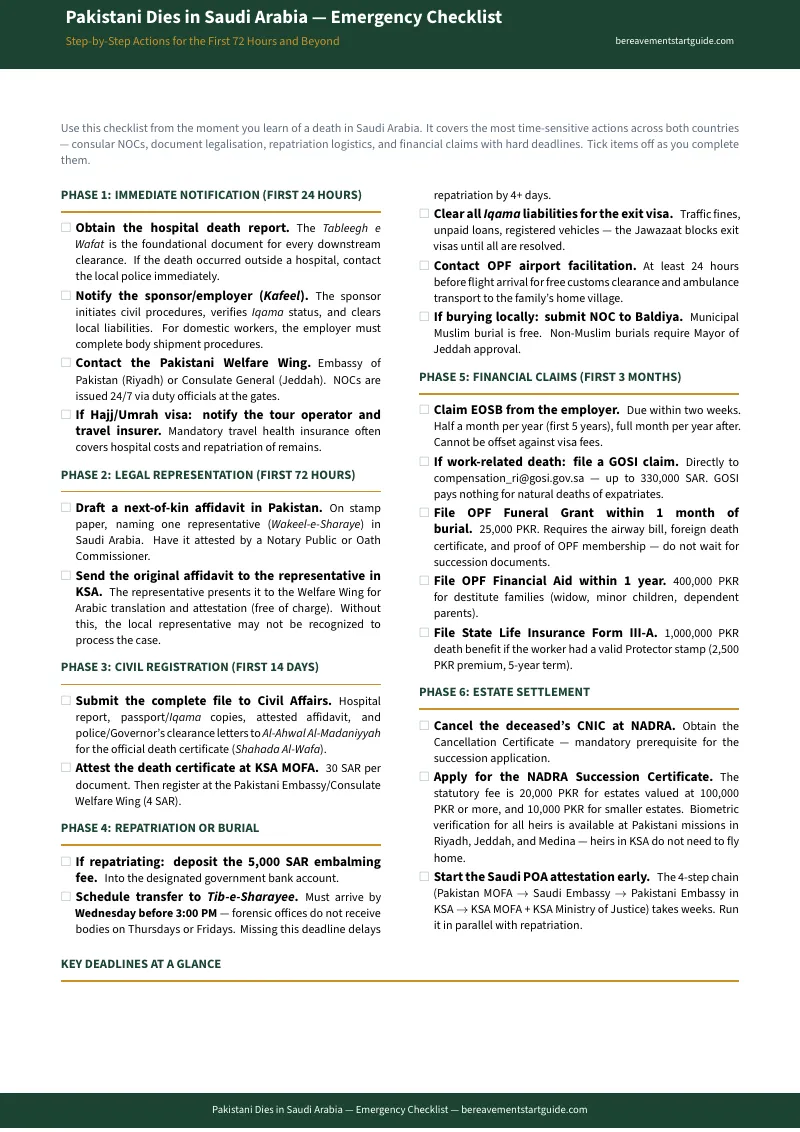
The free checklist gives you the critical action items — the 21 tasks across six phases that must happen in order. It tells you what to do.
The full guide tells you how — with worked examples, fee tables, the contact sequence at each desk, and the explanations behind each step so you can make informed decisions under pressure instead of blindly following instructions you don't understand. When the sponsor hands you a document to sign, the guide tells you what it says, what it means, and whether signing it protects or forfeits your family's rights. The paid kit also includes five print-and-fill worksheets: the 72-Hour Notification Checklist, Document Collection Tracker, Repatriation vs. Local Burial Decision Worksheet, Financial Claims Tracker, and Agency Communication Log.
Who needs this guide
- Families in Pakistan coordinating a repatriation or estate settlement remotely — especially when the only information you have is a phone call from the sponsor and conflicting advice from well-meaning relatives
- The nominated representative in Saudi Arabia who needs a clear, sequential checklist of which government office to visit next, what documents to bring, and what fees to pay
- Employers and HR departments managing the death of a sponsored worker — the guide maps your legal obligations so you know exactly what to provide and what to pay
- Community organisations and mosque committees supporting bereaved families through the process
- Hajj and Umrah tour operators handling a death during pilgrimage — the administrative pathway differs from employment deaths, and the guide covers both lanes
Why free online information isn't enough for this
The Pakistani Embassy website lists requirements. The OPF website lists grants. The GOSI website lists claim procedures. But none of them tell you the order — and in this corridor, order is everything.
A document attested in the wrong sequence gets rejected at the next desk. A GOSI claim filed before the police classification is finalised gets denied. A cargo booking made before the Jawazaat exit visa is cleared wastes thousands of riyals. The guide exists because the information is available online, but the sequencing isn't — and sequencing mistakes cost time you don't have and money your family can't afford to lose.
Full refund, no time limit
If the guide doesn't help, email hello@bereavementstartguide.com for a full refund. No forms, no questions, no deadline. You're dealing with enough right now — the last thing you need is a purchase you regret.
Get the complete guide — the emergency checklist, the 50-page step-by-step manual, and the five printable worksheets — and start working through the process with a clear path forward.