You just learned that your family member has died in France — and the mairie expects the death registered within 24 hours
A hospital administrator, a gendarme, or a tour operator delivered the news. And now you are expected to navigate a bureaucracy that operates entirely in French, a civil registry that permanently impounds identity documents if you do not intervene at exactly the right moment, and a document legalisation chain that was completely redesigned in 2025 — while grieving from across the Channel or scrambling through an unfamiliar French town.
The funeral director may already be quoting prices for a hermetic zinc-lined coffin and international embalming. The bank has frozen every account the deceased held — including joint accounts the surviving spouse depends on for daily expenses. And the British Embassy can give you a list of local contacts, but they cannot pay for a funeral, choose a funeral director, or make legal decisions on your behalf.
Meanwhile, expat forums are warning you about a six-day burial deadline that was replaced by a 14-day window in July 2024. One wrong step with the passport at the mairie and the document is permanently impounded, blocking repatriation. One missed request for a medical attestation, and you spend months trying to extract a cause-of-death document from a French hospital archive while your life insurer withholds every penny.
The Cross-Border Bereavement Navigator — a step-by-step system built for the UK–France corridor
This is not a generic death-abroad checklist. The British Person Dies in France — Family Emergency Guide was built for the specific legal, logistical, and administrative reality of managing a death across France and the United Kingdom. It maps every French agency you will encounter, every document you need, and every decision you face — in the exact order you will face them.
The guide covers three distinct disposition tracks from the moment of death: repatriation of the body to the UK (with full cost benchmarks for road-ferry and air freight), local cremation in France with ashes carried home as hand luggage, and local burial in France. You follow the track that applies to your situation, and every subsequent chapter builds on that foundation.
What's inside the guide
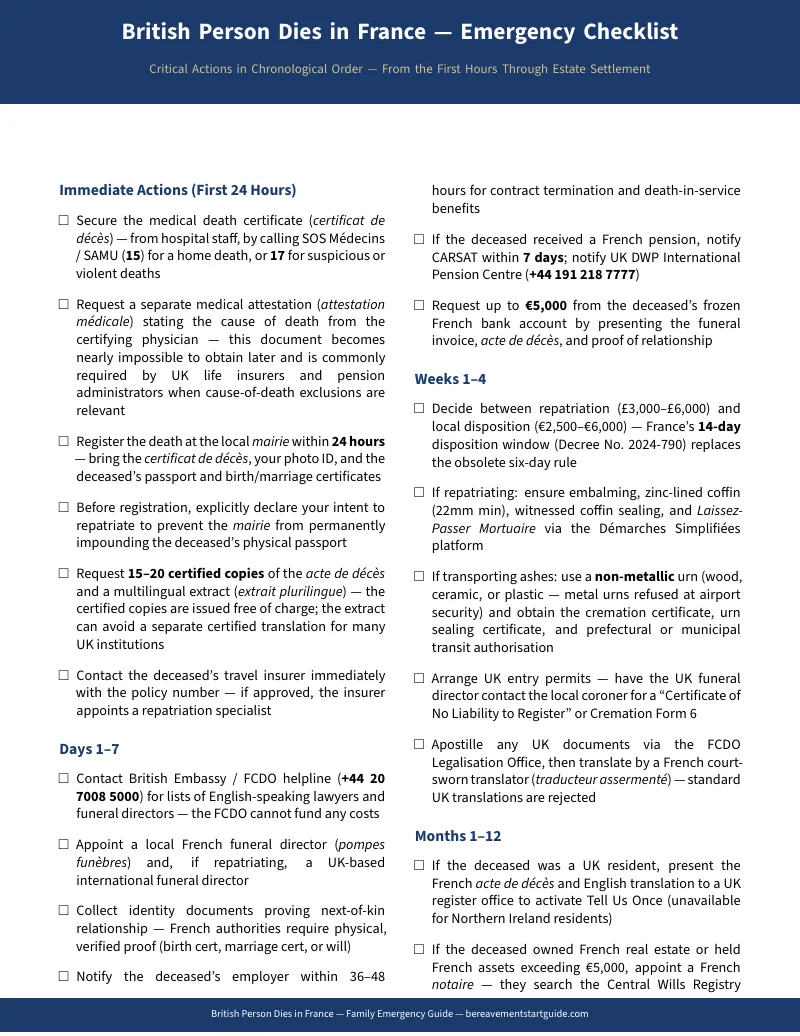
- The 24-hour emergency sequence — who to call (15 for SAMU, 17 for police, 112 for European emergency, the FCDO helpline at +44 20 7008 5000), in what order, and how the location of death — hospital, private residence, or public space — determines which procedure applies and whether a judicial investigation is triggered
- The passport retention trap and the workaround — why the mairie permanently impounds the deceased's passport at registration, and the exact declaration you must make to preserve it for the repatriation transit permit (Laissez-Passer Mortuaire)
- The cause-of-death privacy paradox — why French death certificates do not list the cause of death, why UK insurers reject cause-of-death-blind certificates, and how to request the separate medical attestation (attestation médicale) before the hospital file is archived
- The 2025 apostille reform — how the notary-led apostille system at apostille.notaires.fr replaced the old Court of Appeal process, the new fee schedule with worked cost examples, and the sworn-translation rules that catch families who follow pre-2025 guidance
- The multilingual extract bypass — how to request the extrait plurilingue at the mairie to avoid translation costs entirely for UK institutions and the Probate Registry
- Repatriation vs. local cremation decision matrix — a side-by-side comparison covering full-body repatriation to the UK (typically £3,000–£6,000 for logistics), local cremation with ashes returned as hand luggage, and local burial in France — with the 14-day window under Decree No. 2024-790 that replaced the old six-day rule
- Road-ferry versus air freight — why road repatriation via the Channel Tunnel or ferry is often faster and cheaper for northern France, and when air cargo is the better option for southern regions and Corsica
- The Corsican mortuary trap — why deaths in Corsica generate exceptionally high, unnegotiated storage bills, and how to intervene before the hospital initiates a default transfer to a pre-appointed funeral home
- Carrying ashes as hand luggage — airline-specific rules for British Airways, easyJet, Ryanair, Air France-KLM, and Virgin Atlantic, the non-metallic container requirement, and which documents must accompany the urn through airport security
- Insurance claims — how to protect travel insurance, expat funeral plan, or credit card coverage by notifying the insurer before engaging a local funeral director, the documentation sequence that prevents claim denial, and how to request direct billing
- The €5,000 bank deduction rule — how to legally demand that a French bank release up to €5,000 from the deceased's frozen account to pay the funeral invoice, with a bilingual notification letter template
- French succession law — forced heirship (réserve héréditaire), the Brussels IV election and its limits, the tontine clause exception, and why UK discretionary trusts fail in France
- Cross-border estate administration — when you must appoint a French notaire, how UK probate interacts with French estate procedures, and the Tell Us Once service with its limits for overseas deaths
- French and UK inheritance tax — the French filing deadline, the UK-France double taxation convention, and when UK IHT applies to French assets
- French legal glossary and contact directory — every French legal term in the guide, translated and explained, plus direct contacts for the British Embassy, FCDO, and key French and UK agencies
- 5 printable worksheets — fill-in tools for emergency contacts, document tracking, repatriation cost comparison, French bank notification, and agency communication logging
Who this guide is built for
- The spouse or partner in the UK who needs to act today — you are coordinating across a one-hour time zone gap with French authorities, funeral directors, and solicitors, making irreversible decisions about repatriation or cremation, and trying to get documents that will actually work in UK probate court
- The surviving expat spouse in France — you may be physically isolated, linguistically disconnected from the local bureaucracy, and facing an immediate cash-flow crisis from frozen bank accounts while the €5,000 funeral rule goes unused
- The adult child managing logistics remotely — you are juggling grief, work obligations, and travel decisions while fielding competing advice from family members who each have a different opinion about what should happen
- The executor or probate solicitor — you need the French-to-UK certified document sequence correct on the first attempt under the 2025 apostille reform, because a single legalisation error sends you back to the beginning of a process that takes weeks
- The travel companion at the scene — you are at a French hospital or gendarmerie station, possibly without any French, and you need emergency contact numbers and first-response instructions right now
- Travel insurance case managers and UK funeral directors — you need a structured, client-facing protocol for the UK–France corridor that you can hand directly to grieving families
Why free information falls short in this corridor
The FCDO website tells you to contact a local funeral director. The funeral director directs you to the nearest mortuary. The mairie registers the death and impounds the passport because nobody warned you to declare the intent to repatriate first. Expat forums give you advice from someone who handled a death in Provence when the procedures are different for suspicious deaths under the procureur de la République, or who went through the apostille process before the 2025 reform replaced the entire system.
The problem is not a lack of information — it is that the information is scattered across agencies, websites, languages, and legal systems, and none of it is sequenced. You cannot start UK probate until you have an apostilled, sworn-translated death certificate. You cannot get the apostille until the notary chamber has processed it through the new portal. You cannot file for probate if the death certificate does not show the cause of death — and French certificates never do. A single document error — requesting the condensed extract instead of the multilingual one, apostilling through an agency that is no longer authorised, missing the French inheritance tax deadline — sends you back to the beginning or triggers penalties you cannot reverse.
This guide connects the entire chain. Every chapter tells you what you need from the previous step before you can proceed, what can go wrong, and how to fix it if it does.
Your purchase is protected
Full refund, no time limit. If the guide does not help your situation, email hello@bereavementstartguide.com and we will refund you — no questions, no deadline.
The free checklist gives you the emergency contact sequence and the critical action items for the first 24 hours. The full guide gives you everything else — 14 chapters covering every agency, every document, every decision point, plus 5 worksheets and the French-language reference materials that keep the process moving forward instead of stalling.