You just learned that your family member has died in Greece — and you are making decisions with no map
A hospital in Athens says the body is in the mortuary. A tour operator on the island says the police are involved. Someone mentions a forensic pathologist. You are in the UK, you do not speak Greek, and you need to make decisions about the remains — but you do not know who has legal authority over them, what documents you need, or what anything costs.
The Greek system runs on a decentralised sequence of handoffs: hospital, police, forensic pathologist, municipal registrar, Decentralised Administration, funeral director, airline cargo — each with its own mandate, its own forms, and its own timeline. There is no single authority managing the process. The British Consulate can give you a list of local funeral directors and translators. That is the limit of what they can do. They cannot pay for anything, translate documents, register the death, or make decisions on your behalf.
Expat forums give you advice from someone who handled a repatriation from Corfu when you are dealing with a forensic autopsy on Crete. The FCDO website explains what the government cannot do, but not what you should do instead. And every day you spend sorting this out is another day the 60-hour cremation window narrows, mortuary holding fees accumulate, and the documents your UK bank and probate solicitor need sit incomplete in a Greek registry office.
The Cross-Border Emergency Navigator — a step-by-step system built for the UK-Greece corridor
This is not a generic death-abroad checklist. The British Person Dies in Greece — Family Emergency Guide was built for the specific legal, logistical, and administrative reality of managing a death across Greece and the United Kingdom. It maps every Greek agency you will encounter, every document you need, and every decision you face — in the exact order you will face them.
The guide starts at the moment of death and follows you through three distinct pathways: repatriation of the body to the UK, local burial in a Greek municipal cemetery, or cremation at the Ritsona Cremation Centre — the country's only active crematorium. You follow the pathway that applies to your situation, and every subsequent chapter builds on that decision.
What's inside the guide
- The immediate emergency sequence — who to call (112, the FCDO consular emergency line, the British Embassy in Athens), in what order, and how the cause of death determines whether a hospital physician, the Hellenic Police, or a forensic Medical Examiner takes jurisdiction over the remains
- Death registration at the Lixiarcheio — the municipal Civil Registry process, the documents the registrar requires (original Medical Death Certificate, uncancelled British passport, full civil status details), why you need at least five certified copies with the blue municipal stamp, and the practical registration timeline
- The Hague Apostille and certified translation chain — apostille from the regional Decentralised Administration, three categories of translator that meet UK legal and banking standards (Ministry-registered, Greek Bar Association lawyers, Ionian University graduates), and the step-by-step legalisation sequence that prevents automatic rejection by the UK Probate Registry
- Consular limitations decoded — the specific services the British Embassy in Athens and the Vice Consulates in Crete, Corfu, and Rhodes cannot provide, so you stop waiting for help that will never arrive and start taking the steps that move the process forward
- Repatriation vs. local burial vs. cremation — a side-by-side cost comparison covering full-body repatriation to the UK (£3,000–£6,000 for embalming, zinc-lined transport coffin, and air cargo), Greek cemetery burial (€1,500–€3,000, but subject to the three-year exhumation mandate), and cremation at Ritsona (€2,500–€3,500) — with the legal consequence that choosing local burial permanently blocks a UK coronial inquest
- The three-year exhumation mandate — Greek municipal cemeteries rent graves for three years, then exhume the remains, wash the bones, and place them in a charnel house box; families who cannot be contacted see remains placed in a communal pit
- The 60-hour cremation window — to authorise cremation at Ritsona, the death must be registered at the municipal registry within 60 hours of medical certification, and the family must provide a next-of-kin affidavit verified digitally through gov.gr or in person at a KEP office; miss the window and cremation is legally blocked, forcing burial or repatriation
- Island-to-mainland transfer logistics — deaths on smaller islands require physical transfer to Athens or Thessaloniki before international repatriation can begin, adding 24 to 48 hours and €500 to €1,200 in unexpected costs
- Forensic autopsy and prosecutor delays — what happens when the Medical Examiner seizes the remains, why post-mortem reports can take months, how to secure interim clinical documents that satisfy UK coroners for Cremation Form 6, and how Greek embalming chemicals can interfere with a subsequent UK autopsy
- Travel insurance traps — undeclared pre-existing condition exclusions, the alcohol blood-content threshold that voids coverage, and the unauthorised funeral director signature clause that leaves families personally liable for thousands of euros
- UK probate with Form PA19 — the exact certified document package the Probate Registry requires for a foreign death, the translation standards UK banks accept (CIOL, ITI, ATC), and the specific errors that trigger application rejection and six-to-twelve-week resubmission delays
- Greek legal glossary and contact directory — every Greek legal term translated and explained, plus direct contact details for the British Embassy, Vice Consulates, and key Greek agencies
Who this guide is built for
- The spouse or partner in the UK who needs to act today — you are coordinating remotely across a two-to-three-hour time zone gap with Greek authorities, funeral directors, and hospitals, making irreversible decisions about repatriation, burial, or cremation, and trying to get documents that will actually work in UK probate court
- The surviving travel companion in Greece — you may be physically present but linguistically isolated from the bureaucracy, afraid of violating local laws or incurring personal financial liability by signing documents you do not fully understand
- The adult child managing logistics from abroad — you are juggling grief, work obligations, and travel decisions while fielding competing advice from Greek hospitals, tour operators, and expat forums that may be years out of date
- The executor or probate solicitor — you need the Greek-to-UK certified document sequence correct on the first attempt, because a single legalisation error sends you back to the beginning of a process that takes weeks
- The travel companion at the scene — you are at a Greek hospital or police station, possibly without any Greek, and you need emergency contact numbers and first-response instructions right now
- Travel insurance case managers and UK funeral directors — you need a structured, corridor-specific protocol for the UK-Greece corridor that you can hand directly to grieving families
Why free information falls short in this corridor
The FCDO website tells you to contact a local funeral home. Expat forums give you advice from someone who handled a repatriation from Santorini when the forensic investigation rules work differently on the mainland. A commercial repatriation firm quotes you a price and moves the body — but does not tell you about the three-year exhumation clause attached to a Greek burial, the apostille sequence that prevents your UK probate application from being rejected, or the 60-hour cremation registration window that closes while you are still trying to understand your options.
The problem is not a lack of information — it is that the information is scattered across Greek municipal offices, the FCDO, commercial funeral firms, and online forums, and none of it is sequenced. You cannot start UK probate until you have an apostilled, certified-translated death certificate. You cannot get the apostille until the Lixiarcheio has registered the death. You cannot register the death until the forensic investigation releases the remains — and if the death was sudden or suspicious, that investigation adds weeks or months. A single document error — getting the apostille from the wrong Decentralised Administration, failing to request multiple certified copies, missing the cremation registration deadline — sends you back to the beginning or closes options permanently.
This guide connects the entire chain. Every chapter tells you what you need from the previous step before you can proceed, what can go wrong, and how to fix it if it does.
Your purchase is protected
Full refund, no time limit. If the guide does not help your situation, email hello@bereavementstartguide.com and we will refund you — no questions, no deadline.
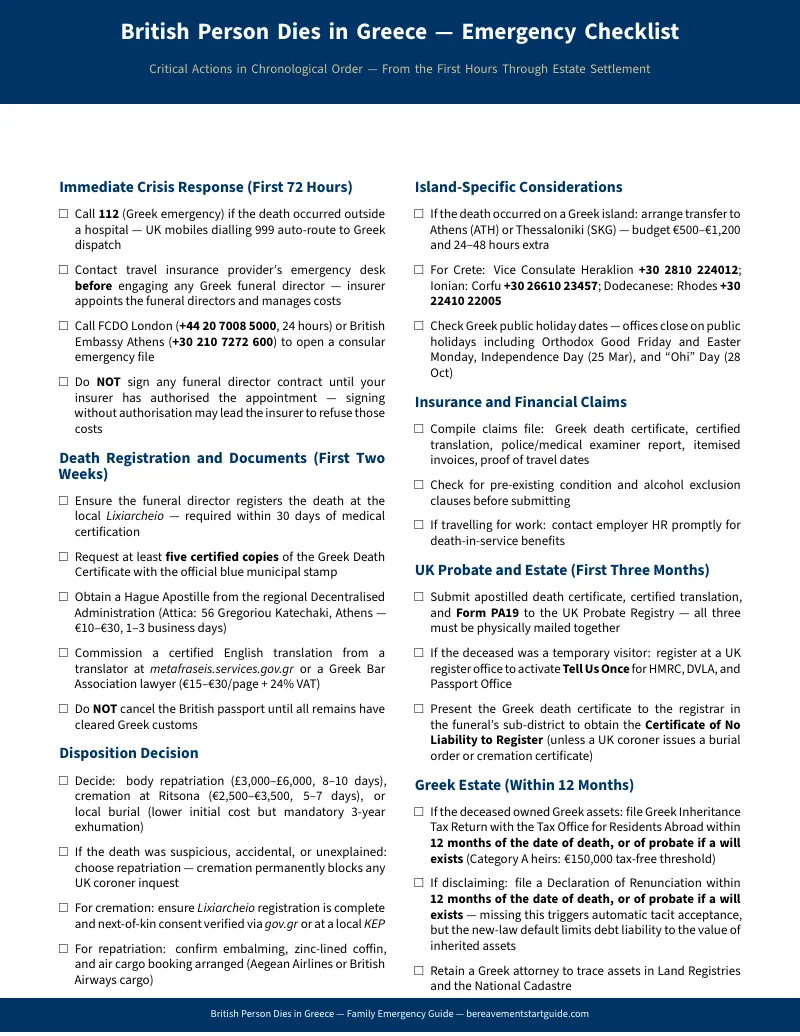
The free checklist gives you the emergency contact sequence and the critical action items for the first 72 hours. The full guide gives you everything else — the detailed how behind every step, the documents, the decision frameworks, the glossary, and the reference materials that keep the process moving forward instead of stalling.