Your family member has died in the UAE — and every account, visa, and asset tied to their name is already frozen
The call comes from Dubai or Abu Dhabi. Someone at the hospital says the body is in the mortuary. The British Embassy says they can issue a No Objection Letter but cannot register the death, arrange transport, or translate anything. The bank says all accounts in the deceased's name are frozen — including the joint account your spouse used to pay rent, school fees, and groceries. The employer says the final salary and end-of-service gratuity have been deposited into the frozen account. The visa office says the dependent visas sponsored by the deceased are being cancelled.
You need to act immediately, but you are coordinating across three separate UAE health authorities (Dubai Health Authority, Abu Dhabi Department of Health, Emirates Health Services in the Northern Emirates), each with its own registration process, its own fees, and its own document requirements. If the death was sudden or accidental, the police have opened an investigation and ordered a forensic autopsy. The public prosecutor must clear the release of remains before you can do anything — bury, cremate, or repatriate. And the Arabic death certificate must pass through a Ministry of Foreign Affairs attestation and certified English translation before a single UK institution will look at it.
The FCDO tells you what to expect. Funeral homes quote you a repatriation price. Expat forums give you advice from someone who handled a straightforward natural death, when you are dealing with a police-held investigation and a surviving spouse whose financial lifeline has been severed. Nobody sequences the steps across both countries in the order you actually face them.
The Cross-Border Emergency Navigator — a step-by-step system for the UK-UAE corridor
This is not a generic death-abroad checklist. The British Person Dies in the UAE — Family Emergency Guide was built for the specific administrative, financial, and legal reality of managing a death across the UAE and the United Kingdom — including the immediate asset freeze, the dependent visa crisis, and the employer gratuity trap that no government resource covers as a single, sequenced workflow.
The guide starts at the moment of death and follows you through every decision: which of the three UAE health authorities registers the death, how to secure the British Embassy No Objection Letter, how to protect frozen assets through either the DIFC Courts or the Abu Dhabi Judicial Department, how to choose between repatriation, local burial, and cremation, and how to get a UAE death certificate through UK probate. Every chapter builds on the previous one, and every step tells you exactly what you need before you can proceed.
What's inside the guide
- The immediate emergency sequence — who to call (999, the FCDO 24-hour consular emergency line, the British Embassy Abu Dhabi or the Consulate-General Dubai), in what order, and how the cause of death determines whether a hospital physician issues the death notification or police transfer the body to a government morgue for forensic investigation
- Death registration across three health authorities — step-by-step workflows for the Dubai Health Authority (DHA), the Abu Dhabi Department of Health (DoH), and the Emirates Health Services (EHS) covering the Northern Emirates, so the family knows exactly which office to approach, which documents to bring, and what fees to pay based on where the death occurred
- The British Embassy No Objection Letter — the mandatory passport cancellation and NOL process, the D1 form, the MoFA-attested death certificate requirement, and the specific documents the embassy needs before it will issue the letter — without which no burial, cremation, or repatriation can proceed
- Joint bank account freeze and asset protection — why UAE joint accounts function as tenants-in-common with no automatic right of survivorship, how the freeze is triggered, the difference between the DIFC Courts and the Abu Dhabi Judicial Department succession routes, and the realistic timeline (six months to two years) for obtaining a court order to release funds
- Dependent visa cancellation and transition — the limited window for dependents to secure alternative sponsorship or exit the country, the employer's visa cancellation obligations, and the steps to protect a surviving spouse's residency status
- Employer end-of-service gratuity and final salary recovery — how UAE labour law governs employer obligations, including the MOHRE trust account that holds funds when the employer cannot locate the family within 10 days, the family's legal right to claim them, and the sequence for unlocking access
- Repatriation vs. local burial vs. cremation — full-body repatriation to the UK (£3,000–£10,000 covering embalming, zinc-lined casket, HUM air cargo, and receiving funeral), local UAE burial (available only to residency visa holders), and cremation at approved facilities in Jebel Ali, Al Foah, or Sharjah (non-Muslims only, with the prohibition on children under three)
- Embalming, zinc-lined caskets, and airline cargo — the government-approved embalming certificate, sealed zinc-lined casket requirements, the seven-document customs clearance package, and HUM cargo standards on Emirates SkyCargo, Etihad Cargo, and other carriers
- Transporting ashes back to the UK — the cremation certificate, police NOC, and attested death certificate sequence, non-metallic container requirements, and airline-by-airline carry-on and checked baggage rules
- MoFA attestation and certified translation chain — the step-by-step document certification sequence from local health authority registration through Ministry of Foreign Affairs attestation to certified English translation that UK probate courts and banks will actually accept
- UK probate with a foreign death certificate — what the Probate Registry requires, how to complete Form PA19 for certified translations, and the solicitor's alternative when attestation and translation are delayed
- DIFC Wills Service Centre and Sharia default succession — the difference between dying with a registered DIFC or Abu Dhabi JD will versus dying intestate, default distribution rules for non-Muslim expats, and the Waqf risk for estates where no legal heirs are identified
- Forensic autopsy and public prosecutor delays — what triggers an automatic police investigation and forensic autopsy, how long clearance typically takes, the public prosecutor's role in releasing remains, and how to obtain interim documentation for UK coroners and insurance claims
- Travel insurance claims and exclusions — immediate insurer notification protocols, commonly covered expenses, pre-existing condition exclusions, high-risk activity clauses, and the documentation sequence that prevents claim refusals
- Tell Us Once and UK government notifications — how to use the Tell Us Once service for a death abroad and which UK agencies require separate notification
- Contact directory — direct details for the British Embassy Abu Dhabi, the Consulate-General Dubai, the DHA, DoH, and EHS registration offices, the MoFA attestation office, VFS Global London, and specialist UK–UAE repatriation funeral directors
Who this guide is built for
- The expat spouse in the UAE — your partner has died and your joint accounts are frozen, your dependent visa is being cancelled, and the employer's final salary payment has been deposited into an account you cannot access; you need the court-ordered asset recovery sequence and the visa transition steps before anything else
- The adult child or sibling in the UK — you are coordinating remotely across a four-hour time zone gap with UAE hospitals, police, health authorities, and funeral directors, making irreversible decisions about repatriation, burial, or cremation while managing grief, work, and contradictory advice from expat forums
- The executor or probate solicitor — you need the UAE-to-UK certified document sequence correct on the first attempt, especially where the deceased held assets in both countries or died without a registered UAE will and the estate falls under Sharia default succession rules
- Corporate HR managers and global mobility directors — you are responsible for a British employee who has died in the UAE and must manage repatriation liabilities, visa cancellations, and end-of-service gratuity compliance while supporting the family
- UK funeral directors and repatriation specialists — you are managing the reception of remains from the UAE and need families to arrive with the correct embalming certificate, transport permits, and MoFA-attested documentation
Why free information falls short in this corridor
The FCDO publishes a bereavement guide for the UAE. It tells you to contact the embassy, get the death registered, and arrange transport. It does not tell you that your joint bank accounts will be frozen the moment the bank is notified, that your dependent visa has started a countdown to cancellation, or that the employer will deposit the final salary into an account you cannot access for months. A Dubai funeral home quotes you a repatriation price but does not mention that the Arabic death certificate needs MoFA attestation and a certified English translation that meets both Probate Registry and UK bank compliance standards — two different sets of requirements. Expat forum advice tells you to withdraw cash from the joint account before the bank finds out, which is a criminal offence under UAE law.
The problem is not a lack of information — it is that the information is scattered across three health authorities, the British Embassy, commercial funeral firms, UAE banking law, and online forums, and none of it is sequenced. You cannot start UK probate until you have a MoFA-attested, certified-translated death certificate. You cannot get the MoFA attestation until the death is registered. You cannot get the embassy's No Objection Letter until you have the attested certificate and the cancelled passport. And you cannot release frozen assets until a UAE court issues an order — which requires a succession case file that itself depends on the registered death certificate.
This guide connects every step into a single, sequenced system. Every chapter tells you what you need from the previous step before you can proceed, what can go wrong, and how to fix it if it does.
Your purchase is protected
Full refund, no time limit. If the guide does not help your situation, email hello@bereavementstartguide.com and we will refund you — no questions, no deadline.
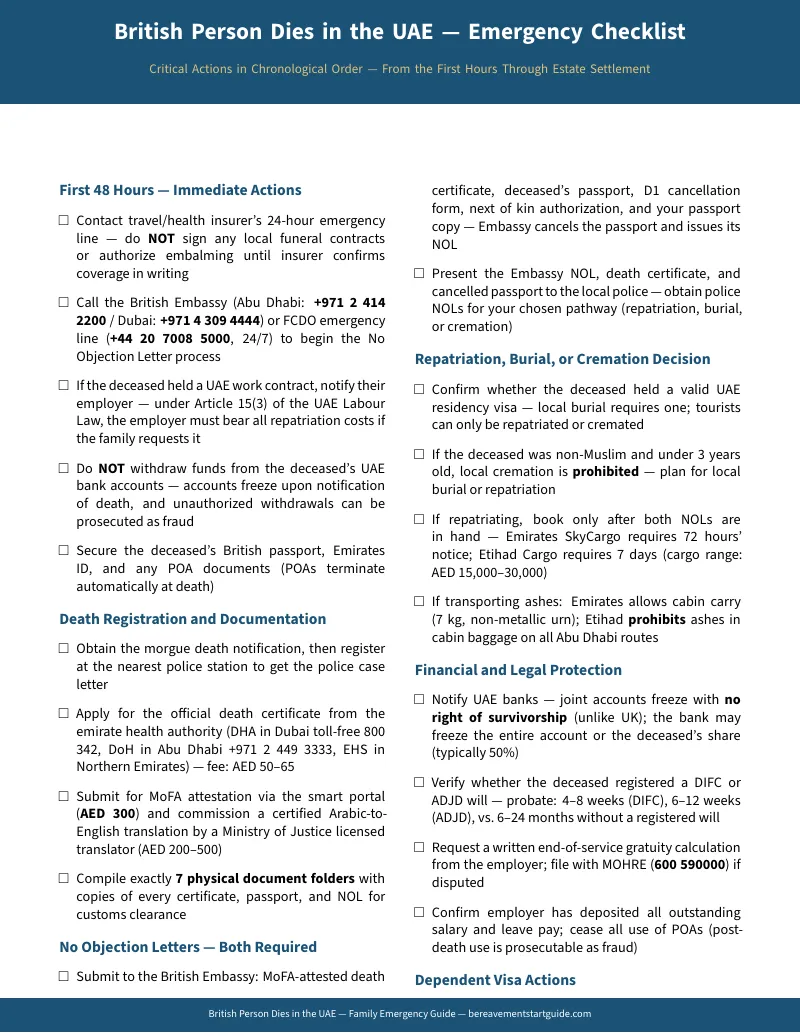
The free checklist gives you the emergency contact sequence and the critical action items for the first 48 hours. The full guide gives you everything else — the detailed how behind every step across both countries, the joint account asset protection strategy, the employer gratuity recovery sequence, the DIFC vs. Abu Dhabi court comparison, the cost comparison framework, the certified translation instructions, and the document sequences that keep UK banks, insurers, and the Probate Registry moving forward instead of stalling — plus seven standalone printable planning tools: an emergency contacts card, a master document tracker, an NOL progress checklist, a disposition decision worksheet, a financial asset register, an end-of-service gratuity tracker, and a dependent visa transition planner.