Your loved one died in Greece — and now a country that runs on Greek paperwork wants everything from you at once.
The hospital needs a signed authorization. Or worse — the death was sudden, and the remains are locked in a regional coroner's office while a mandatory forensic autopsy proceeds without your consent. Your travel insurance provider is asking for pre-authorization documentation you have never heard of. And behind all of it, a seven-hour time difference means every call to the U.S. Embassy happens during a window that keeps shrinking.
The Embassy will hand you a list of funeral directors and tell you they cannot pay for anything. They cannot override Greek jurisdiction, arrange logistics, or help you navigate the inheritance rules that started a twelve-month countdown the moment your family member died.
You are on your own — managing Greek police reports, a Civil Registry that operates entirely in Greek, Hague Apostille procedures, airline cargo regulations, cross-border estate law, and frozen Greek bank accounts — while grieving from thousands of miles away.
The Cross-Border Crisis Roadmap
The American Dies in Greece — Family Emergency Guide is a 41-page chronological workflow that takes your family from the first emergency phone call through final estate settlement. Every chapter produces a specific document that feeds the next step, so nothing stalls waiting for a piece of paper you did not know you needed.
This is not a generic "what to do when someone dies abroad" article padded with condolence advice. It is a cross-border operations manual — built around the actual document chain, Greek regulatory timelines, and bureaucratic sequences your family will encounter when an American citizen dies on Greek soil.
What You Get
- First 72 Hours Crisis Protocol — the exact sequence of calls, authorizations, and document retrievals that prevents the most expensive bottlenecks, including what to do when the death occurs on a Greek island where there is no permanent forensic pathologist and no airport cargo infrastructure
- Greek Death Registration Workflow — how to navigate the Civil Registry (Lixiarcheio), the one thing you must verify on the certificate before leaving the office, and how omitting it restarts the entire documentation chain and delays every downstream process by weeks
- eCRODA Filing Guide — the electronic Consular Report of Death Abroad is the single document you need for U.S. probate, insurance claims, banking, Social Security, and property transfers; the guide lists every required input, how to prove next-of-kin authority, and the affidavit workaround when civil documents are unavailable
- Repatriation vs. Cremation vs. Local Burial — a side-by-side cost and timeline comparison with worked examples, so you make an informed decision instead of accepting the first option a funeral director quotes you: full-body repatriation (€4,000–€5,500 mainland), cremation at Ritsona (€2,500–€3,500), or local burial (€1,500–€4,000 with the mandatory three-year exhumation most American families do not expect)
- Ritsona Crematorium Process — Greece has exactly one cremation facility, opened in 2019 after decades of Orthodox Church opposition; you cannot book directly, and the statutory consent requirements, forensic inspection, and funeral home intermediary add steps that do not exist anywhere else your family has dealt with
- The Three-Year Cemetery Lease — why choosing a local Greek burial creates a long-term obligation that includes a mandatory exhumation after three years, family attendance requirements, ongoing storage fees, and the risk of mass grave disposal if payments lapse
- Hague Apostille and Certified Translation Chain — the exact sequence to make Greek documents legally valid in U.S. courts, which translations get rejected (and why bilingual family members and standard U.S. notaries are not sufficient), and the e-Apostille eligibility cutoff date
- Greek Inheritance and the Twelve-Month Debt Trap — if the deceased held any Greek assets, banks freeze everything immediately; heirs who do nothing within twelve months are deemed to have accepted the entire inheritance including all debts; the guide walks through acceptance, renunciation, forced heirship rules, and the September 2026 reform that converted forced heir claims from property stakes to monetary claims
- Social Security Survivor Benefits — Post-Repeal — the GPO and WEP are repealed as of January 2025; if the deceased or surviving spouse received a Greek EFKA pension, the old reductions no longer apply — but survivors who never filed must apply actively, because the SSA does not auto-enroll them, and retroactive payments are capped at six months
- Island Death Logistics — deaths on Santorini, Mykonos, Crete, Rhodes, or smaller islands escalate costs and timelines significantly; the guide covers ferry and domestic air transfers to the mainland, the two-to-four-week summer delay, and interim storage requirements
- Travel Insurance Claim Tracker — fillable documentation checklists and evidence logs designed to prevent the most common reasons travel insurance repatriation claims are denied
- Six Printable Worksheets — document tracker, repatriation timeline planner, cost tracker, agency communication log, Greek inheritance action checklist, and insurance claim tracker — fillable forms you print and use to stay organized through every phase of this process
Who This Guide Is For
- Spouses, adult children, siblings, and other relatives coordinating from the United States after an unexpected death in Greece — whether the person was vacationing, retired, working, or studying abroad
- Executors and legal representatives managing cross-border estate settlement involving Greek property, bank accounts, or tax obligations
- Families of long-term expats and retirees who built a life in Greece and held local assets that now need to be untangled
- Travel insurance case managers, corporate HR directors, and university study-abroad coordinators who need a structured crisis response workflow
Why Not Just Google It?
You could. Here is what you will find: a U.S. Embassy page listing funeral directors with no guidance on how to evaluate them. A Greek government portal that requires Greek internet banking credentials you do not have. Forum posts from 2022 that still describe the old consular authentication process. Funeral home websites that quote a repatriation price without mentioning that cremation at Ritsona and ash transport runs less than half the cost. And nothing — anywhere — that warns you about the twelve-month deadline after which your silence becomes an unconditional acceptance of every debt the deceased left behind in Greece.
The information exists — scattered across embassy websites, Greek municipal registries, Apostille offices, airline cargo policies, and EU inheritance regulations. This guide brings it into one document, organized in the order your family actually needs it, updated for 2026 law.
The Free Checklist vs. the Full Guide
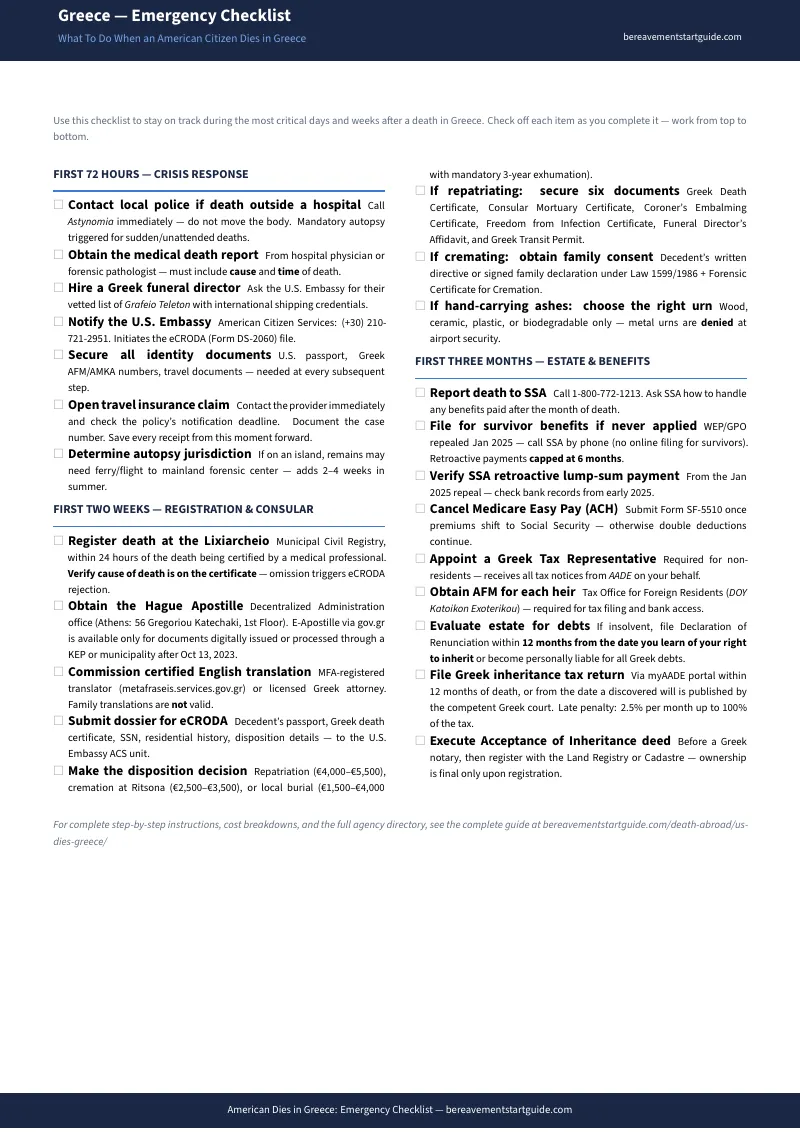
The free emergency checklist gives you the first-response action list — enough to stabilize the situation and avoid the most immediate mistakes. The full guide takes you from there through the entire process: Greek death registration, the eCRODA filing, repatriation logistics, the Apostille chain, cremation procedures, inheritance acceptance and renunciation, Social Security survivor benefits, and estate settlement.
The checklist tells you what to do. The guide tells you how, when, where, and how much.
Full Refund, No Time Limit
If the guide does not help your family, email hello@bereavementstartguide.com for a full refund. No time limit, no questions, no hoops.
Get the American Dies in Greece Guide →
Your family is dealing with enough right now. The paperwork should not be the part that breaks you.