You just got the worst phone call of your life — and now two countries need you to make decisions you were never prepared for
Your family member has died in Israel. The hospital, a tour guide, or a travel companion delivered the news. And within hours, you are expected to navigate a system built for a different language, a different legal tradition, and a burial culture that operates on a 24-hour clock — while grieving from seven thousand miles away.
The Chevra Kadisha may already be pressing for immediate burial. The Ministry of Health has issued a burial permit. The Population and Immigration Authority has its own registration timeline. And the forensic institute at Abu Kabir may have custody of the remains if the death was sudden or unattended — with autopsy proceedings you cannot override without a court order.
Meanwhile, you are fielding calls from family, reading contradictory advice on expat forums, and terrified that one wrong step with documents will trap the remains in Israel or get your paperwork rejected by an American bank, probate court, or the Social Security Administration.
The Cross-Border Bereavement Navigator — a step-by-step system built for the U.S.–Israel corridor
This is not a generic death-abroad checklist. The American Dies in Israel — Family Emergency Guide was built for the specific legal, logistical, and administrative reality of managing a death across Israel and the United States. It maps every Israeli agency you will encounter, every document you need, and every decision you face — in the exact order you will face them.
The guide covers three distinct disposition tracks from the moment of death: local burial in Israel (including non-resident tourist plots and Mount of Olives costs), full-body repatriation to the United States (with the halachic conflict around IATA embalming requirements), and cremation at Aley Shalechet followed by ash repatriation. You follow the track that applies to your situation, and every subsequent chapter builds on that foundation.
What's inside the guide
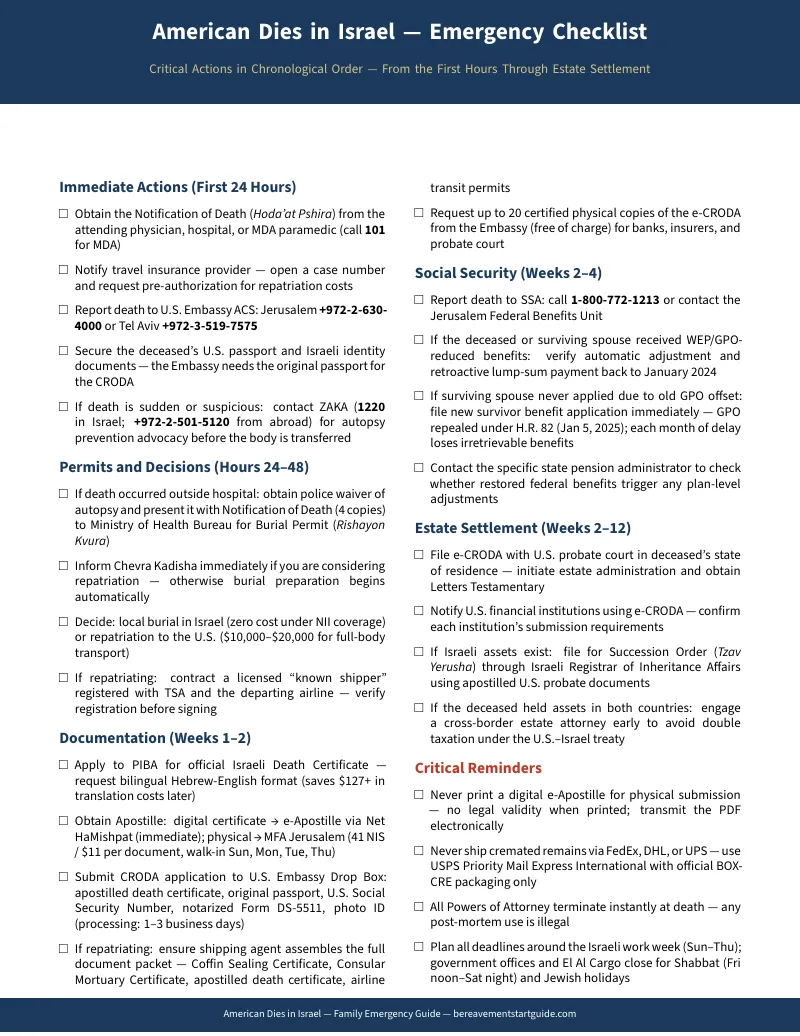
- The 48-hour emergency sequence — the exact notification order (MDA at 101, U.S. Embassy Jerusalem ACS, Israel Police at 100, insurance provider), what each agency does and does not do, and how the location of death determines which administrative pathway you follow
- Abu Kabir forensic autopsy navigation — what happens at the Greenberg National Institute of Forensic Medicine, how Israeli law governs next-of-kin consent, the court-order process when families object on religious grounds, and the 15-working-day toxicology timeline that can delay repatriation
- PIBA death registration — the Ministry of Interior process for issuing the official Death Certificate (Te'udat Petira), the in-person vs. consular filing routes, and the up-to-60-day processing window that catches families who file from abroad
- The dual apostille system — the exact distinction between the physical Apostille seal from the Ministry of Foreign Affairs (Jerusalem, 1–3 business days) and the digital e-Apostille from the Ministry of Justice (instant to 24 hours), which U.S. institutions accept which format, and how to avoid requesting the wrong one
- Repatriation vs. local burial decision matrix — a side-by-side cost comparison covering local Israeli burial ($12,000–$43,000 for non-resident tourist plots), full-body repatriation ($10,000–$20,000 including El Al/United cargo), and ash repatriation ($3,200–$5,000 via Aley Shalechet), plus the halachic conflict with IATA embalming requirements and how observant families negotiate airline policies
- Cremation in Israel — the Aley Shalechet facility in Ra'anana, documentation requirements, costs ($2,700–$3,000), and the ash transport rules for returning cremated remains to the United States by air
- CRODA procurement — how to obtain the electronic Consular Report of Death Abroad from the U.S. Embassy, why U.S. probate courts and banks routinely reject an apostilled Israeli death certificate even with a sworn English translation, and the document sequence that prevents rejections
- Post-repeal Social Security survivor benefits — the Social Security Fairness Act (signed January 2025) eliminated WEP and GPO; the guide walks through both the automatic adjustment path for active beneficiaries and the manual filing path for surviving spouses who never applied
- Cross-border estate settlement — proving next-of-kin authority in Israel, Power of Attorney with apostille, U.S. probate court filing requirements for foreign death certificates, bank account closures, and life insurance claims
- Hebrew legal glossary and contact directory — every Hebrew legal term used in the guide, translated and explained, plus direct phone numbers for the embassy ACS, Israel Police, Ministry of Health, Ministry of Interior, Ministry of Foreign Affairs, Ministry of Justice, and Aley Shalechet
- 8 printable worksheets — fill-in tools for the 48-hour emergency period, agency contact tracking, document legalization status, repatriation cost comparison, insurance claim filing, estate asset inventory, Social Security benefit verification, and the local burial vs. repatriation decision scoring matrix
Who this guide is built for
- The spouse or family member in the United States who needs to act today — you are coordinating across a seven-to-ten-hour time zone gap, making decisions about repatriation vs. local burial, and trying to get documents that will actually work in American probate court
- The travel companion or tour leader in Israel — you are at a hospital or police station, possibly without Hebrew, and you need emergency contact numbers and first-response instructions immediately
- The adult child managing logistics from abroad — you are juggling grief, work obligations, and travel decisions while fielding competing advice from family members who each have a different opinion about what should happen
- The executor or probate attorney — you need the Israeli-to-U.S. certified document sequence correct on the first attempt, because a single legalization error sends you back to the beginning of a process that takes weeks
- Study-abroad administrators and gap-year coordinators — you need a structured, family-facing protocol that fulfills your institutional duty of care
- Synagogue leaders and community rabbis — you are guiding congregants through the intersection of halacha and Israeli civil law, and you need clear answers on the embalming conflict, the Chevra Kadisha process, and the cremation option
Why free information falls short in this corridor
The U.S. Embassy's website tells you to contact a local funeral home. The funeral home directs you to the Chevra Kadisha. The Chevra Kadisha says burial should happen within 24 hours. The Ministry of Interior says registration takes up to 60 days from abroad. Expat forums give you advice from someone who handled a different type of death, in a different city, years ago.
The problem is not a lack of information — it is that the information is scattered across agencies, websites, languages, and legal systems, and none of it is sequenced. You cannot get the CRODA until you have the Israeli death certificate. You cannot get the death certificate until the burial permit is processed. You cannot get the burial permit until the medical notification is completed — and if the death was referred to Abu Kabir, the entire timeline shifts by weeks. A single document error — requesting a physical apostille when you needed the e-Apostille, a name transliterated differently between the Hebrew certificate and the U.S. passport, a burial permit that was never converted to a full death certificate — sends you back to the beginning.
This guide connects the entire chain. Every chapter tells you what you need from the previous step before you can proceed, what can go wrong, and how to fix it if it does.
Your purchase is protected
Full refund, no time limit. If the guide does not help your situation, email hello@bereavementstartguide.com and we will refund you — no questions, no deadline.
The free checklist gives you the emergency contact sequence and the critical action items for the first 48 hours. The full guide gives you everything else — the detailed how behind every step, the documents, the decision frameworks, the worksheets, and the Hebrew reference materials that keep the process moving forward instead of stalling.