
The phone rang. Now everything is complicated.
A coroner, a hospital administrator, or a relative you haven't spoken to in years just delivered the news: someone you were estranged from has died. And within hours, the pressure starts.
Sign this release. Claim the body. Split the funeral costs. Come to the service — they were still your family.
Meanwhile, you are processing something most people around you will never understand: grief that exists alongside relief. Sadness tangled with anger. The permanent closing of a door you kept cracked open — not because you wanted them back, but because the possibility of change was the last thread connecting you to hope.
Traditional bereavement resources cannot help you here. They assume you lost someone you loved deeply and saw regularly. They offer sympathy cards and casserole schedules. They do not address what happens when the person who hurt you is the same person you are expected to mourn.
The Estrangement Grief Defense System
When an Estranged Family Member Dies is not a grief book. It is a protective operational manual — built for the specific legal, emotional, and interpersonal terrain that estranged survivors face when a death forces them back into contact with a family system they left for good reason.
The guide gives you three things traditional resources do not: legal protection from institutional pressure, clinical frameworks that validate your actual emotional experience, and pre-written scripts so you never have to improvise a response while your nervous system is in crisis.
What's Inside
- First 48-Hour Legal Triage Protocol — exactly what to say to hospitals, coroners, and funeral homes before signing anything. One wrong signature on a funeral contract can make you personally liable for thousands in costs. The protocol tells you what to pause, what to ask, and what to refuse.
- Next-of-Kin Rights and Obligations Map — a plain-language breakdown of what your legal status actually requires. Spoiler: being next of kin gives you the authority to make decisions. It does not create the obligation to accept them. The guide covers passive forfeiture windows, judicial disqualification in states that allow it, and how doing nothing can legally transfer responsibility to someone else.
- Funeral Decision Framework — every option from direct cremation to public health burial, with cost ranges, process steps, and scripts for each. Includes guidance for when siblings expect you to split costs you never agreed to, and what happens if the entire family refuses to claim the body.
- Estate Protection and Debt Defense — how intestacy works when you are estranged, how to disclaim an inheritance you do not want, and how to shut down creditors who pressure you into paying debts that are not yours. Includes the critical distinction between declining involvement and "intermeddling," which can accidentally lock you into the executor role.
- Defensive Communication Scripts — pre-written, copy-and-paste responses for the institutional and interpersonal confrontations estranged survivors face: hostile relatives demanding attendance, HR departments that do not recognize estrangement bereavement, extended family weaponizing guilt, funeral directors requesting signatures, and debt collectors calling about the estate.
- Closed-Door Grief Integration — a structured emotional processing framework grounded in the clinical work of Dr. Pauline Boss (ambiguous loss), Dr. Kenneth Doka (disenfranchised grief), and Annie Wright, LMFT (closed-door grief). Covers why relief is neurologically normal, how attachment style shapes your grief response, and somatic regulation techniques for when your body processes the death before your mind catches up.
- Boundary Preservation System — the Grey Rock Method for unavoidable family contact, gatekeeper designation protocol, digital contact filtering, and a 30-day communication shield setup. Includes templates for informing institutions of the estrangement so they stop defaulting to you as the point of contact.
- Private Memorial Alternatives — because traditional funerals are designed for supportive communities, not for people whose family of origin is the source of their trauma. Covers unsent letter rituals, solo anniversary ceremonies, chosen-family memorials, and how to honor the truth of the relationship without performing fake public sorrow.
- Returning to Work and Daily Life — how to navigate a world that does not have a framework for your loss. Covers employer disclosure scripts, the mechanism of grief delay in high-functioning survivors, cognitive fatigue management, and when to seek professional help.
Who This Guide Is For
- Adult children who cut contact with a parent who has now died — and are being pressured to act as if the estrangement never happened
- Siblings navigating a death alongside relatives they no longer speak to, where the estate, the funeral, and the family narrative are all contested ground
- People named as executor or next of kin who want to understand their options for declining — before they accidentally lock themselves in
- Partners, friends, or therapists supporting someone through an estrangement death who need to understand the specific dynamics at play
Why Free Resources Are Not Enough
The information exists — scattered across clinical blogs, Reddit threads, legal forums, and hospice handouts written for a different kind of loss. The problem is not access. The problem is that when a coroner calls at 2 a.m. and your nervous system is in fight-or-flight, you do not have the cognitive bandwidth to synthesize twelve browser tabs into a coherent plan of action.
This guide puts the answers in sequence: what to do first, what can wait, what to never do, and exactly what to say when you are too overwhelmed to think clearly. Every recommendation is organized by urgency, not by topic — because in the first 48 hours, the legal decisions are more time-sensitive than the emotional processing, and getting them wrong has financial consequences that last years.
The Free Checklist vs. the Full Guide
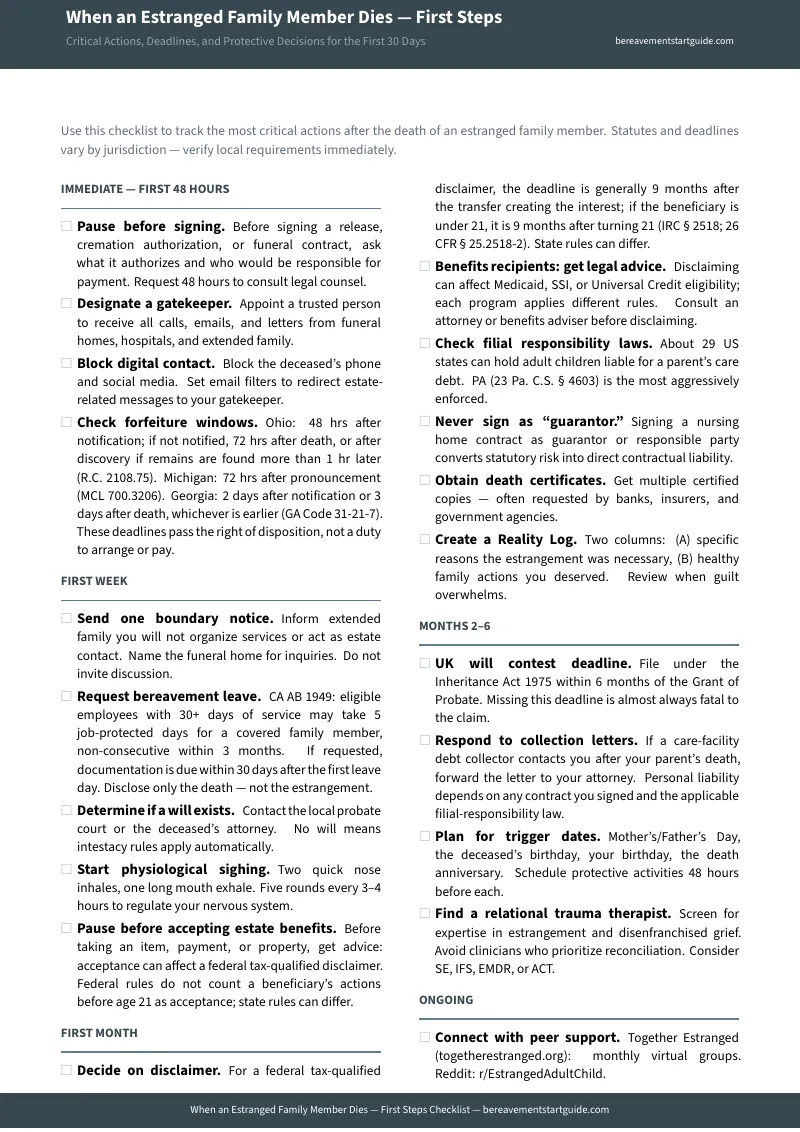
The free checklist gives you the what — a one-page overview of the immediate steps. The full guide gives you the how, the why, and the exact words to use at every stage. It includes the legal frameworks, the communication scripts, the emotional processing tools, the boundary systems, and six printable worksheets — a 30-day support plan, reality alignment log, disposition action card, anniversary sanctuary calendar, family contact shield, and asset screening tool — that turn a crisis into a managed process.
This is a one-time purchase. No subscription. No app. No community forum where you have to explain your estrangement to strangers. Just a private, downloadable set of PDFs you can use at 2 a.m. without anyone knowing.
Satisfaction Guarantee
Full refund, no time limit. If the guide does not help, email hello@bereavementstartguide.com and you will get your money back. No forms, no questions, no waiting period.
Your boundaries were valid before they died. They are still valid now. Get the guide that was built for your reality — not someone else's version of how you should grieve.
Get the Estrangement Grief Defense System →
Already downloaded the free checklist? Upgrade to the full guide →