
The meeting everyone is dreading — and no one knows how to lead
Someone died, and now you need to sit the family down and talk about money, property, debts, and who is responsible for what. Everyone is grieving. Half the family has opinions about the house. One sibling has not returned your calls. And you have no idea whether you are even legally allowed to touch the bank accounts yet.
You do not need a grief book. You need a meeting playbook — something that tells you exactly what to say, in what order, with a plan for what happens when someone gets angry or shuts down.
The Estate Conversation Blueprint
This is not a checklist you scan and forget. It is a structured facilitation system built around the First Conversation Framework — a preparation-to-follow-through method that gives you a timed meeting agenda, word-for-word scripts for the hardest moments, and conflict-resolution worksheets so the conversation produces decisions instead of damage.
The framework works because it separates the administrative reality (what must legally happen and when) from the emotional reality (who feels left out, who did the caregiving, who thinks they were promised something). Most families fail the first meeting because they try to handle both at the same time. This toolkit keeps them on parallel tracks so neither derails the other.
What's Inside
- Pre-meeting document organizer — a five-folder system for gathering vital records, estate directives, financial account statements, property deeds, and liabilities, so you walk into the meeting knowing exactly what the estate holds and what is missing
- Timed meeting agenda template — a structured, segment-by-segment agenda covering the will overview, asset inventory summary, creditor timelines, executor authority boundaries, and immediate action assignments — designed to prevent tangents and keep the conversation productive
- Word-for-word facilitation scripts — opening remarks that set the right tone, transition phrases that redirect emotional outbursts, and de-escalation language for the five most common flashpoints: disputes about the house, sentimental item arguments, caregiver compensation claims, verbal promises not in the will, and demands for immediate payouts
- Round-robin and play-money auction worksheets — two proven personal property distribution systems backed by established family mediation practices, so sentimental items are divided by transparent rules instead of who argues loudest
- Authority and timeline explainer — a plain-language breakdown of Letters Testamentary, the probate court appointment process, creditor notice periods, and EIN setup, written so every family member understands why assets cannot be distributed early — and why that protects them
- Meeting invitation and follow-up templates — pre-written emails for inviting family members, summarizing what was decided, and updating absent beneficiaries, so every communication is documented and nothing gets misremembered
- Decision-pacing guide — a research-backed system for separating urgent tasks (first 48 hours), sensitive tasks (weeks one through four), and non-urgent tasks (months one through six), so nobody is pressured into rushing a decision under grief
- Professional referral decision tree — clear criteria for when to bring in a probate attorney, CPA, mediator, or appraiser, with typical cost ranges so the family can make an informed choice together
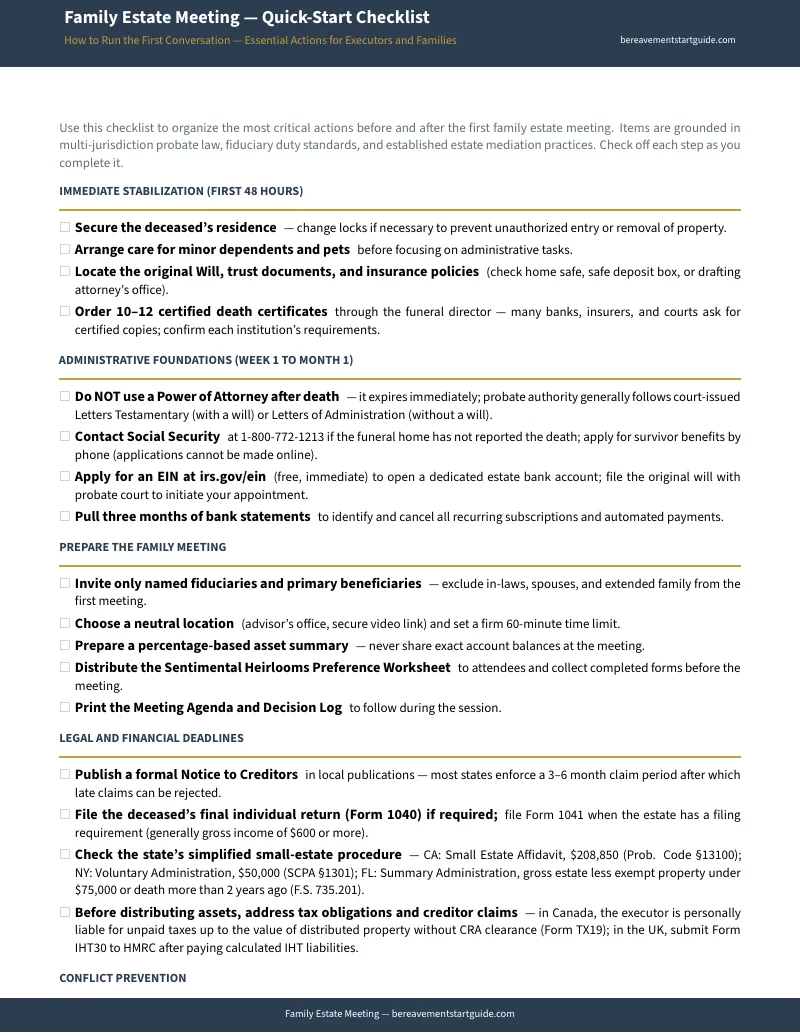
- Printable quick-start checklist — a one-page summary of every critical step from the first 48 hours through final distribution, included free with every download
Who This Toolkit Is For
This toolkit is built for the person who has been named executor, appointed administrator, or simply designated as the one who "handles things" — whether the death was recent or the estate conversation keeps getting postponed. It is especially useful if:
- You have siblings or co-beneficiaries with different expectations about who gets what
- Your family has unresolved tension around caregiving history, money, or favoritism
- Nobody in the family has been through probate before and you need to explain the process without sounding like a lawyer
- The estate includes a family home, small business, or collection of sentimental property that multiple people want
- You want to reduce your personal legal exposure by following a structured, documented process
- A relative is already claiming the deceased made promises that are not reflected in the will
Why Not Piece It Together from Free Resources?
You could. Thousands of executors do, spending dozens of hours reading probate statutes, legal blog posts, Reddit threads, and funeral home handouts — each covering one narrow slice of the process, most written for professionals who already understand the terminology.
The problem is not that the information does not exist. The problem is that grief impairs exactly the cognitive functions you need most — planning, sequencing, and decision-making. Trying to assemble a coherent meeting plan from fragmented sources while under emotional duress is how critical steps get missed: the creditor notice period that runs out before you knew it started, the bank account that gets frozen because you tried to access it without Letters Testamentary, the sibling who stops speaking to you because they felt blindsided by information you shared with someone else first.
This toolkit does the assembling for you. Every script is pre-written. Every legal concept is explained in plain language. Every step is sequenced so the meeting produces clear outcomes — not just conversation.
Full Refund, No Time Limit
If the toolkit does not help you, email hello@bereavementstartguide.com for a full refund. No time limit, no questions asked. You are dealing with enough already — a purchase decision should not add to the weight.
The conversation is going to happen whether you prepare for it or not. The only question is whether it ends with a plan — or a fight.
Get the Family Estate Meeting Toolkit →
Includes the free Quick-Start Checklist — a one-page summary of the most critical first steps. Download it now and decide later whether the full toolkit is right for you.