You cannot grieve and administrate at the same time — until you can
Someone you love has died, and now two completely separate catastrophes are happening at once. There is the grief — the fog, the nausea, the way you walk into rooms and forget why you came. And there is the aftermath — the bank accounts to close, the documents to locate, the family members who need answers you do not have, the probate deadlines that do not pause because your prefrontal cortex is running at half capacity.
Most people try to power through the paperwork for three days, collapse into emotional paralysis for a week, fall behind on deadlines, and then feel worse about everything. The administrative pile grows. The grief stays unprocessed. The guilt compounds in both directions.
Free checklists tell you what to do. Grief journals give you blank pages. Legal form sites hand you dense documents and assume you can read them while your brain is on fire. None of them acknowledge the central problem: the person filling out these forms is in a clinically measurable state of cognitive impairment — and that impairment gets worse every time you force yourself to suppress what you are feeling.
The Oscillation Method
This toolkit is built on a single clinical insight: healthy grieving is not linear. It oscillates. The Dual Process Model, developed by grief researchers Stroebe and Schut, shows that the most adaptive response to bereavement is a deliberate rhythm — alternating between emotional processing and practical action, rather than trying to do both at once or suppressing one to power through the other.
The Grief Journaling Toolkit turns that research into a concrete weekly system. Emotional processing days use guided prompts built on Dr. James Pennebaker's expressive writing protocol — 15 to 20 minutes of structured writing that clinical data shows reduces cortisol, improves immune function, and cuts health center visits by 50%. Administrative action days use checklists, trackers, and communication scripts designed for a brain running on emergency power. You alternate between the two. The grief feeds the capacity for logistics. The logistics create space for the grief.
What's inside
- Grief Brain Science — the neurobiology of why you cannot think straight, explained so you stop blaming yourself for the fog, the memory failures, and the decision paralysis
- The Oscillation Method — a weekly pacing system combining the Dual Process Model with Pennebaker's expressive writing protocol, so you process grief in doses instead of drowning in it or shoving it aside
- First 72 Hours Triage — the immediate actions that must happen now separated from everything that can wait, designed for a person in acute shock
- FTC Funeral Rule Consumer Rights — the federal protections that funeral homes routinely obscure, including itemized pricing rights, third-party casket protections, and the upsells you can legally decline
- Probate and Legal Authority Guide — how Letters Testamentary work, why Power of Attorney dies with the person, when to open an estate bank account, and the creditor claim windows that govern when you can safely distribute assets
- Month-by-Month Administrative Timeline — the full 18-month estate settlement process broken into phases with specific deadlines and filing requirements, so you always know what is due and what can wait
- Family Conflict De-Escalation — decision trees for dividing belongings, handling the sibling who wants immediate distributions, and navigating relatives who think you are moving too fast or too slow
- Three Guided Journaling Sequences — structured prompts that move through release, fear, control, and next steps across four-day cycles, so you never face a blank page when you most need to write
- Five Communication Scripts — exact words for calling banks, notifying employers, setting boundaries with family, requesting deadline extensions, and declining invitations you cannot face
- Professional Trigger Guide — when to call a probate attorney, CPA, appraiser, or therapist, what each one costs, and how to avoid overpaying for general services when you need a specialist
- Seven Standalone Worksheets — deadline tracker, asset inventory, heirloom allocation log, weekly planner, communication log, agency script pad, and emotional check-in tracker, all designed for fifteen-minute sessions and ready to print
Who it's for
Anyone who has lost someone and is trying to hold it all together. Surviving spouses facing the first weeks alone. Adult children managing a parent's estate while their own life keeps moving. Executors who were handed a role nobody trained them for. Siblings trying to cooperate through grief that makes everyone irrational. People who downloaded every free checklist and still cannot figure out the right order, the right timing, or why they keep crying in the middle of a phone call to the bank.
Why free resources fall short
Grief journals give you space to feel but no guidance on what to do. Legal checklists give you tasks but ignore the fact that you cannot think clearly enough to complete them. Funeral home websites stop at the first 30 days and leave you on your own for the other 11 months of estate administration. Corporate end-of-life platforms ask you to upload sensitive documents to a cloud server when you can barely remember your own password. Government portals give you the requirements in dense bureaucratic language and assume you can parse them while running on cortisol and broken sleep.
The Grief Journaling Toolkit sits in the gap between all of them. It connects the neuroscience of why you are struggling to the specific administrative steps you need to take, with journaling prompts that process the emotional weight of each task and communication scripts for the conversations nobody teaches you how to have.
Full refund, no time limit
If this toolkit does not help you navigate your loss with more clarity and less overwhelm, email hello@bereavementstartguide.com for a full refund. No questions, no time limit.
Start tonight
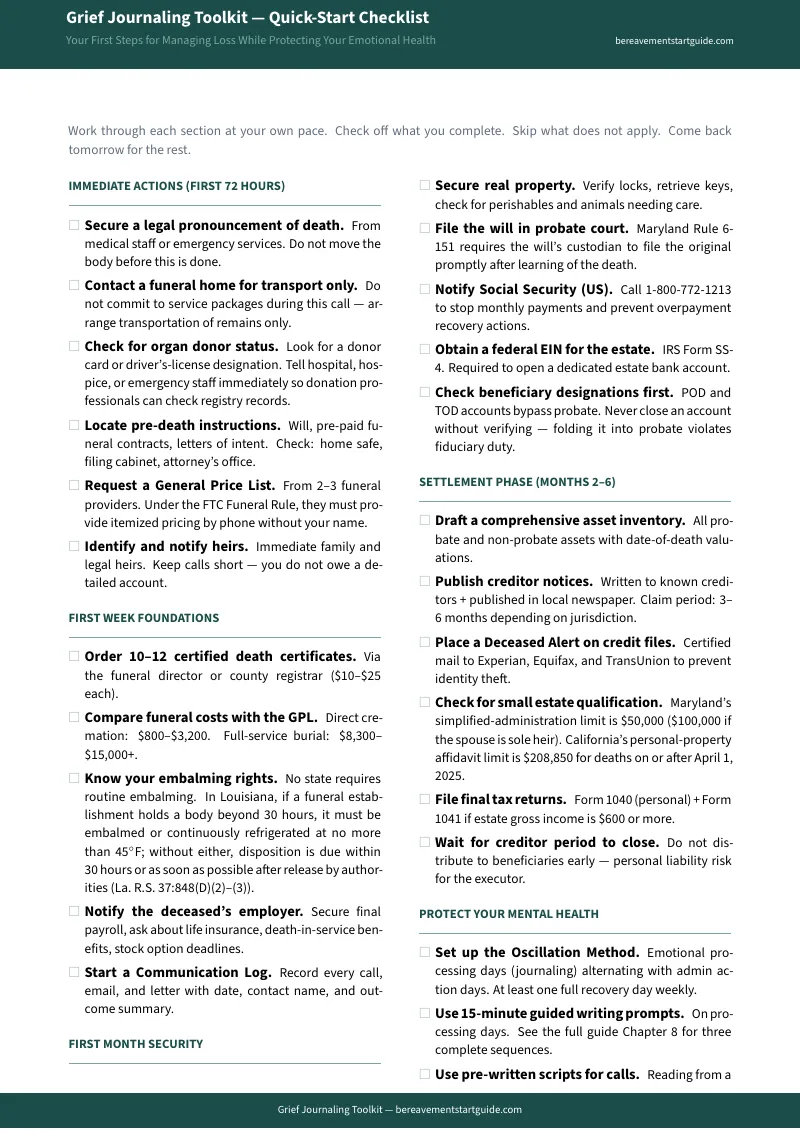
Download the free 26-item checklist to get the highest-priority actions right now. When you are ready for the full system — the science, the journaling sequences, the scripts, the deadline trackers, the family conflict frameworks, and the worksheets — the complete toolkit is waiting.