Writing an Obituary While Grieving Is One of the Hardest Things You'll Ever Do. It Doesn't Have to Be Dangerous Too.
You're sitting at a screen at 2 a.m., cursor blinking, coffee cold, funeral home calling first thing tomorrow. Someone you loved is gone, and now you have to summarize their entire life in a few hundred words — under a newspaper deadline, with family members texting edits, while your brain can barely remember what day it is.
And here's the part nobody tells you: that obituary you're about to publish is also a security document. Identity thieves actively scan obituaries for birth dates, maiden names, and home addresses. Burglars use published funeral times to target empty houses. A single well-meaning sentence — your mother's maiden name, the street she lived on — can expose the estate to fraud that takes months to untangle.
The Secure Obituary Writing System is the only toolkit that treats the obituary as both a tribute and a security event. It doesn't just give you templates — it sits beside you through the entire process, from gathering facts under grief brain fog to submitting a security-audited draft to the newspaper while staying under budget.
Here's exactly what's inside — and why each piece exists
- Fill-in obituary templates for every situation — standard, military, religious, and minimalist formats structured around the seven-section blueprint that professional obituary writers use. You open the template, fill in the blanks, and have a publishable draft in under an hour — because at 2 a.m. you need structure, not a creative writing exercise.
- The Vital Statistics Omission Worksheet — a line-by-line security audit that flags the five biographical details identity thieves harvest from published obituaries: full middle name, mother's maiden name, exact date and place of birth, home address, and specific employer names. You run your draft through it before submission. What it catches, fraudsters never see.
- Blended-family and estrangement scripts — because traditional templates assume one marriage, biological children, and everyone on speaking terms. The guide provides four distinct linguistic strategies (neutral mention, summary grouping, minimalist notice, and open-context framing) with exact wording you can copy directly into your draft. No more guessing how to handle the stepchildren, the ex-spouse, or the sibling nobody has spoken to in years.
- Trauma-informed language guides — specific, clinically accurate alternatives to phrases like "committed suicide" or "overdosed," aligned with guidelines from the American Foundation for Suicide Prevention and the WHO. Includes charitable directive templates that pair honest disclosure with constructive community action.
- The Budget and Word-Line Limit Tracker — because a 45-line obituary with a photo in a major metro daily can exceed $800, and nobody mentions that until the invoice arrives. The tracker shows you the total before you authorize, and the print-plus-digital split strategy section shows you how to publish the full tribute online while running a short death notice in print — saving hundreds on a single publication.
- Communication templates and family scripts — pre-written emails for requesting memories from distant relatives, sending the draft for family review with a firm deadline, and submitting copy to newspaper editors. Plus the Obituary Design Decision Log for documenting family agreements before drafting begins, so nobody rewrites history after the fact.
- The Photo Rights Sourcing Letter — a fill-in template for requesting usage licenses from professional photographers. Most studios grant bereavement requests at no charge, but you have to ask correctly. Using watermarked proofs or scanning copyrighted prints is a direct copyright violation — even in grief.
- The Survivor Verification and Fact-Checking Log — a structured form for recording and cross-checking every name, preferred name, relationship, and city before the draft leaves your hands. Misspelled names in a printed obituary cannot be corrected after publication.
- The Obituary Design Decision Log — a write-in record of agreed wording, the chosen photograph, publication channels, and who approved each choice, so family discussions do not get rewritten after the fact.
- The Image Sourcing and Permissions Log — a tracking sheet for every photograph considered: source, copyright holder, permission status, and print-ready format. Newspaper reproduction needs 300 DPI at the published size.
- The Identity Theft Protection Action Tracker — credit-bureau freezes, IRS notification, DDNC opt-out, and account closures, with confirmation numbers living on the sheet instead of in your head.
- The Agency Communication Log — every call, email, and letter to banks, insurers, newspapers, and government offices, with the reference number and the next follow-up on the same row.
Who this is built for
- The family member who just became the designated obituary writer and doesn't know where to start
- Executors juggling funeral logistics, estate paperwork, and newspaper deadlines simultaneously
- Families navigating complicated dynamics — divorces, stepchildren, estrangements — who need neutral language that avoids public drama
- Anyone writing about a death from suicide, overdose, or violence who wants honesty without stigma
- People who want to protect the estate from identity theft during the most public moment of the process
Why free templates won't protect you
Free obituary templates tell you to publish the deceased's full name, date and place of birth, maiden name, and home address — handing identity thieves and burglars a complete profile on a silver platter. They don't address what to do when half the family isn't speaking. They don't tell you that newspaper obituaries are priced by the line, that Sunday surcharges add 20–50%, or that a photo placement fee is separate from the text charge. They give you a blank form and leave you alone with it at 2 a.m.
This toolkit was built for the reality of obituary writing: grief-impaired cognition, compressed deadlines, family conflict, security exposure, and publication costs that nobody warns you about until it's too late.
A full refund, no time limit
If the toolkit doesn't help, email hello@bereavementstartguide.com for a full refund. No time limit, no questions, no hoops. You're dealing with enough right now.
Get the free checklist or the complete toolkit
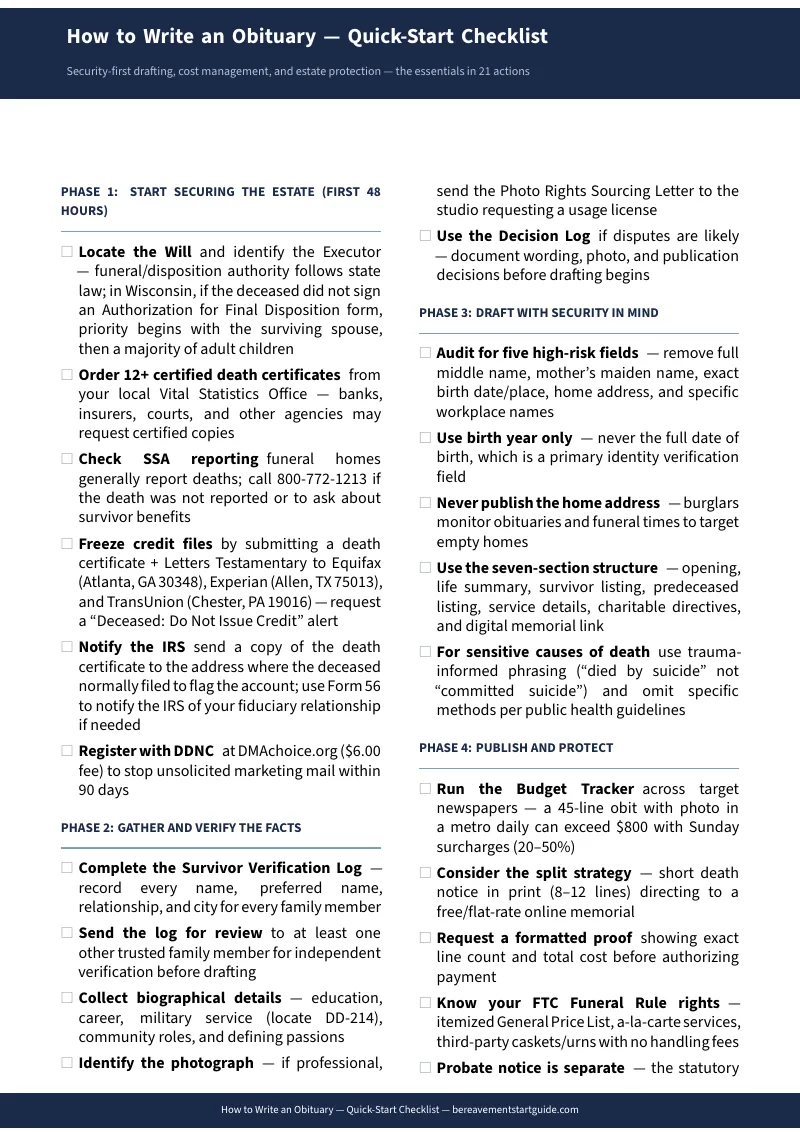
The free Quick-Start Checklist gives you the sequence — the 21 steps from securing the estate through publication. The full Secure Obituary Writing System is 13 PDFs: the 43-page guide plus 11 fillable worksheets, logs, letters, and templates you print and write on. Both are instant PDF downloads — open on any device, print what you need, start immediately.
The full toolkit costs less than a single extra line in a major newspaper obituary — and it's designed to save you far more than that.