You're Settling an Estate From a State You Don't Live In — and Every Day Costs Money
The house is sitting empty. Utility bills are arriving at an address you can't check. The homeowners insurance policy has a vacancy clause you probably don't know about — and it could void your coverage in 30 days. The bank froze the accounts the moment the death certificate was filed. Heirs are calling about their inheritance. And the probate court won't grant you any legal authority until you file paperwork in a county you've never visited.
You're not failing at this. You're doing something genuinely difficult — administering an estate across state lines while grieving — and the system was not designed to help you do it remotely.
The Remote Executor's Command System
This toolkit replaces the scattered tabs, contradictory blog posts, and panicked calls to an attorney's answering service with a single sequential system built specifically for executors who can't be physically present.
It covers the operational and logistical work that attorneys don't handle — securing the property, redirecting the mail, managing carrying costs, communicating with heirs, and making the dozens of practical decisions that pile up when you're hundreds of miles from the estate. Your attorney handles court filings and legal strategy. This handles everything else.
What's Inside
- Remote Property Security Protocol — because standard homeowners insurance voids coverage after 30–60 days of vacancy, and most executors find out the hard way. Step-by-step instructions for converting to vacant property insurance, shutting off utilities that cause damage, setting up remote monitoring, and navigating the legal line between securing an empty home and illegally locking out residents.
- USPS Fiduciary Mail Forwarding Packet — the exact forms, documents, and in-person procedure for redirecting a deceased person's mail to your address. Includes the Deceased Do Not Contact registration that stops identity-theft-enabling junk mail within 90 days.
- Out-of-State Filing Workflows — eFiling specifications, remote notarization options, video hearing protocols, and the list of proceedings that still require physical presence. Plan the trips that matter and skip the ones you can handle from your laptop.
- Creditor and Beneficiary Communication Scripts — copy-and-paste templates for explaining statutory waiting periods to impatient heirs, requesting records from out-of-state financial institutions, notifying utility providers, and responding to aggressive creditors without making promises you can't keep.
- Decision-Pacing Framework — a structured system (24-hour, 48-hour, and 7-day waiting rules) designed around the neuroscience of grief. Your prefrontal cortex is running at reduced capacity right now. This framework prevents you from making permanent decisions with a temporarily impaired brain.
- Ancillary Probate Roadmap — when the estate owns property in more than one state, you need a second probate proceeding in each additional state. This section covers exemplified records, triple-certification filing, resident agent designation, and the coordination timeline between domiciliary and ancillary courts.
- Professional Delegation Triggers — a decision tree that tells you exactly when to stop handling things yourself and hire local counsel. Specific criteria for when you need a probate attorney, CPA, licensed appraiser, or independent administrator — so you spend on professional fees only for the issues that genuinely require them.
- 30-60-90 Day Strategic Pacing Plan — maps every major task to the month it belongs in, so you know what to do now, what can wait, and what you should actively avoid until the acute shock subsides.
Who This Is For
- Executors and personal representatives who live in a different state from the deceased
- Successor trustees managing a revocable trust with out-of-state assets
- Adult children settling a parent's estate from across the country
- Anyone coordinating probate, property, and mail from a distance — whether the estate is straightforward or involves assets in multiple states
Why Free Resources Won't Get You Through This
Court self-help portals are written in legalese and assume you're a practicing attorney. Legal blogs cover one topic at a time and contradict each other across state lines. Corporate bereavement platforms are locked behind employer partnerships you don't have access to. And estate planning software focuses on drafting documents before death — not executing an active estate after it.
None of these resources address the operational reality of remote administration: who secures the house, how you forward the mail, what to do when the insurance lapses, how to appear in court without flying there, or how to keep family members from losing trust in you because you're not physically present.
This toolkit was built for the gap between legal advice and practical execution — the work that has to happen but that nobody else handles for you.
Full Refund, No Time Limit
If this toolkit doesn't reduce your stress and organize your administration, email hello@bereavementstartguide.com for a full refund. No time limit, no questions.
Your files are stored locally on your device — your family's financial and legal information never sits on someone else's server.
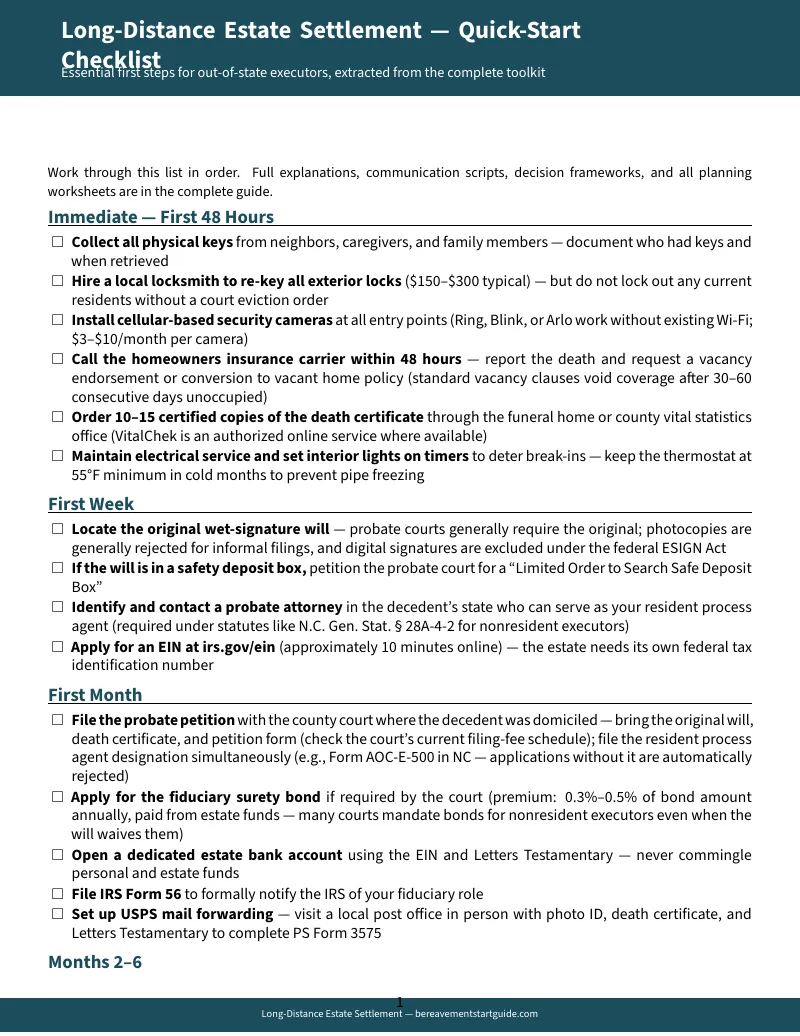
Start With the Free Checklist — or Get the Full Toolkit
The free checklist gives you the sequence of what needs to happen and when. The full toolkit gives you the infrastructure to execute it remotely: the forms, the scripts, the protocols, the decision frameworks, and the pacing system that keeps your grief from driving your administration.