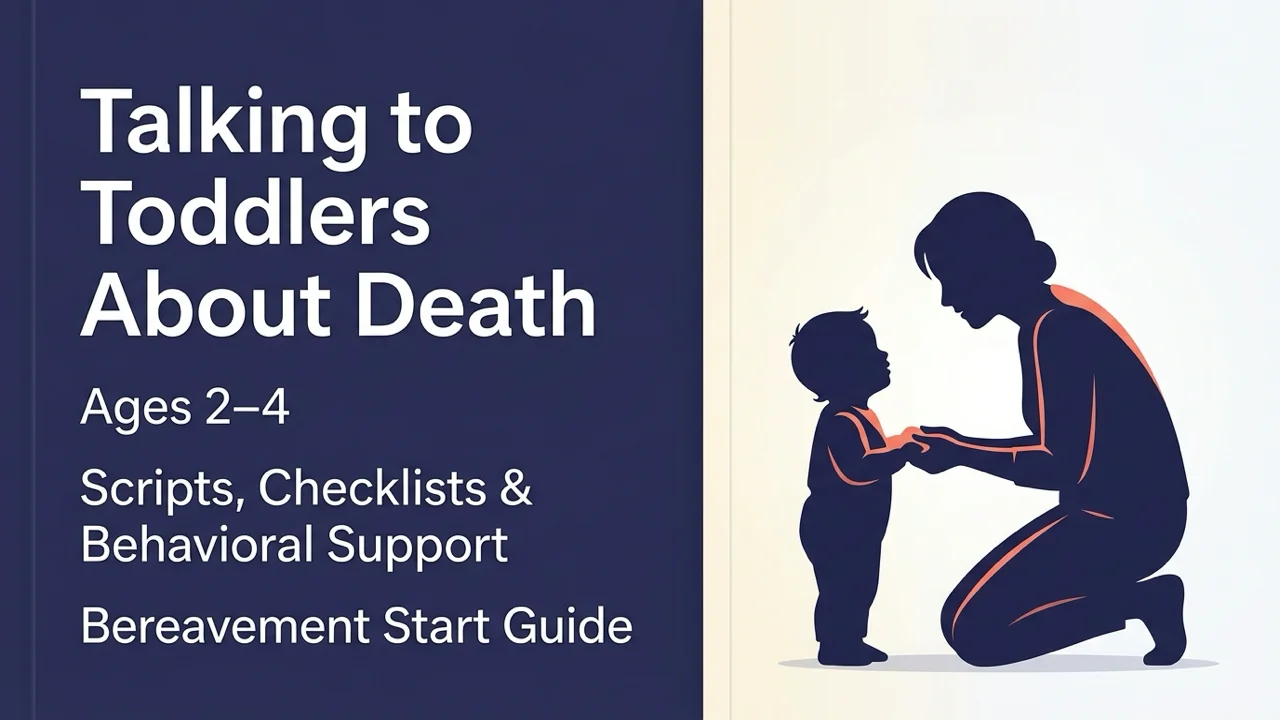
Your toddler just asked where Mommy went. You have about ten seconds before the silence becomes the answer.
Someone you love has died, and somewhere between the funeral logistics and the legal paperwork and the family members calling with opinions, a small person is tugging at your sleeve asking a question that makes your chest cave in.
You want to say the right thing. But you are exhausted and heartbroken and terrified of getting it wrong — because at this age, the wrong words do not just confuse a child. They create phobias. A three-year-old told that Grandpa "went to sleep" may refuse to close their eyes for weeks. A two-year-old told they "lost" someone may spend months searching, unable to understand why nobody will help them look.
The developmental psychology research is clear: toddlers aged two to four are concrete, literal thinkers who need direct, biological language about death. But knowing that principle and executing it at two in the morning while your own grief is tearing through you — those are different things entirely.
The Dual-Track Bereavement System — because the person comforting the child is also the person managing everything else
This is not a collection of vague reassurances or a list of children's books to buy. The Talking to Toddlers About Death toolkit is a structured, dual-track system that handles both the emotional support your child needs and the practical coordination you are drowning in — simultaneously, in one place.
It works because it was built around a reality that most grief resources ignore: the caregiver explaining death to a toddler is almost always the same person who needs to secure the house, notify the daycare, handle the estate paperwork, and manage relatives who mean well but keep saying exactly the wrong things to your child.
What's inside
- Word-for-word conversation scripts by age and cause of death — separate scripts for two-year-olds, three-year-olds, and four-year-olds, with adapted language for terminal illness, sudden accidents, suicide, and overdose. You do not need to find the right words. They are written for you.
- The Behavioral Regression Tracker — a structured monitoring system for sleep changes, bedwetting, appetite shifts, clinginess, aggression, and withdrawal. It gives you a concrete record to bring to a pediatrician or therapist instead of trying to describe weeks of worry from memory.
- Daycare and school notification templates — ready-to-send emails and letters that tell your child's caregivers what happened, what language you are using at home, and what behavioral shifts to watch for. You do not have to figure out how to have that conversation while you can barely hold your own together.
- The Euphemism Boundary Script — a firm, compassionate script you can hand to grandparents, aunts, uncles, and family friends who keep telling your child that the deceased "went to a better place" or "is watching from the stars." It explains the developmental reasoning so they understand this is clinical guidance, not a preference.
- Professional intervention thresholds — a clear decision framework that tells you exactly when your child's grief behavior has crossed from developmentally normal into territory that needs a pediatric play therapist. No more lying awake wondering if what they said today was a red flag.
- Administrative timeline and protection checklists — a parallel track covering the legal, financial, and logistical tasks that pile up after a death, organized chronologically so you can handle the urgent items first without missing deadlines that carry real consequences.
- Family dispute resolution framework — a decision-tree approach for navigating disagreements over funeral arrangements, religious communication with the child, and custody or guardianship questions that surface when everyone is grieving and nobody is thinking clearly.
- Seven standalone printable tools — a behavioral regression tracking log, conversation preparation checklist, weekly consistency planner, daycare accommodation letter, document tracker, family decision log, and agency communication log. Print them, fill them out, bring them to appointments. They work as standalone worksheets outside the main guide.
Who this is for
This toolkit was built for people carrying the weight of two impossible jobs at once:
- Surviving parents who are trying to hold a small child's world together while their own is falling apart
- Grandparents who have suddenly become the primary caregiver and need guidance calibrated to a developmental stage they last navigated decades ago
- Aunts, uncles, and family friends stepping in to support a child whose parents are unable to be the steady presence right now
- Foster parents receiving a bereaved toddler with limited history and no roadmap
- Daycare directors, pediatric nurses, and school counselors who need a structured reference for supporting families through early childhood bereavement
Why scattered free advice is not enough right now
You could spend hours assembling information from pediatric grief blogs, parenting forums, and clinical websites. Some of it would be excellent. Some of it would directly contradict what the research says. And you would be doing this assembly work during a period when psychological research shows your decision-making capacity is reduced by up to thirty percent from grief-related cognitive impairment — a state that can persist for six to twenty-four months.
The cost of getting this wrong is not abstract. A euphemism used carelessly at age three can create a sleep phobia that takes months of therapy to resolve. A behavioral warning sign dismissed as "just a phase" can become entrenched. A family member's well-meaning but developmentally inappropriate conversation with your child can undo weeks of careful, consistent messaging.
This toolkit puts clinically grounded scripts, structured tracking tools, and ready-to-use templates in your hands tonight — not after forty hours of research you do not have the cognitive bandwidth to perform.
Full refund, no time limit
If this toolkit does not serve you, email hello@bereavementstartguide.com for a full refund. No time limit, no questions, no hoops. You are dealing with enough.
Frequently Asked Questions
How is the free checklist different from the full guide?
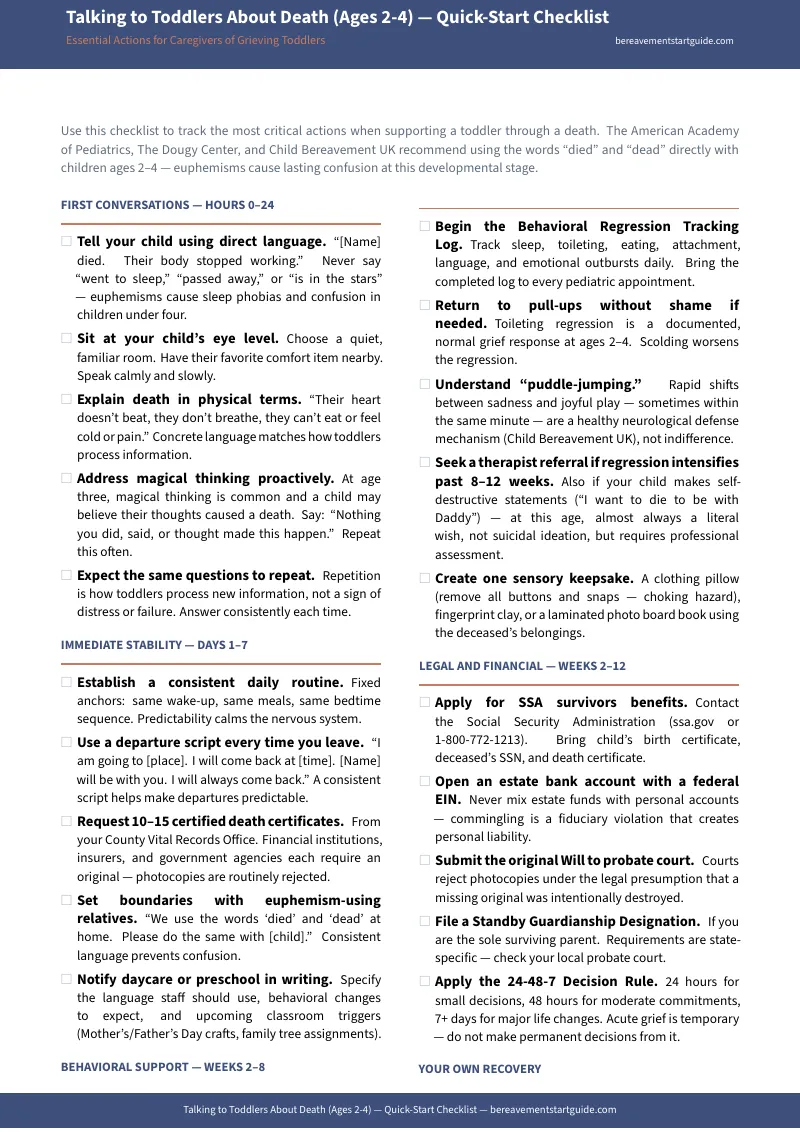
The checklist is a single-page summary covering the essential steps and common mistakes. The full guide is fourteen chapters of developmental science, word-for-word scripts for different causes of death, a behavioral regression tracking system, communication templates for daycare and family, and an administrative timeline. The checklist tells you what to do. The guide walks you through exactly how to do it and explains why it works.
My child is two and barely verbal. Will the scripts still work?
Yes. Chapter 1 explains that a two-year-old processes loss as sensory absence — the disappearance of a voice, a smell, a physical presence — rather than as an intellectual concept. The scripts for two-year-olds use extremely short, concrete sentences paired with physical comfort. The guide also covers nonverbal indicators of distress that are specific to this age.
What if the death was a suicide or overdose? I do not know how to explain that to a small child.
Chapter 2 includes adapted scripts specifically for suicide and accidental overdose. The language explains these deaths in concrete, biological terms that a toddler can process without being frightened — focusing on a brain illness that caused an unsafe decision, not on the mechanics. The scripts also directly address the magical thinking a toddler may develop, reassuring them that nothing they did or thought caused the death.
Can I share this with the daycare or preschool?
The daycare notification templates in Chapter 4 are specifically designed to be shared. They give your child's teachers the language framework you are using at home so everyone in your child's life is consistent — which is the single most important factor in reducing confusion and anxiety at this age.
Does this replace a child therapist?
No. The guide includes clear professional intervention thresholds — specific behaviors and timelines that signal when a pediatric play therapist is needed. What it gives you is a structured framework for the weeks and months of daily caregiving that happen before, between, and alongside therapy sessions, plus organized observations to bring to that first appointment.
I am too overwhelmed to read anything long right now.
The guide is modular. Each chapter stands alone. If your child asked a question tonight, go straight to Chapter 2 for the conversation scripts. If their behavior has changed and you are worried, Chapter 5 has the regression tracker and the thresholds for when to call a professional. You do not need to read it sequentially or completely.