Your child asked where Daddy is. You need the right words in the next sixty seconds — and "he's in a better place" is not them.
Someone you love has died, and the child sitting across from you — five, six, seven, maybe eight — is watching your face for an answer that will shape how they understand death for the rest of their life. They are old enough to know something terrible has happened. They are young enough that the wrong explanation will not just confuse them. It will create fears that take months of therapy to untangle.
A five-year-old told Grandpa "went to sleep" develops a phobia of bedtime. A six-year-old told "we lost Mommy" starts searching the house, then the yard, then refuses to let you out of sight because lost things sometimes come back and sometimes do not. A seven-year-old who is not explicitly told "nothing you did caused this" will silently conclude, based on the magical thinking that governs this developmental stage, that the angry thought they had last Tuesday is the reason their parent is dead.
Every major pediatric bereavement center in the world agrees on the principles that prevent this kind of damage. The Dougy Center, Child Bereavement UK, the American Academy of Pediatrics, and the National Alliance for Children's Grief all publish the same core guidance: use literal language, address guilt proactively, monitor behavioral regression against clinical thresholds, and coordinate with the school. But those principles are scattered across clinical papers, nonprofit PDFs, therapist-only training materials, and appointment-only consultations that have three-week waiting lists.
The Developmental-Stage Bereavement System — built for the caregiver who is also the executor, the school contact, and the family mediator
This is not a book of comforting platitudes or a list of children's grief titles to order from a bookshop. The Talking to Young Children About Death (Ages 5–8) toolkit is a structured system built around the specific cognitive architecture of children in this age range — the transition from magical thinking to concrete logic, the emergence of existential anxiety, the unique behavioral patterns that signal normal grief versus clinical red flags.
It works because it solves the problem most grief resources refuse to acknowledge: the person who needs to find the right words for a grieving seven-year-old tonight is usually the same person who needs to file for survivor benefits this week, notify the school before Monday, manage relatives who keep saying "he's watching over you from heaven," and settle an estate that requires decisions they are cognitively unable to make at full capacity.
What's inside
- Conversation scripts calibrated to developmental stage — word-for-word language for telling your child about death from illness, sudden accidents, suicide, and overdose, with separate scripts for the five-to-seven window (where magical thinking creates hidden guilt) and the eight-to-nine window (where existential anxiety about their own mortality emerges). Every script uses the literal, direct language the Dougy Center recommends: "dead" and "died," never "passed away" or "went to sleep."
- Magical-thinking intervention protocol — proactive scripts that surface and neutralize the self-blame nearly every child in this age range carries in silence. Children aged five to seven routinely conclude that an angry thought, a disobedient moment, or a sibling fight physically caused the death. The guide gives you exact language to address this before it entrenches into behavioral patterns that mimic compliance disorders or oppositional defiance.
- Behavioral red-flag tracker — a structured monitoring framework drawn from AAP and AACAP clinical guidance that separates normal grief (intermittent regression, circular questioning, death-themed play) from patterns that warrant a referral (persistent regression beyond six months, expressions of wanting to join the deceased, sustained academic collapse). Stop lying awake wondering whether today's behavior was a red flag.
- School coordination templates — copy-and-paste notification letters for principals, teachers, and counselors that specify the language your family is using, the behavioral changes to expect, the assignment triggers to avoid (family trees, Mother's Day and Father's Day projects), and the counselor contact protocol. Includes Section 504 plan guidance (US), SEN Support via SENCO (UK), and NCCD provisions (Australia).
- Survivor benefits walkthrough with worked examples — step-by-step SSA application instructions, the documents to bring, the phone number to call, and dollar-amount calculations showing what your child may be entitled to. Benefits accrue from the date you file, not the date of death — every week of delay is money permanently lost.
- Custody and guardianship across four jurisdictions — guardianship appointment processes for the US (state-by-state delegation of parental authority), UK (parental responsibility, testamentary guardianship, Children Act), Australia (state-specific family court orders), and Canada (provincial guardianship statutes), including emergency temporary custody procedures when no will exists.
- First-year timeline and milestone preparation — a month-by-month roadmap covering the first birthday without them, the first holiday season, the death anniversary, and school-year transitions, with preparation scripts and behavioral patterns to expect at each stage.
- Family conflict resolution framework — decision trees for navigating disagreements over funeral participation, religious framing of death with the child, custody disputes, and sentimental-property division — all calibrated for the acute grief period when nobody is thinking clearly.
- Institutional communication scripts — templates for banks, insurers, government agencies, employers, medical providers, and legal offices so you stop explaining the worst thing that ever happened to you to strangers on hold.
Who this is for
This toolkit was built for the caregiver carrying the dual burden: supporting a child whose brain is still learning what death means, while managing the funeral, the finances, the family dynamics, and the legal paperwork that death creates. That includes:
- Surviving parents trying to hold a child's world together while their own is coming apart
- Grandparents who have suddenly become the primary caregiver and need guidance calibrated to a developmental stage they have not navigated since their own children were small
- Aunts, uncles, and close family friends stepping into a guardianship role with no preparation and no roadmap
- Foster parents receiving a bereaved child with limited history
- School counselors, pediatric social workers, and family therapists who need an age-calibrated resource to hand to the families they serve
Why scattered free advice is not enough right now
The information exists online — some of it is excellent. But assembling it into a coherent system requires mental energy you do not have. Psychological research shows grief reduces decision-making capacity by up to thirty percent, a state called "administrative grief" that can persist for twelve to twenty-four months. You are being asked to do the most cognitively demanding parenting of your life with a brain running at seventy percent.
The cost of getting this wrong is not abstract. A euphemism used carelessly creates a specific phobia. A behavioral red flag dismissed as "just a phase" becomes entrenched. A well-meaning relative's conversation with your child undoes weeks of careful, consistent messaging. A survivor benefit application filed six weeks late means six weeks of payments your child will never receive.
This toolkit puts clinically grounded scripts, structured tracking tools, and ready-to-use templates in your hands tonight — not after the hours of exhausting research you cannot afford to do.
Full refund, no time limit
If this toolkit does not serve you, email hello@bereavementstartguide.com for a full refund. No time limit, no questions, no hoops. You are dealing with enough right now.
Frequently Asked Questions
How is the free checklist different from the full guide?
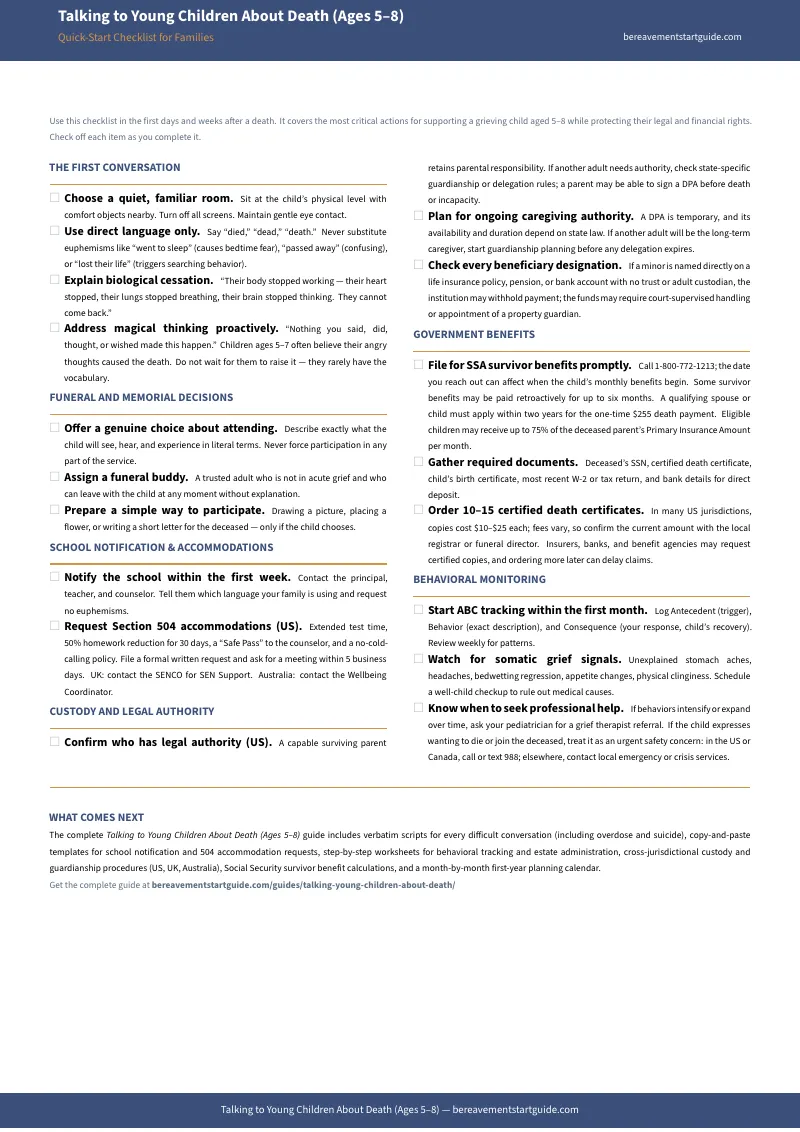
The checklist is a single-page summary of the critical first steps — what to say, what to avoid, when to call for help. The full guide is twelve chapters covering the developmental science behind how five-to-eight-year-olds process death, word-for-word conversation scripts for different causes of death, a structured behavioral tracking framework, school coordination templates with formal accommodation guidance, survivor benefits walkthroughs, custody processes across four jurisdictions, and a month-by-month first-year timeline. The checklist tells you what to do. The guide walks you through exactly how and explains why it works.
My child is four-and-a-half. Should I use this or the toddler version?
The developmental boundary is real but not a wall. If your child is already asking "why" and "how" questions about death — not just "where did they go?" — this guide's language and frameworks will serve them well. If they are closer to four and primarily processing through play, repetitive one-word questions, and separation behaviors, the Talking to Toddlers About Death toolkit may be a better starting point.
Does this cover sudden or traumatic death?
Yes. The conversation scripts include separate language for expected death from illness, sudden accidents, suicide, and overdose. Each scenario requires different framing — suicide demands explicit "this was not your fault" language from the first conversation; overdose requires age-appropriate honesty about what happened to the body without stigmatizing the person who died.
I am too exhausted to read a long book right now.
The guide is modular by design. Every chapter is self-contained. If your child asked a question tonight and you need the right words now, go straight to the conversation scripts. If their behavior changed and you are worried, go to the behavioral tracker and intervention thresholds. If you need to notify the school before Monday, go to the templates. You do not need to read it sequentially.
What if family members keep using euphemisms I am trying to avoid?
The guide includes a boundary-setting script designed to be shared with grandparents, aunts, uncles, and other well-meaning relatives. It explains the developmental reasoning — why "went to sleep" creates a specific phobia in a literal-thinking child — so your family understands this is not a personal preference but clinical guidance from every major pediatric bereavement organization.
Does this replace a child therapist?
No, and it does not try to. The guide includes clear thresholds for when professional help is warranted and when your child's behavior is within the range of normal grief. What it gives you is a structured framework for the weeks and months of daily caregiving that happen before, between, and alongside therapy sessions — and organized observations to bring to that first appointment instead of scattered worry.