
You're One Unsigned Listing Agreement Away from a Lawsuit You Can't See Coming
An executor calls you about a property. They say they're authorized to sell. You draft the listing agreement, get a signature, and start marketing the home.
Three weeks later, the estate attorney tells you the court hasn't issued Letters Testamentary. The listing agreement is unenforceable. The buyer's offer is void. Your commission evaporates. And if a beneficiary decides you wasted estate resources, you're looking at a surcharge action — where the personal representative is forced to repay your fees out of their own pocket.
This is not a rare scenario. It is the single most common liability trap in deceased estate real estate, and it starts with a document most agents never think to ask for.
The Fiduciary Transaction System — A Complete Operational Protocol for Deceased Estate Sales
The Real Estate Agent's Deceased Estate Property Guide is a transaction-ready protocol system that replaces guesswork with defensible, repeatable procedures across every stage of an estate sale — from verifying legal authority on day one through protecting your commission at the court confirmation hearing.
This is not a continuing education overview or a prospecting playbook. It is a working reference built for the agent who has a deceased estate listing on their desk right now and needs to know exactly what to do next.
What's Inside
- Fiduciary Verification Protocol — a step-by-step procedure for confirming that the person signing your listing agreement actually holds court-issued authority, with exact signature-block language for personal representative capacity designations. Because a death certificate is not authority to sell, and an unsigned power of attorney died with the principal.
- Probate Track Decision Tree — how to identify whether the estate is on an independent or court-supervised track, and what each track means for your listing period, pricing flexibility, and commission security. Because the track determines whether you spend 45 days or 18 months on this transaction.
- Court Confirmation and Overbid Playbook — the statutory overbid formula, the step-by-step process for preparing your buyer to bid in open court, and the exact moment you must request your commission on the record (miss it and you forfeit it permanently). Because most agents discover the overbid system for the first time while sitting in the courtroom.
- Death Disclosure Decision Matrix — a state-by-state framework mapping mandatory disclosure windows, stigma exemptions, and the Fair Housing boundaries that override everything else. Because California requires proactive disclosure of any death within three years, while Florida protects your silence unless the buyer asks directly — and getting this wrong costs licenses.
- Beneficiary Dispute Scripts — word-for-word language for de-escalating pricing arguments between feuding heirs, redirecting emotional conversations to market data, and recognizing the exact moment a dispute has crossed from negotiation into litigation territory where you need to step back and refer to counsel.
- Compassion Fatigue and Boundary Protocols — structured recovery procedures for after high-stress estate transactions, clear criteria for identifying secondary traumatic stress, and scripts that maintain professional empathy without absorbing client grief. Because standard real estate burnout resources were not designed for agents who watch families fall apart over a kitchen table.
- Multi-Jurisdiction Compliance Guide — side-by-side operational requirements for U.S. (state-specific), U.K. (Grant of Probate, HM Land Registry forms), and Australian (state Supreme Court grants, CGT exemptions) estate transactions. Because probate clients increasingly hold property across borders.
- Audit-Ready Documentation Templates — pre-formatted file structures, conversation logs, and consent-tracking workflows that build a defensible transaction record from day one, so you're protected when a beneficiary challenges your involvement two years after closing.
Who This Is For
- Listing agents who have just received their first deceased estate referral and need a reliable operational framework before the first family meeting
- Experienced probate specialists who want a portable reference for the compliance details that vary by state and transaction type
- Managing brokers building a deceased estate practice within their brokerage who need standardized protocols their agents can follow
- Transaction coordinators handling the administrative complexity of estate sales — fiduciary verification, court filing timelines, and multi-party signature coordination
- CPRES-designated agents who have the prospecting training and want the operational companion that covers transaction execution
Why Free Resources and CE Courses Leave You Exposed
State association materials are written by compliance attorneys for regulatory purposes. They explain the statute. They do not tell you what to say when a grieving daughter insists the house is worth $200,000 more than the market data supports because her father spent 30 years renovating it.
Continuing education courses like the CPRES certification are strong on pipeline strategy and lead generation — how to identify probate leads and position yourself as a specialist. But they do not provide the word-for-word scripts, decision trees, and filing checklists that determine whether a live transaction survives or collapses.
Law firm blog posts deliver excellent legal analysis — but they are written for attorneys, not for agents. They explain what the code says without translating it into the specific operational step you need to take at the listing table.
This guide fills the gap between all three: it translates the legal requirements into transaction-ready procedures, provides the scripts and templates that CE courses skip, and adds the trauma-informed communication layer that compliance materials never address.
Your Purchase Is Protected
Full refund, no time limit. If this guide does not make you measurably more confident handling deceased estate transactions, email hello@bereavementstartguide.com and you will get your money back.
Start With the Free Checklist or Get the Complete Guide
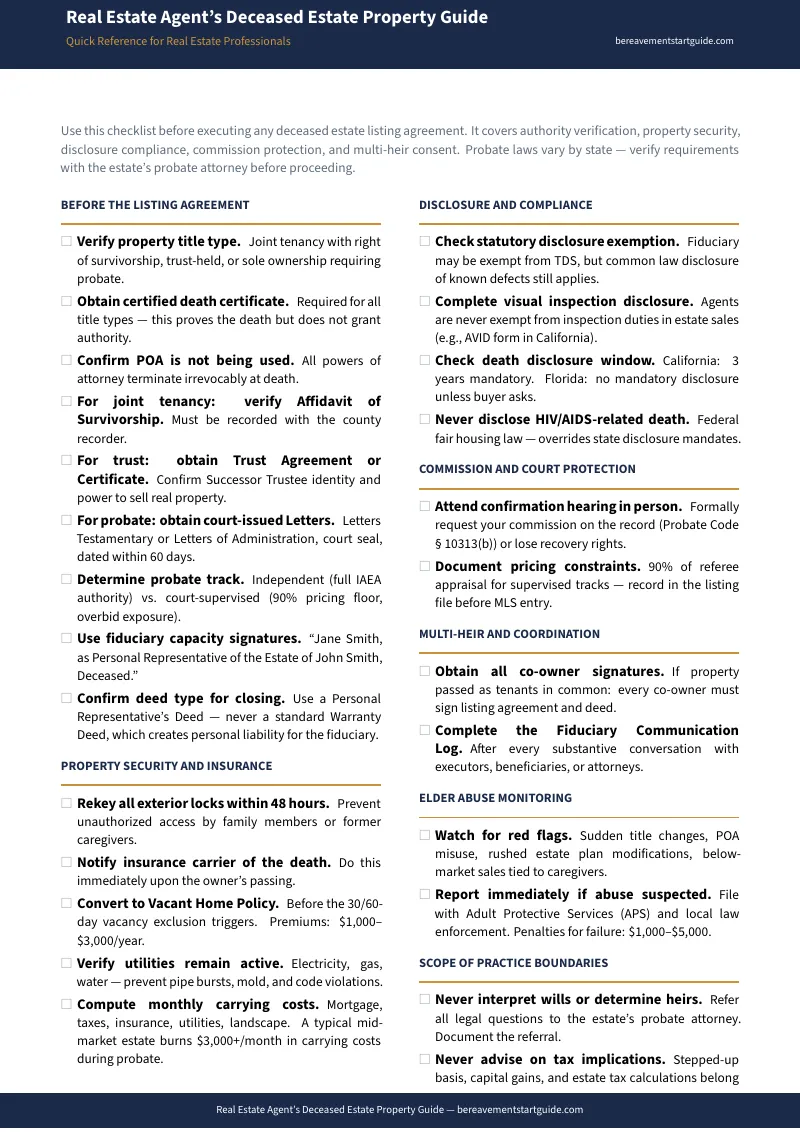
Download the free quick-reference checklist to see the framework in action — a concise overview of the critical verification steps and disclosure rules. When you're ready for the full protocol system with scripts, templates, decision trees, and multi-jurisdiction coverage, get the complete guide at /professional/real-estate-agent-deceased-estate/.