Your Training Covered Grief Theory. Your Caseload Demands Grief Protocols.
A client dies by suicide on a Thursday evening. By Friday morning you need to know — without guessing — what to document, who to notify, what to say to the family, and what not to say. You need to know whether your records will survive a licensing board review. You need to know how to write a condolence letter that expresses genuine compassion without confirming a clinical relationship.
Most clinician training programs never taught you any of that.
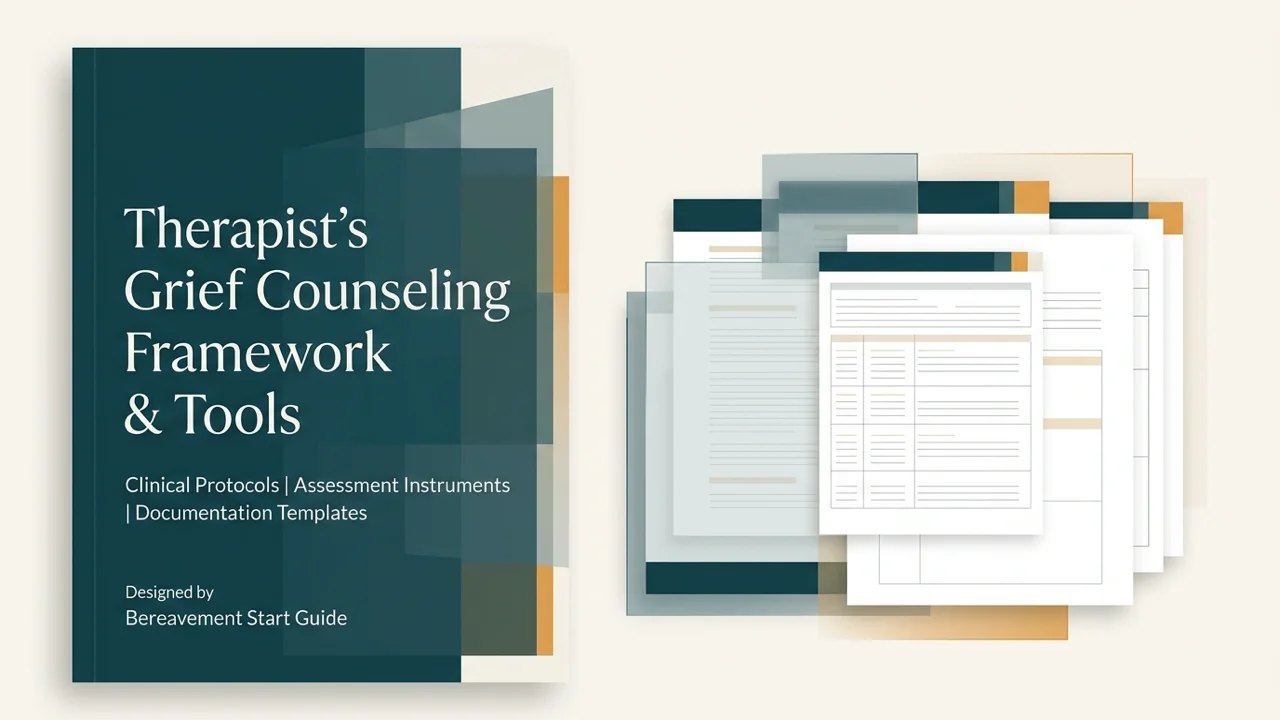
The Therapist's Grief Counseling Framework & Tools is the Clinical Protocol System built for the gap between what your graduate program covered and what your practice actually demands. It is not a textbook. It is not a CE course. It is a practice-ready operational manual — validated assessment instruments with clinical thresholds, session-by-session treatment protocols, ethically informed scripts, and documentation templates that hold up under managed care reviews, records subpoenas, and licensing board inquiries.
What's Inside the Framework
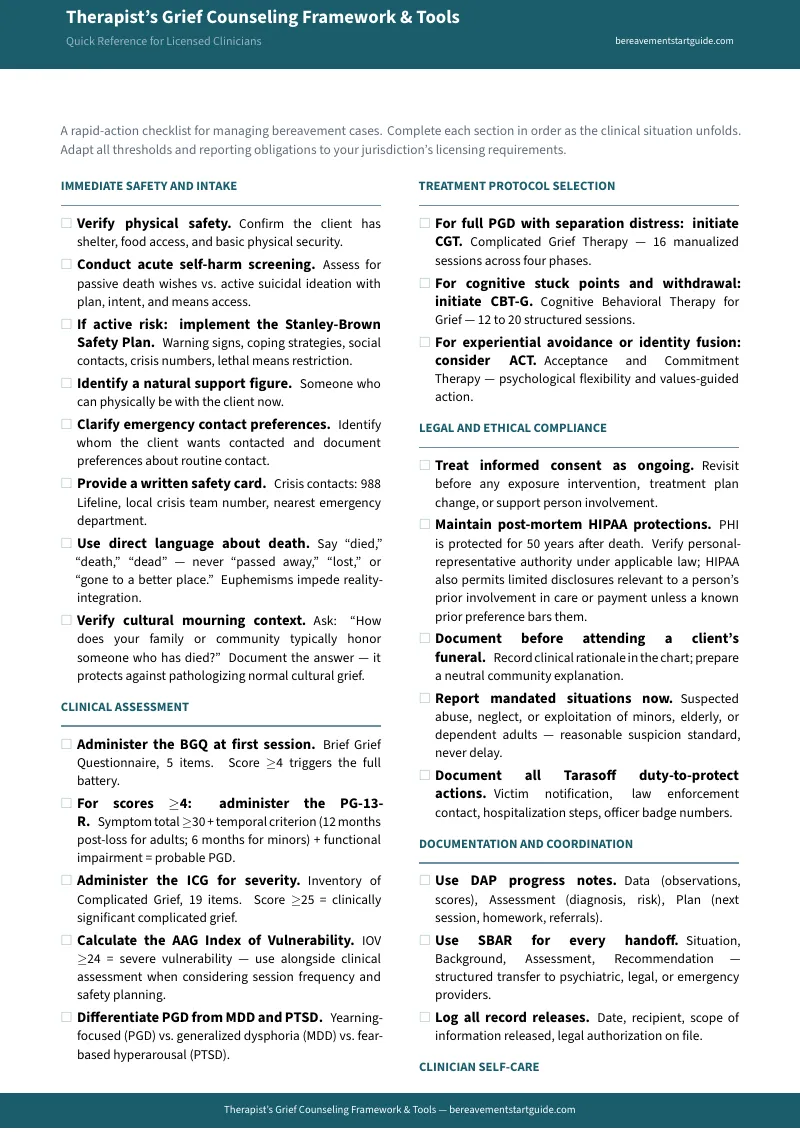
- Validated Assessment Battery — the Brief Grief Questionnaire (BGQ), PG-13-R, and Inventory of Complicated Grief (ICG) with scoring guides and clinical cutoff thresholds, so your grief assessments produce defensible, objective data instead of subjective impressions
- Differential Diagnosis Protocol — a structured decision matrix for separating Prolonged Grief Disorder from Major Depressive Disorder and PTSD, including the comorbidity patterns that make single-diagnosis treatment plans dangerous
- Manualized Treatment Sequences — session-by-session outlines for Complicated Grief Treatment (CGT) and grief-focused CBT, with session goals, therapeutic tasks, and between-session assignments ready to adapt to your clinical style
- Post-Mortem HIPAA Compliance Checklist — the step-by-step procedure for managing protected health information after a client dies, including the 50-year PHI protection rule, personal representative verification, and record release protocols
- Family Communication Scripts — exact language for expressing condolences, handling hostile or blaming family members, navigating funeral attendance decisions, and declining records requests from unauthorized parties without damaging the therapeutic legacy
- Safety Planning Protocol — a structured framework for differentiating passive reunion fantasies from active suicidal intent in bereaved clients, including the Stanley-Brown Safety Plan implementation and lethal means restriction procedures
- Documentation Templates — DAP-format progress note template specifically designed for grief counseling sessions, with medical necessity language that supports managed care authorization for ongoing bereavement therapy
- Incident Report Framework — the operational protocol for documenting client deaths in program settings, including the six-question incident report structure and the clinical-administrative documentation split
- Clinician Self-Care System — structured debriefing protocols for after a client's death, secondary traumatic stress monitoring, and the self-assessment tools clinicians need to protect their own wellbeing while doing this work
Who This Framework Is For
- Licensed therapists and counselors who carry bereavement cases and want structured protocols that match the current DSM-5-TR/ICD-11 diagnostic landscape
- Clinical supervisors who need to standardize grief care documentation across their team and onboard new clinicians with consistent, defensible procedures
- Group practice owners who carry vicarious liability for every clinician's case notes and want a protocol system that reduces organizational exposure
- Community mental health clinicians who face high-acuity bereavement cases with limited administrative support and tight reporting timelines
- Palliative care and hospice social workers navigating high mortality rate environments where grief work is constant and compassion fatigue is occupational
Why Not Free Resources?
Professional association toolkits (ADEC, ACA, NASW) carry high ethical authority but rarely provide ready-to-use templates or operational scripts — they teach principles, not procedures. CE courses from PESI and Evergreen ($200 to $460 per course) lock usable clinical tools behind hours of video and mandatory exams. Law firm compliance articles give you legal precision without any clinical warmth. Etsy worksheets give you visual templates without any clinical depth or legal defensibility.
This framework sits at the intersection those categories miss: clinical rigor, legal defensibility, and immediate operational utility — without the membership fees, exam requirements, or theoretical abstraction.
Satisfaction Guarantee
Full refund, no time limit. If the framework does not meet your clinical needs, email hello@bereavementstartguide.com and we will process your refund — no questions, no expiration.
Every protocol, template, and script works entirely offline. No client data is ever uploaded, transmitted, or stored on any server. Your clinical records stay on your device, under your control.
Get the Complete Clinical Framework →
The free quick-reference checklist covers the essential assessment steps and documentation checkpoints. The complete framework expands every item into full protocols with scripts, scoring guides, treatment sequences, and ready-to-use templates — everything you need to provide defensible, compassionate grief care starting in your next session. Get the Full Framework →