Someone died. You chose direct cremation. Now you have 48 hours before the decisions start making themselves.
Forty-eight hours before the hospital defaults the body to whatever funeral home is on their referral list. Forty-eight hours to figure out who legally authorizes the cremation (it may not be you — even if you are paying for everything). Forty-eight hours to compare providers whose advertised prices exclude the surcharges that double the bill. And forty-eight hours to explain to your sister why there will not be a viewing, while she forwards you articles about how skipping a funeral causes unresolved grief.
Direct cremation is the most affordable disposition option in the United States. It is also the one with the least guidance — because the funeral industry makes its margins on the services you just declined.
The Direct Cremation Navigation System
The Direct Cremation (No Service) Guide is not a pamphlet about what cremation is. It is a 53-page coordination manual plus six standalone printable worksheets, built for the person who has already decided on direct cremation and now needs to execute it — under time pressure, through family resistance, around hidden fees, and across the gap between "simple process" and "process nobody explains."
It replaces the panicked late-night cross-referencing — provider websites that hide surcharges, state statutes written in legalese, Reddit threads that mix useful advice with traumatic crematory descriptions — with a single document you can act on the day you need it.
What's Inside
- First-48-hours action sequence — who to call, what to authorize, and the exact order of operations from pronouncement of death through body transfer. Expected deaths and sudden deaths each get their own track, because the forms and timelines are different.
- FTC Funeral Rule field guide — your federal rights under 16 CFR Part 453, rewritten from regulatory prose into the specific questions to ask each provider: "Am I required to buy a casket for direct cremation?" (no), "Can I provide my own alternative container?" (yes), "Must you give me itemized pricing over the phone?" (yes, by law).
- Provider comparison worksheet — a structured side-by-side tool that surfaces the surcharges low-cost cremation providers routinely exclude from their advertised price. Bariatric weight premiums ($1–$10 per pound over 250–300 lbs). Pacemaker removal ($50–$500). Daily custodial sheltering ($100–$200/day during family disputes). Out-of-radius transport mileage ($2–$7/mile). State regulatory fees that up to 75% of California providers exclude from their quoted price. Fill in each provider's answers and the real comparison appears.
- Next-of-kin authorization map — how statutory cremation authorization works in majority-rule states (Florida, Texas, Michigan, Kentucky, Indiana), where a single objecting sibling can freeze the entire process and trigger daily storage fees. Includes the hierarchy charts, the majority-signature requirements, and a sibling alignment script designed to reach consensus before the provider gets involved.
- Two worked cost examples — a straightforward direct cremation at $1,340 vs. a case with bariatric surcharges, long-distance transport, pacemaker removal, and custodial sheltering totaling $3,601.50, each broken down line by line so you know where every dollar goes and which line items you can legally decline.
- Faith tradition reference — where direct cremation stands with Catholic (permitted since 1963, but the Church requires a funeral Mass with the body present before cremation, and ashes must be entombed in consecrated ground), Orthodox Jewish (prohibited under Halakhah), Reform Jewish (permissible), Islamic (strictly prohibited), Hindu and Buddhist (spiritually normative, with witness cremation adaptations), and secular frameworks. Each section includes the theological reasoning, compromise pathways, and conversation scripts for talking with clergy.
- Body transport and remains shipping — pacemaker removal requirements, TSA carry-on urn rules (container must be X-ray scannable — metal and stone urns will be rejected), USPS Publication 139 shipping protocols (the only legal carrier for cremated remains), and international repatriation documentation for sending ashes abroad.
- Family communication scripts — copy-and-adapt templates for announcing private arrangements, aligning siblings on authorization, responding to relatives who expected a traditional funeral, and handling the social "grief void" that comes with choosing no service.
- Mourning without a service — how to create meaningful remembrance when there is no funeral to anchor the grief: celebration-of-life frameworks, memorial gathering structures, scattering ceremony templates, and keepsake options.
Who This Is For
- Families coordinating a direct cremation within 24–72 hours of a death, under time pressure and acute grief
- Adult children acting as executor or next of kin who need to understand their legal authority before calling a provider
- Budget-conscious arrangers who chose direct cremation to save money and want to avoid the hidden surcharges that erase the savings
- Distant or diaspora relatives managing arrangements from another state or country, unfamiliar with local authorization rules and transport logistics
- Interfaith families navigating conflicting positions on cremation — one household, multiple theological traditions, one decision to make together
- Pre-planners establishing advance directives that specify direct cremation with no service
- Death doulas, celebrants, and independent end-of-life planners who advise families outside the funeral home system
Why Free Resources Fall Short
Cremation provider websites advertise low base prices — then omit the surcharges you will discover after the body is already in their care. Bariatric fees, pacemaker removal, storage during family disputes, mileage beyond the free pickup radius. The advertised price is the starting bid, not the final cost.
The FTC's Funeral Rule guides are accurate and objective — and written in the language of federal regulation, with no emotional context, no family conflict guidance, and no help for the person who just learned that their sister's signature is legally required and their sister is not answering the phone.
Reddit threads carry raw, first-hand accounts from funeral directors and grieving families — mixed with unverified advice, graphic crematory descriptions, and state-specific information that may or may not apply to your jurisdiction.
Funeral home websites explain the full spectrum of services — because their commercial interest lies in steering you toward the high-margin viewing, the embalming, and the casket you do not need for direct cremation.
This guide consolidates the legal, logistical, financial, religious, and relational steps into a single document — verified against current statutes and industry practices, sequenced for crisis use, and written so you can act on it the hour you need it.
Your Guarantee
Full refund, no time limit. If the guide does not give you what you need, email hello@bereavementstartguide.com and we will refund you. No forms, no waiting period, no questions.
Two Ways to Start
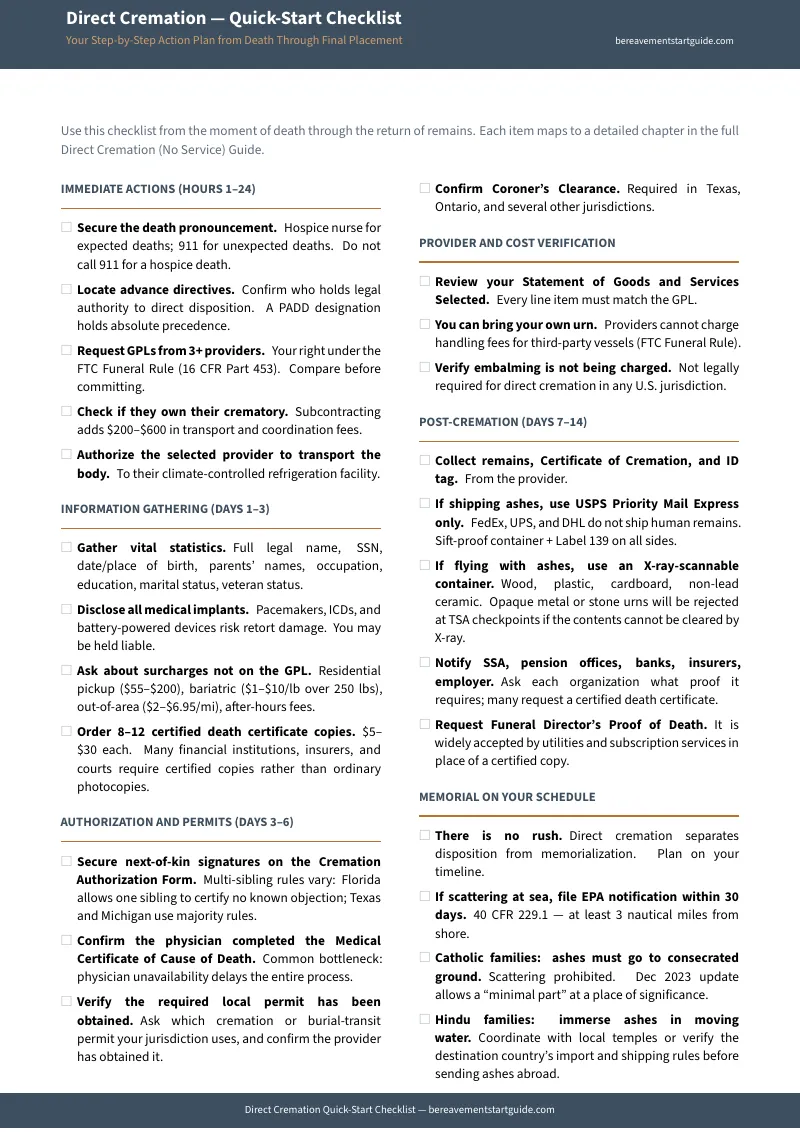
Download the free two-page checklist — 27 critical tasks from death pronouncement through final disposition — and see whether the approach resonates. When you are ready for the full provider comparison framework, next-of-kin authorization maps, faith tradition scripts, cost breakdowns, and six standalone printable worksheets, the complete guide is waiting.