Planning an Ethiopian Orthodox Tewahedo Funeral Shouldn't Mean Guessing at Ancient Rites While Your Family Watches
Your parent or grandparent has passed. The priest is asking about the Fitihat. Your aunt is calling from Addis about repatriation. The funeral director just suggested cremation. And you're standing in the middle of it — unsure which chant mode to request, whether tomorrow is a fasting day, or how to tell the mortician that only someone of the same sex can wash the body.
Parish priests handle the liturgy. Funeral directors handle logistics. But the gap between them — the fasting calendar, the body preparation protocols, the repatriation paperwork, the idir coordination, the family disagreements about what's church canon versus village custom — that gap is where diaspora families break down during the worst week of their lives.
The Tewahedo Funeral Blueprint: A Complete Operational Bridge Between Church and Cemetery
The Eastern Orthodox Funeral — Ethiopian (Tewahedo) guide is a structured, step-by-step resource that closes the operational gap between your priest and your funeral director. It translates centuries of Tewahedo liturgical tradition into clear, actionable English — with phonetic Ge'ez and Amharic throughout — so you can coordinate a funeral that honors your loved one without a single ritual misstep.
This isn't a theology textbook or a generic "Eastern Orthodox" guide that lumps Ethiopian traditions in with Greek or Russian customs. It covers the specific liturgical, cultural, and logistical requirements of the Ethiopian Orthodox Tewahedo Church — from the Ezel chanting mode codified by Saint Yared to the Trinitarian blessing required for meat at a non-fasting memorial meal.
What's Inside
- First-48-Hours Priority Checklist — when burial custom calls for interment within 24 hours, you need a sequenced action list, not a book chapter. What to do right now (call the priest, coordinate same-sex body preparation, notify the idir), what can wait until morning, and what must happen before the service.
- Complete Fitihat Service Walkthrough — the absolution liturgy explained step by step: Psalm 119 recitation in three stanzas, the Evlogetaria funeral praises, the anointing with holy oil and consecrated earth, incense protocols, and casket positioning facing east. Phonetic Ge'ez pronunciations for every congregational response so you can participate meaningfully even if you grew up speaking only English.
- Funeral Director Instruction Sheets — printable, hand-to-vendor pages that explain same-sex body washing requirements, the cremation prohibition, east-facing burial orientation, open-casket protocols, and low-smoke incense alternatives for fire-alarmed venues. No awkward improvised explanations at the funeral home — just hand them the sheet.
- Fasting Calendar and Christian Slaughter Reference — the Tewahedo fasting calendar is one of the most rigorous in Christendom (180+ days per year). If your memorial falls on a Wednesday, Friday, or during one of the extended fasting seasons, serving any animal product is a catastrophic offense. The guide maps fasting periods against your memorial timeline and explains the Trinitarian blessing requirement for meat on non-fasting days, plus practical sourcing strategies for diaspora cities where Christian-slaughtered meat is hard to find.
- Lekso Mourning Protocol — a day-by-day framework for the 3-to-12-day mourning period: how to prepare your home for continuous visitors, the reverse-netela draping protocol, what the idir handles versus what falls on the family, and how to navigate municipal zoning rules for mourning tents in Western suburbs.
- Memorial Timeline and Teskar Planning — every post-funeral milestone mapped: 3rd-day resurrection prayers, 7th-day memorial, the 40th-day Teskar feast (including menu planning worksheets), and annual remembrance. What the priest expects, what the family provides, and what the community contributes at each stage.
- Repatriation Logistics — a complete document checklist for transporting remains back to Ethiopia: death certificate, health certificate, embalming report, hermetically sealed zinc-lined container, passport or Ministry authorization letter, Ethiopian Airlines cargo procedures, and coordination with receiving morgues in Addis Ababa. Typical repatriation costs run $12,000 to $20,000 — this section helps you avoid the storage fees ($500 to $1,200 per week) that pile up from minor paperwork errors.
- Sensitive Situations — guidance on deaths by suicide (including the oikonomia pastoral exception when clinical depression or mental illness is documented), autopsies and organ donation, and navigating conversations with church authorities when the cause of death carries community stigma.
Who This Guide Is For
- Second-generation diaspora adults who grew up in Western countries and now face organizing a Tewahedo funeral while worrying about getting it wrong in front of Amharic-speaking elders
- Interfaith and cross-cultural spouses who married into an Ethiopian Orthodox family and suddenly need to coordinate a funeral tradition they've never experienced
- Families managing repatriation — navigating embassy clearances, airline cargo regulations, and Kebele interment permits while processing grief
- Funeral directors and hospice workers serving Ethiopian Orthodox communities who need a reliable cultural reference instead of guessing at unfamiliar protocols
Why Free Online Resources Fall Short
The information available for Ethiopian Tewahedo funerals is scattered across parish websites written entirely in Amharic, Reddit threads with conflicting advice, academic liturgical texts in Ge'ez designed for clergy, and generic "Eastern Orthodox" funeral sites that recommend cremation and flower arrangements — both culturally wrong for Tewahedo practice.
Traditional idirs provide community support but operate on unwritten oral traditions with no downloadable checklists or bilingual planning tools. Seminary publishers like SVS Press produce funeral service books for Byzantine, Greek, and Slavic Orthodox traditions that completely omit the Oriental Orthodox liturgy, the Ge'ez Zema chanting modes, and the distinct cultural practices of the Tewahedo Church. And self-published "Ethiopian Liturgy" books on Amazon frequently lack ecclesiastical approval and contain unorthodox content that can create conflict with your parish priest during the service.
The Tewahedo Funeral Blueprint consolidates canonical liturgical requirements, practical diaspora logistics, and cultural guidance into one verified, English-language resource — so you spend your energy on mourning, not on guessing.
Your Purchase Is Protected
If the guide doesn't help you navigate the funeral planning process with confidence, email hello@bereavementstartguide.com for a full refund. No time limit, no questions, no hoops.
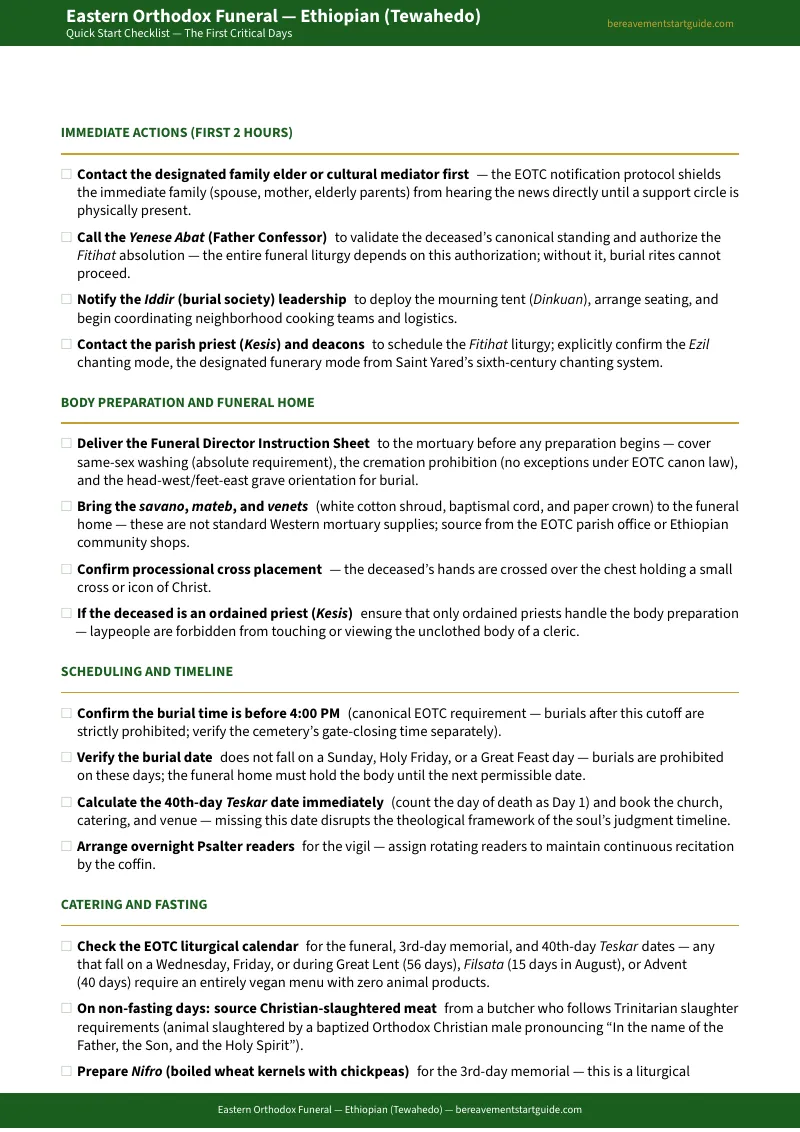
The free checklist gives you the essential action items. The full guide gives you the liturgical detail, the vendor instruction sheets, the fasting calendar, the repatriation paperwork, and the memorial planning worksheets that turn those action items into a funeral your family and your church community will respect.
Get the Full Guide | Download the Free Checklist to start with the essentials.
Frequently Asked Questions
What if the rules change after I buy?
We update the guide when the rules change. Email us any time, even years later, and we'll send you the current edition free.