Your family just lost someone. The priest has been called. Now what?
The Opelo service happens on the third day. The Daća memorial meal has to follow strict fasting rules. The 40-day mourning period starts the moment they're buried. And somewhere between the grief and the logistics, someone in the family needs to figure out how all of this actually works — the prayers, the food, the timing, the etiquette, the paperwork.
If you grew up hearing these traditions but never had to execute them yourself, you already know the problem: the elders expect everything done correctly, the priest assumes you understand the liturgical calendar, and the funeral director has never heard of Koljivo.
The Serbian Orthodox Funeral Navigator
This isn't a generic "Eastern Orthodox" overview that lumps Serbian customs in with Greek and Russian practices. The Eastern Orthodox Funeral — Serbian guide is built around the specific rituals, foods, mourning timelines, and family dynamics that Serbian Orthodox families actually face — from the Trisveto prayers at the bedside through the annual Parastos memorial.
It bridges the gap between the priest (who handles the liturgy) and the funeral director (who handles the logistics) by giving you the complete picture that neither one provides: the Daća menu planning, the mourning calendar, the repatriation process, and the family coordination tools to hold it all together during the worst week of your life.
What's Inside
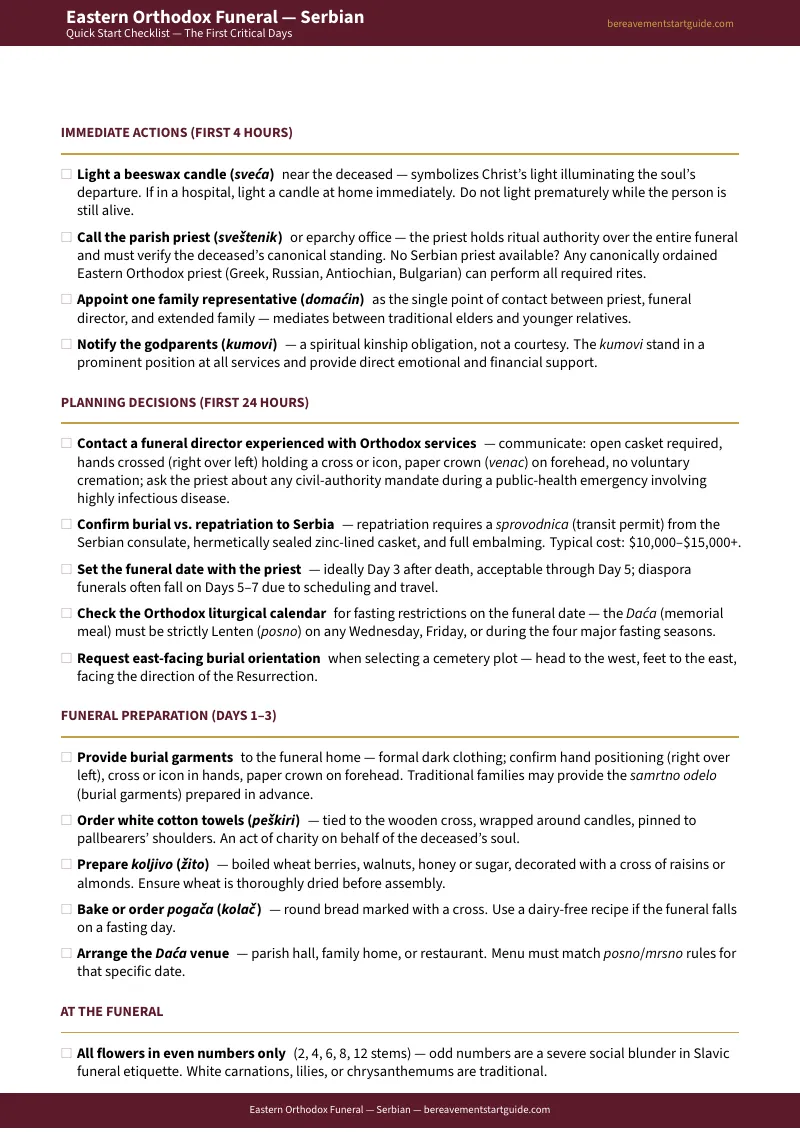
- First 72-hour action plan — a prioritized checklist that tells you exactly what to handle right now, what can wait until tomorrow, and what needs to be arranged before the Opelo. No guessing, no scrambling through forum posts at 2 AM.
- Complete Opelo service walkthrough — every element explained in plain language with phonetic Serbian pronunciations: the Psalm 119 chanting, the paper crown (venac), the Prayer of Absolution, the Last Kiss (Poslednji celiv), and the proper candle etiquette. Follow along confidently even if you don't speak Serbian.
- Koljivo recipe and Daća planning worksheets — the traditional Žito preparation with the funeral cross pattern (not the Slava version), plus a complete fasting calendar tool so you know whether the memorial meal must be posno or mrsna. Includes catering quantity planners for 20, 50, and 100+ guests.
- 40-day mourning roadmap — every memorial milestone from the morning-after graveside visit through the 7th day, 40th day Četrdesetnica, 6-month, and annual Parastos. What the priest needs from you at each one, what food to prepare, and what mourning restrictions apply.
- Funeral director instruction sheet — a printable one-page handout you give directly to the mortuary staff, covering open-casket requirements, icon placement, east-facing burial orientation, the no-cremation policy, and every other detail they wouldn't know to ask about.
- Repatriation logistics guide — the complete process for transporting remains to Serbia, Bosnia, or Montenegro: Sprovodnica permit procedures, zinc-lined casket specifications, consular documentation, embassy contacts, and realistic transit timelines that reconcile the traditional three-day burial window with international shipping realities.
- Church canon vs. folk custom reference — a clear breakdown of what the Serbian Orthodox Church actually requires versus what is a regional village tradition (coins on the eyes, mirror covering, water on the windowsill). Backed by canonical sources so you can navigate family disagreements without guessing who's right.
- Elder Discussion Prompts — structured conversation starters for clarifying your family's specific regional customs with older relatives, so you satisfy the people who matter most without blindly following internet advice from a different part of the Balkans.
- Condolence phrase guide — phonetic pronunciations and Cyrillic/Latin spellings for essential Serbian condolence phrases, liturgical responses, and memorial greetings. Use them at the service, in sympathy cards, or when speaking with the priest.
- Zadušnice and memorial calendar — how to observe the four annual Memorial Saturdays, what food and offerings to bring to the gravesite, and how to maintain the full mourning calendar when you live in the diaspora, thousands of miles from the ancestral plot.
Who This Guide Is For
- Diaspora descendants organizing a Serbian Orthodox funeral for a parent or grandparent — you know the traditions matter, but you've never had to run them yourself, and the elders are watching
- Non-Orthodox spouses and partners who need to coordinate a funeral tradition they've never experienced, with a family and a priest who assume you already know the basics
- Families repatriating remains to Serbia, Bosnia, or Montenegro — you're dealing with consular paperwork, zinc-casket requirements, and transit delays on top of the grief
- Funeral directors and celebrants serving Serbian Orthodox families in multicultural communities who want to provide culturally precise, respectful service
Why Free Tools and Forum Advice Fall Short
You've probably already tried Googling "Serbian Orthodox funeral customs." Here's what you found: a Reddit thread where three people disagree about whether coins on the eyes are a real tradition or a pagan holdover. A funeral home page that describes "Eastern Orthodox" customs without distinguishing between Greek, Russian, and Serbian practices. A parish website in Cyrillic that assumes you already know the liturgical calendar. An academic PDF about Balkan funerary anthropology that's fascinating but useless when you need to plan a Daća for Thursday.
The problem isn't that information doesn't exist — it's that it's scattered across dozens of sources, contradictory between regions, and never organized around the actual sequence of decisions you need to make when someone dies. This guide consolidates the canonical framework, the regional variations, the practical logistics, and the family coordination tools into a single resource structured around your actual timeline.
Satisfaction Guarantee
If the guide doesn't help you navigate your family's Serbian Orthodox funeral with more clarity and confidence, email us and we'll refund your purchase — no questions, no hoops.
Honor Them the Right Way
Your loved one deserves a funeral that respects the tradition they lived by. You deserve a resource that helps you deliver it — without the panic, the guesswork, or the 3 AM Google searches.
Download the free checklist for a one-page overview of the essential steps, or get the complete kit — 10 PDFs including the full guide, printable worksheets, a funeral home instruction sheet, memorial planners, a condolence phrase card, and mourning calendars. Available as instant-download PDFs — start using them within minutes, on any device, and print the pages you need to share with family or your funeral director.
Your purchase:
Frequently Asked Questions
What if the rules change after I buy?
We update the guide when the rules change. Email us any time, even years later, and we'll send you the current edition free.