A funeral home will sell you a "green package." This guide helps you see through it.
Your loved one wanted a natural burial — or you want one for them. You've started researching and discovered that the term "green burial" means different things depending on who is selling it. A bamboo casket shipped from Southeast Asia. A "natural" cemetery section that still requires a concrete vault liner. Embalming fluid marketed as "eco-friendly" that is still formaldehyde-based. A $6,500 package that is barely cheaper than the traditional alternative.
Meanwhile, the actual information you need — your state's transport permit requirements, which nine states require a licensed funeral director, how to keep the body cool during a three-day home vigil without poisoning the room with CO₂, whether your chosen cemetery will accept a cotton shroud instead of a casket, and what the FTC Funeral Rule actually entitles you to decline — is scattered across industry certification documents, raw state health codes, forum threads of varying accuracy, and funeral home blogs designed to sell you services.
The Green / Natural Burial Guide is a crisis-navigation toolkit that replaces fragmented research with one verified, structured document. It walks through every decision in the order you face it: from who holds legal authority over disposition, through body care and container selection, to the graveside service and the cemetery's long-term ecological stewardship.
What's Inside
The Disposition Rights Framework — who holds legal authority over what happens to the body, how the statutory hierarchy works when siblings disagree, and how an advance directive overrides every other claim. Maps the nine states where a funeral director is mandatory and exactly what they must do in each one.
Body Care Protocols — step-by-step cooling instructions for both dry ice and Techni-Ice polymer sheets, with specific safety procedures for CO₂ ventilation, the four-hour window for washing and positioning, and the signs that tell you when professional refrigeration is the safer option.
The GPL Cost Auditor — a worksheet that walks through every line of the funeral home's General Price List to identify fees the FTC Funeral Rule makes optional or prohibits outright. Two worked cost examples compare a full-service natural burial ($4,000–$8,000) against a traditional arrangement (national average over $10,000), so you can evaluate quotes against real benchmarks instead of industry marketing.
Container Comparison — untreated pine, wicker, seagrass, wool shrouds, cotton shrouds, cardboard, family-built coffins. What each actually costs, what cemeteries accept, what structural requirements exist for lowering, and which materials (synthetic glues, metal fasteners, polyester linings) disqualify a container from genuine GBC certification.
The Cemetery Evaluation Checklist — how to distinguish a hybrid cemetery section from a true natural burial ground from a conservation burial ground, with specific questions to verify vault waivers, marker policies, long-term land trust protections, and whether the cemetery's "green" marketing reflects actual ecological standards.
Transport and Permit Maps — state-by-state rules for family-led transport of unembalmed remains, cross-border restrictions, the burial-transit permit process, and cooling protocols during transit.
Religious Compatibility Across Five Faiths — where green burial aligns with Jewish Halakha (no embalming, plain wooden casket, no vault), Islamic Sharia (rapid burial, natural shroud, direct earth), Catholic canon, Eastern Orthodox tradition, and Protestant practice. Includes de-escalation language for conversations with traditional clergy and family members.
Mourning Rites and Guest Etiquette — what to wear to a woodland committal (sturdy boots, not dress shoes), what flowers and mementos conservation cemeteries permit, and how grave preparation, backfill, and ecological restoration actually work at sites that do not use concrete vaults.
Eight Planning Worksheets — a disposition-rights decision tree, container comparison sheet, cemetery evaluation checklist, GPL cost auditor, 72-hour action timeline, body care and cooling log, funeral director interview questions, and condolence etiquette quick reference.
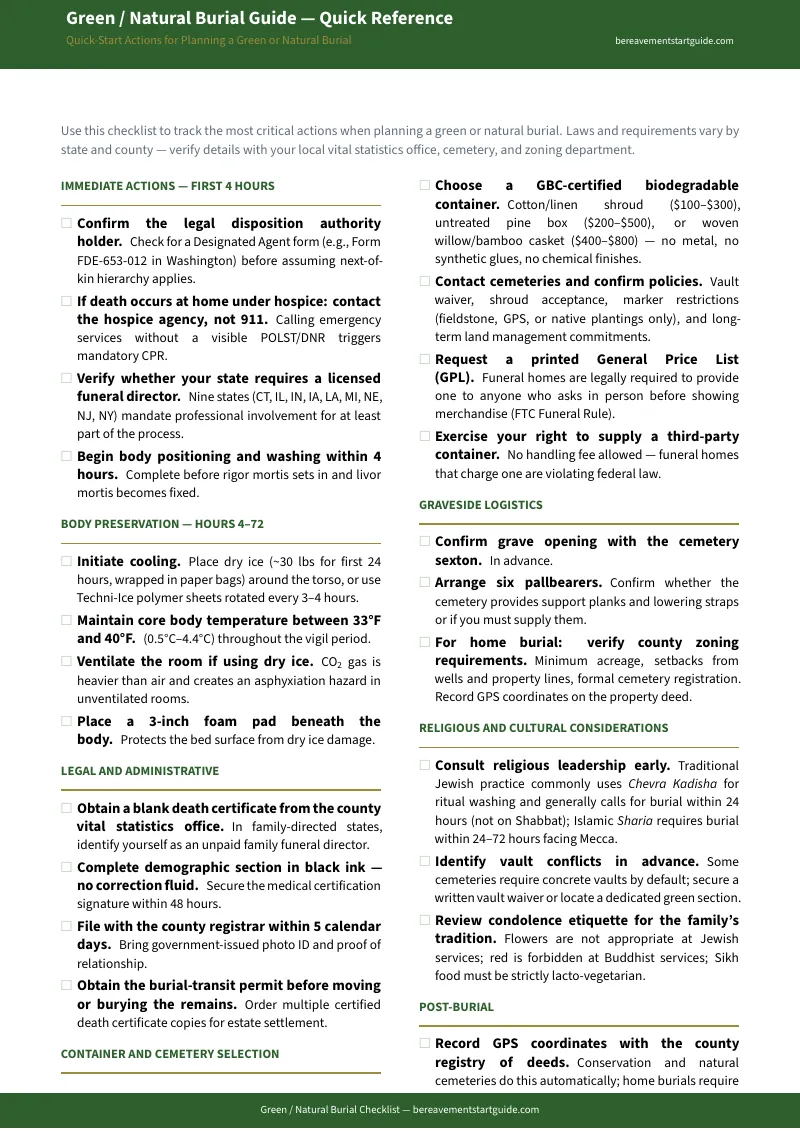
25-Item Companion Checklist — the entire process condensed into a two-page printable reference.
Who It's For
- Families who have chosen a green burial and need the step-by-step operational detail — cooling protocols, permits, container rules, cemetery verification — that no single online resource consolidates
- Appointed agents or adult children navigating a family disagreement over burial method, who need the legal disposition hierarchy and the religious compatibility evidence to resolve it
- Interfaith families where ecological values and traditional religious expectations are in tension
- End-of-life doulas, secular celebrants, and independent funeral planners who need a non-commercial reference for natural arrangements
- Pre-planners documenting their green burial wishes with enough legal and logistical specificity that a surviving relative can execute them
Why Not Free Resources?
The Green Burial Council's documentation is comprehensive — and written for funeral industry professionals pursuing certification, not a grieving coordinator making decisions in real time. State health department sites publish raw statutory codes without plain-language guidance. Reddit threads offer genuine peer experiences alongside outdated legal claims that could get your family's transport permit denied. Published books on the death-positive movement are 300-page philosophical narratives, not crisis-navigation tools.
The funeral home's own website will tell you about their "green package." It will not tell you that you can legally decline embalming in every state, that you can supply your own casket or shroud without surcharge under the FTC Funeral Rule, or that their $1,200 wicker casket has a higher carbon footprint than a $200 locally sourced pine box.
This guide consolidates verified legal citations, practical body care procedures, cost benchmarks with worked examples, and structured planning worksheets into a single document — designed for the cognitive load of actual bereavement, when your ability to research, evaluate, and synthesise is at its lowest.
Full Refund, No Time Limit
If the guide does not deliver the clarity you need, email hello@bereavementstartguide.com for a full refund. No time limit, no conditions.
Download the free checklist to see the structure and scope. When you need the full legal detail, the body care protocols, the cost worksheets, and the religious compatibility frameworks, the complete guide is ready — .