You Have Hours to Make Decisions That Last Forever — and Google Can't Tell You Which Ones Are Right
Your parent just died, or they're in hospice and you know the call is coming. You grew up around Conservative Judaism — the Shabbat dinners, the High Holidays, the cemetery where your grandparents are buried — but you never learned the mechanics. Now you're standing in the gap between tradition and logistics, and every decision is urgent, irreversible, and freighted with the possibility of doing something wrong in front of people who will notice.
The funeral home wants to schedule a viewing. Your sister wants cremation. Your father's non-Jewish wife doesn't know if she can attend the graveside. The rabbi's office doesn't pick up after five. And every search result you find either assumes you already know what tahara means or tells you about Orthodox practice when your family is Conservative — which is a different set of rules with different rabbinical rulings on almost every contested question.
The Conservative Bereavement Roadmap
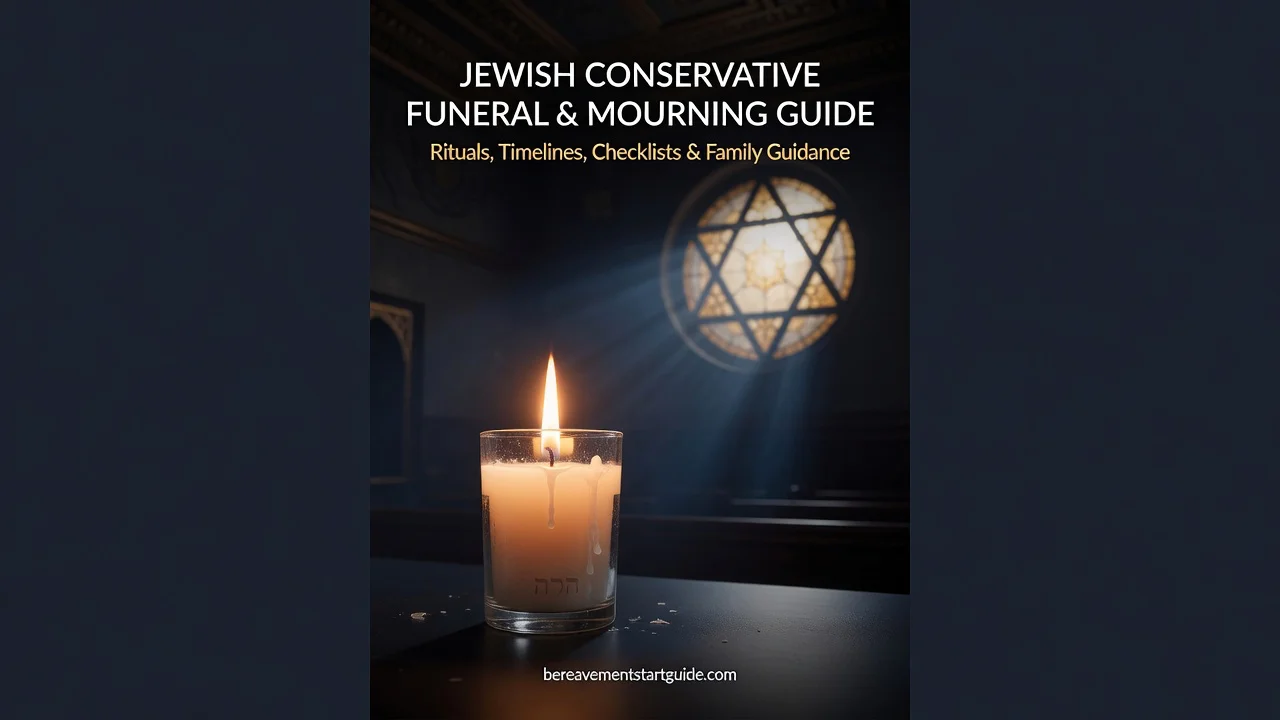
The Jewish Conservative Funeral & Mourning Guide is a 49-page crisis-ready handbook that translates Conservative halakhah into a sequence of decisions organized in the order they actually arise — from the moment of death through yahrzeit observance one year later. It doesn't replace your rabbi. It prepares you to work with your rabbi productively instead of desperately, and it gives you a set of printable tools you can hand to siblings, the funeral director, and the friend who's setting up the shiva house.
We call it a roadmap because that's what it is: the full Conservative framework (including the major CJLS teshuvot that most synagogue handouts skip) laid out as a step-by-step sequence with worksheets, scripts, and checklists built into the path.
What's Inside
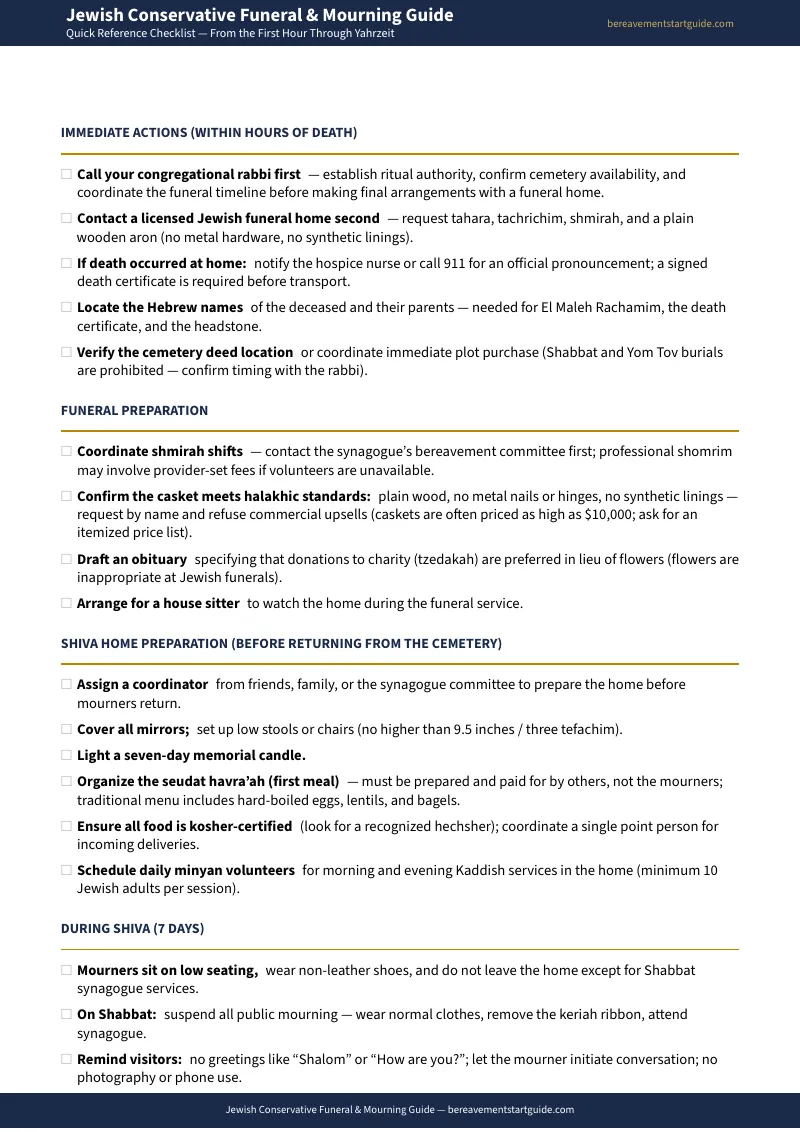
- First-12-Hours Crisis Checklist — the exact call sequence that prevents scheduling conflicts and premature financial commitments. Rabbi first, funeral home second, family third. Each step tells you what to say and what to confirm before hanging up.
- Tahara, Tachrichim, and Shmirah Explained — the body preparation process described clearly enough that you understand what the Hevra Kadisha does, why the garments have no pockets, and how to organize a shomer rotation without hiring a professional at funeral-home markup.
- Casket Selection Script — Conservative halakhah requires an all-wood casket with no metal hardware. The guide includes a list of questions to ask the funeral director and a script for declining the bronze-handled upgrade without confrontation. The FTC Funeral Rule gives you the right to source your own casket — most families don't know this.
- The Cremation Decision Tree — the 1986 CJLS teshuvah instructs rabbis not to officiate at burial of cremated remains, but permits a pre-cremation memorial service. The guide maps out what happens if your family proceeds: which cemeteries accept urns, how to sit shiva after cremation, and how to talk to the rabbi about a decision they disagree with.
- Interfaith Cemetery Navigator — the 2010 CJLS ruling permits burial sections within Jewish cemeteries where Jewish and non-Jewish family members rest with a physical separation of four amot. The guide explains the fence height, the liturgy restrictions, and includes a cemetery comparison worksheet so you can evaluate your options systematically.
- Complete Shiva Home Setup — low seating, covered mirrors, memorial candle, the seudat havra'ah meal, minyan coordination, visitor etiquette, and the hygiene clarification that Conservative practice permits bathing for cleanliness. Includes a printable host instruction card and a visitor etiquette door card.
- Virtual Minyan Guide — the post-pandemic CJLS rulings on digital participation explained clearly: when Zoom counts for Kaddish, when it doesn't, and how to coordinate a minyan when your community is geographically scattered.
- Full Mourning Timeline — aninut through yahrzeit, with each transition point marked so you know exactly when keriah is performed, when shiva ends, when shloshim restrictions lift, and when the headstone unveiling happens.
- Phonetic Transliteration Cards — Mourner's Kaddish and El Malei Rachamim in full phonetic transliteration so family members who don't read Hebrew can participate at the graveside and during shiva services without fumbling through an unfamiliar prayer book.
- Cost Planning Worksheets — a funeral cost comparison tracker that breaks down every line item (funeral director fees, tahara, shmirah, casket, cemetery plot, grave opening, rabbi honorarium, headstone) so you can compare quotes against realistic benchmarks instead of accepting the first number you're given.
Who This Guide Is For
Semi-affiliated adult children who want to honor a parent's Conservative traditions but haven't attended services regularly in years. You need the halakhic framework and the practical logistics, not a judgment call about your observance level.
Interfaith spouses and partners navigating cemetery restrictions, service protocols, and shiva etiquette in a tradition that was never yours. The guide tells you clearly what you can participate in, what you cannot, and why.
Dispersed families coordinating across time zones — the guide covers permissible delays, Shabbat scheduling rules, and remote shiva arrangements so you can make decisions collaboratively instead of reactively.
The friend or neighbor setting up the shiva house who needs to know what food to bring (kosher certification matters), what not to bring (no flowers), and how the daily minyan works.
Why Free Resources Don't Cover This
Synagogue handouts are written for their own congregation and skip the contested questions — cremation, interfaith burial, virtual minyans — that cause the most family conflict. Funeral home brochures are sales documents; they explain the services they sell, not the halakhic rights that help you decline unnecessary ones. My Jewish Learning and Chabad.org are excellent educational resources, but they're written for learning, not for crisis management — you can't hand a 4,000-word article to your brother at midnight and expect him to extract a checklist.
Reddit threads on r/Judaism contain real, empathetic advice, but it takes hours to separate the verified answers from the well-meaning guesses. And every generic funeral planning site misses the Conservative-specific rulings that define what makes this tradition different from both Orthodox and Reform practice.
This guide exists in the gap between all of them: one document, organized for crisis use, with the CJLS teshuvot built into the decision paths instead of left as footnotes.
You're Protected
If the guide doesn't help your family navigate the process with more clarity and less stress, email us and we'll refund you — no questions, no conditions. This is a crisis resource, and we'd rather you have it and not need it than hesitate because you're not sure it's worth it.
Get the Guide
The free checklist gives you the one-page quick reference — the call sequence, the key terms, and the timeline at a glance. It's a solid starting point, and it's yours immediately.
The full Jewish Conservative Funeral & Mourning Guide — — gives you 49 pages of step-by-step guidance, the complete CJLS framework, printable worksheets, transliteration cards, and negotiation scripts that cover every stage from the first phone call through yahrzeit. Get the Toolkit
Frequently Asked Questions
What if the rules change after I buy?
We update the guide when the rules change. Email us any time, even years later, and we'll send you the current edition free.