You Have 72 Hours, Hundreds of People Are Coming, and You Don't Know the Rules of the Marae
Someone you love has died. Within hours, the whānau will begin arriving — some from across the country, some from Australia. The marae is expecting you. The kaumātua need answers you don't have. And the three days of bereavement leave your employer offers barely covers the drive there, let alone a tangihanga that runs for three to five days of continuous communal obligation.
You want to do this right. You want to honour the tikanga. But you grew up in the city. You don't speak fluent te reo. You don't know whether this marae uses tau utuutu or pāeke speaking order, where exactly the tūpāpaku should be positioned, or what happens if someone walks across the courtyard during a whaikōrero. And right now, at the worst possible moment, you are expected to lead.
The Tangihanga Cultural Navigation System
The Māori Tangihanga Guide is a complete planning framework that prepares you for every conversation, decision, and protocol from the first hours after death through the hura kōhatu a year later. It does not replace the kaumātua — it prepares you to walk onto the marae with the right questions, the right paperwork, and a clear financial plan so you can focus on what actually matters: grieving together as whānau.
The guide draws a careful line between tikanga (the universal Māori values you carry with you) and kawa (the strict, location-specific rules of each marae). It gives you a Kaumātua and Marae Committee Interview Script — the exact te reo Māori questions to ask the local hosts — so you honour their authority instead of accidentally imposing rules from a different tribal region.
What's Inside
- First Hours Legal Sequence — which forms to file, how to register the death, and how to complete the BDM39 form that lets your family transport the tūpāpaku without paying a funeral director. Most families don't know this form exists.
- Kaumātua and Marae Committee Interview Script — printable questions in te reo Māori covering speaking order, tūpāpaku positioning, seating arrangements, overnight protocols, and kitchen requirements. You walk onto the marae prepared to ask, not prepared to assume.
- Body Preparation Without Embalming — embalming is not legally required in New Zealand, and natural cooling techniques can save your family $700–$1,000 while aligning with tikanga values about the body's return to the earth.
- Tangihanga Financial Planner — two worked examples showing a carefully managed tangihanga at under $3,000 (potentially covered by the WINZ Funeral Grant) versus $16,000+ when relying entirely on commercial funeral homes. The planner tracks every line item so there are no surprises on top of grief.
- Trans-Tasman Repatriation Roadmap — mandatory embalming, zinc-lined casket specifications, MPI biosecurity clearances, and airline restrictions for bringing a loved one home from Australia. Includes the cremation-and-return alternative and the cultural reality that some marae prohibit cremated remains.
- Attendee Briefing Sheet — a printable one-pager for non-Māori partners, colleagues, and friends covering dress code, shoes, seating, koha presentation, photography rules, and how to approach the casket. Hand it to anyone attending for the first time.
- Tapu and Noa Management Guide — the spiritual boundary system that determines where food can go, who must wash before leaving the wharenui, and how the hākari feast restores the entire assembly to noa. Explained in practical terms, not academic abstraction.
- Post-Burial Obligations Tracker — takahi whare (house cleansing), kawe mate (carrying the memory), and hura kōhatu (headstone unveiling) on a single timeline with financial estimates and preparation checklists for each stage.
Who It's For
- Families who grew up away from the ancestral marae — you feel the obligation deeply but don't have the local knowledge. The Interview Script bridges that gap before you arrive.
- Non-Māori spouses and executors — you are legally responsible for the body and the estate, but culturally you are navigating protocols you never learned. The guide gives you the framework to lead without overstepping.
- Diaspora families in Australia — repatriation is expensive, bureaucratic, and emotionally devastating. The Repatriation Roadmap gives you the exact sequence of steps, the actual costs, and the alternatives.
- First-time tangihanga attendees — you've been invited and you want to show up with aroha, not anxiety. The Attendee Briefing Sheet tells you everything you need in one page.
- Professional funeral directors and celebrants — serving multicultural whānau means understanding protocols that vary by iwi. The guide is a structured reference for culturally safe practice.
Why Free Resources Leave You Guessing
Government websites (Te Hokinga ā Wairua, Citizens Advice Bureau) cover the legal steps — registering a death, cancelling a passport — but provide zero cultural guidance on marae etiquette, whaikōrero, or karanga. They are Pākehā-centric checklists for a deeply Māori process.
Community initiatives like How To Tangi are beautiful starting points, but they deliberately stop short of detailed instructions to avoid overstepping local kawa. Academic texts provide exhaustive analysis but are useless for crisis management — you cannot read a 300-page ethnography while arranging transport for the tūpāpaku.
Online forums (Reddit, Facebook) give raw, honest peer advice — "don't step over bedding," "bring cash for koha" — but it is unverified, contradictory, and local to one marae's practice.
The Māori Tangihanga Guide consolidates all of this into a single, structured framework: the cultural depth of academic sources, the practical directness of peer advice, the legal accuracy of government resources, and the respectful boundaries of community initiatives — organised into the sequence you actually need it in.
Our Guarantee
If the guide does not give you the confidence and clarity you need, email hello@bereavementstartguide.com for a full refund, no time limit. We would rather refund you than have you feel unsupported at a time like this.
Get Started Now
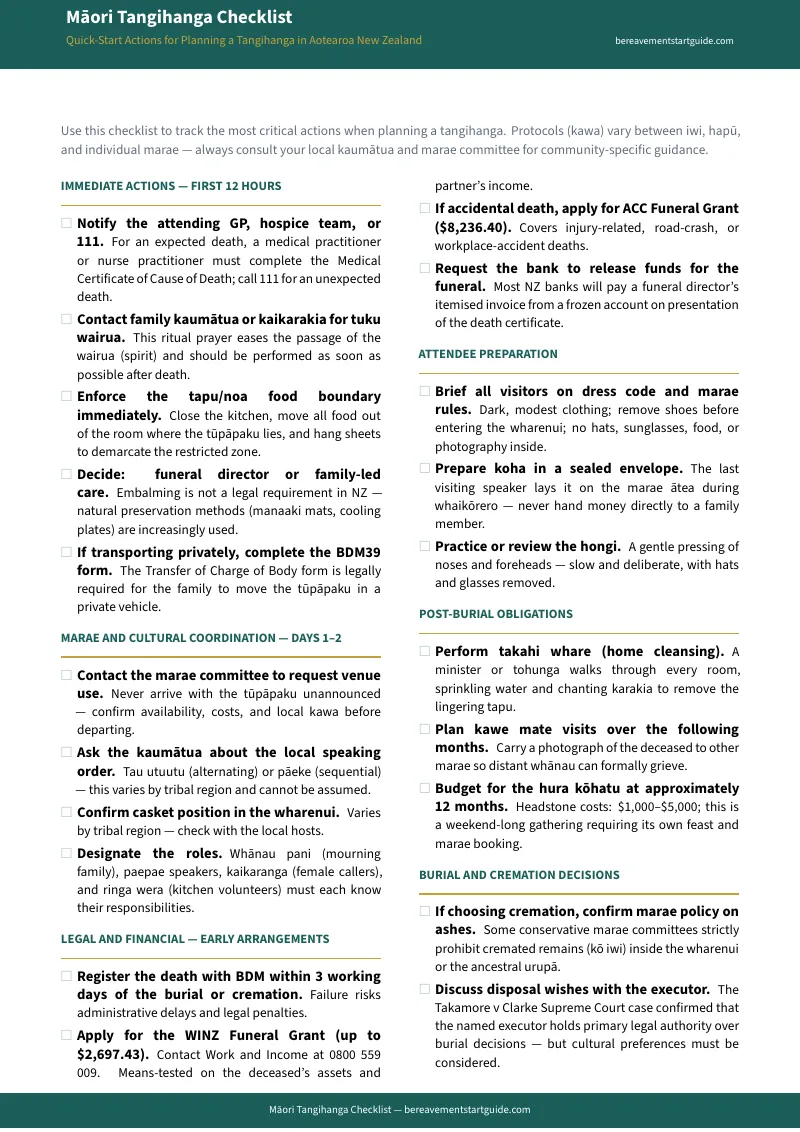
Download the free checklist to see the sequence at a glance. When you're ready for the full framework — the cultural reasoning, the legal forms, the financial planner, the printable planning tools, and the tribal variations — the complete Māori Tangihanga Guide is and available immediately.