The Honours Coordination System — Because Scattered Advice Isn't a Plan
Your veteran served in the British Armed Forces. Now you're trying to plan a funeral that does justice to that service — and the information you need is spread across MoD manuals written for military staff, RBL ceremonial handbooks designed for active volunteers, funeral director marketing pages, and Reddit threads where every response contradicts the last.
You have five days to register the death in England and Wales. Eight in Scotland. Somewhere in that window, you need to figure out which end of the coffin drape the canton goes on, whether the bearer party steps off with the left foot or the inside foot, whether a bugler costs £75 or £367 or nothing at all — and whether the three-month deadline for the war pension funeral grant has already started ticking.
The Honours Coordination System brings every protocol, every deadline, and every coordination step into one document. Not a collection of tips from someone who attended a military funeral once — a structured planning system built from JCCC directives, RBL ceremonial handbooks, Veterans UK benefit guidance, and the actual experience reports that surface when families discover what went wrong after the service was over.
What Most Families Get Wrong — and What It Costs
The mistakes don't happen because families don't care. They happen because nobody told them the rules before the deadline arrived.
- The drape goes on wrong, and nobody catches it until the coffin is in the hearse. The Union Flag coffin drape must be positioned with the canton — the upper corner containing the crosses of St George, St Andrew, and St Patrick — directly over the left shoulder of the deceased. Many funeral directors have never handled a military drape and will position it incorrectly. Once the hearse is loaded, correcting it means delaying the procession.
- The family hires a bugler at £367 when a free recording would have been identical. Veterans with full pensionable service or an operational service medal may qualify for a Royal Marine bugler at public expense. When that's unavailable, private veteran buglers charge around £75 plus travel. But crematorium media systems play high-quality recorded versions of The Last Post through Wesley or Obitus at no cost — and most attendees cannot tell the difference. Families who don't know this pay hundreds of pounds for something the crematorium provides for free.
- The WPA 0010 deadline passes, and the grant disappears. For war pensioners, Veterans UK covers funeral costs — but only if form WPA 0010 is submitted within three months of the service. Families who spend those three months grieving, then discover the form, find the window already closed. There is no extension.
- Standard bearers arrive without coordination, and the ceremony stalls. Standard bearers from the RBL or RNA are volunteers. They follow specific protocols — positioning six paces from the crematorium entrance, using a black mourning drape tied below the spearhead, dipping the standard as the curtains close. When no one tells the funeral director these requirements in advance, the timing falls apart. The standard bearer stands in the wrong place. The dip happens at the wrong moment. The family remembers a ceremony that felt disjointed.
What's Inside the Guide
- Two complete planning pathways — the state-managed JCCC route for serving personnel (Visiting Officer, Purple Pack, ADT grant up to £15,000) and the family-led route for veterans (registration, Veterans UK, regimental association outreach). Each pathway walks through every step in order, with the decisions that branch the process clearly marked.
- The full ceremony protocol — coffin drape positioning with canton placement, bearer party formation (six bearers plus one in-charge, tallest pair at the head, descending height), inside-foot step-off for the slow march, medal display on a dark cushion at the head of the coffin, and the removal sequence before burial or cremation. Written so a civilian family member can verify every detail with the funeral director before the service — not after.
- Bugler and music sourcing with cost comparison — the Single Service Tasking Authority route for publicly funded buglers, private veteran networks, and crematorium media systems. Each option includes what it costs, how to book it, and when to choose it.
- Standard bearer coordination guide — how to request an RBL or RNA standard bearer, the mourning drape specification (153cm × 15cm, tied in a bow below the spearhead), the six-pace crematorium positioning rule, and the exact dipping sequence during Last Post and as the curtains close.
- Medal, dress, and attendee etiquette — veterans wear their own medals on the left breast of a lounge suit; civilian relatives may wear a deceased relative's medals on the right breast, but only in civilian dress and never in a military uniform. White cotton gloves for escorts, no carrying slings. Every rule sourced to the RBL ceremonial handbook.
- Financial claims with deadline warnings — the £1,000 Next of Kin grant for serving personnel deaths, private funeral reimbursement up to £4,314, war pensioner assistance via WPA 0010 (three-month deadline), Bereavement Support Payment via BSP1 (three-month deadline for full entitlement), Continuity of Education Allowance, Armed Forces Bereavement Scholarship Scheme, and Inheritance Tax exemption for conflict-related deaths.
- Service record recovery procedures — era-by-era guidance for The National Archives, MOD requests through GOV.UK, and direct regimental contact when official channels take months. Includes the Veterans UK alternative and advice on medal replacement applications.
- Natural burial, burial at sea, and secular ceremony coordination — how green burial restrictions (no embalming, biodegradable coffins only, synthetic drape removal) interact with military display protocols, and how humanist or interfaith celebrants coordinate with military representatives.
- Communication scripts — pre-written questions and phone scripts for Veterans UK, regimental associations, RBL branches, funeral directors, and crematorium staff. Built around the specific coordination failures families report most often.
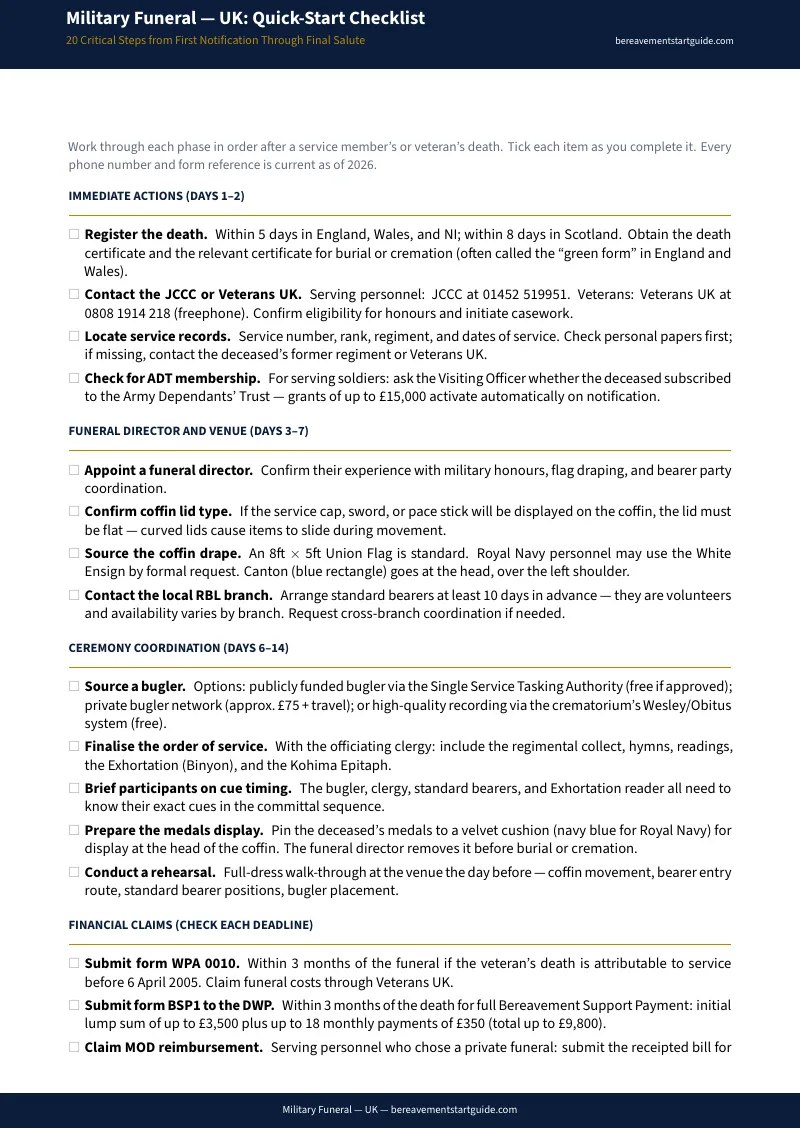
- 20-item printable checklist — every task, contact, form, and deadline on a single document your family can divide among multiple people.
Who This Is For
This guide is built for the people who are actually coordinating the funeral — not military insiders who already know the protocols.
- Adult children honouring a parent's service for the first time — discovering medals in a drawer, locating a regiment that disbanded decades ago, and trying to understand what military honours actually look like in practice
- Surviving spouses and partners managing the dual burden of planning the funeral while navigating pension claims, housing transitions, and the financial paperwork that has its own separate deadlines
- Siblings, friends, and extended family stepping in because the closest relative is too overwhelmed to coordinate logistics, make phone calls, and chase volunteer availability
- Executors and solicitors verifying benefit eligibility, managing estate costs, and ensuring grant deadlines are met before the three-month windows close
- Funeral directors and celebrants looking for a reliable, branch-specific ceremonial reference that goes deeper than the RBL's internal handbooks — written for someone coordinating their first military funeral, not their fiftieth
Why Free Resources Fall Short
The MoD's guidance tells families of serving personnel what the state provides. It offers almost nothing for families of veterans who die of natural causes decades after discharge — which is the vast majority of military funerals in the UK.
The RBL's ceremonial handbook is thorough but written for branch members organising their own Standard Bearer attendance — not for a grieving daughter trying to understand why the funeral director is asking about drape dimensions. Funeral directors' websites offer marketing overviews designed to generate bookings, not step-by-step planning systems.
Forum advice is personal and often wrong. One family's experience with their local RBL branch doesn't transfer to your region, your branch of service, or your crematorium's scheduling constraints. The protocols are technically free — but the coordination that prevents a ceremony from falling apart at the graveside is not something a Google search can assemble in five days.
This guide does not replace your funeral director, your celebrant, or Veterans UK. It gives you the specific questions to ask each of them so you can verify what they're telling you — and catch the gaps before they become visible at the service.
The Guarantee
Full refund, no time limit. If the guide doesn't help you plan a service that honours your veteran's legacy, email hello@bereavementstartguide.com and you'll get every penny back. No forms, no waiting period.
Their service spoke for itself. The ceremony should too.
The free checklist gives you the 20 critical tasks with deadlines, contacts, and form references — enough to keep the first week from unravelling. The full toolkit adds the 52-page guide, planning worksheets, communication scripts, ceremony protocols, and the financial tracking that turns a checklist into a complete coordination system.
Get the toolkit and plan with confidence — for .