The funeral your family expects is a multi-day operation — and nobody handed you the manual
A Romani funeral is not a service you schedule and attend. It is a three-day vigil with hundreds of mourners, a body preparation governed by purity codes most funeral directors have never heard of, a denominational negotiation between traditional and Pentecostal relatives, and — for diaspora families — a repatriation decision that can define your family's standing for a generation.
The elders know how it all works. But the elder is often the person who just died. Or the elder is three countries away. Or the elder expects you to already know — and the stakes of asking the wrong question, or asking too late, are real: a single misstep with marimé purity rules, an improperly handled body, or a poorly timed notification can create rifts that outlast the mourning period by decades.
The Romani Funeral Planning System — every ritual, every timeline, every script, in one place
The Roma/Romani Funeral Traditions Guide is the integrated planning system that replaces panic-Googling, conflicting WhatsApp advice, and dense academic texts with a clear, actionable framework. It separates the structural principles shared across the entire diaspora from the variations that differ by subgroup — Vlax, Sinti, Romanichal, Gitano — so you always know what is universal and what you need to confirm with your own family.
This is not a cultural study or a tourist's overview. It is a logistics toolkit built for the person who has to coordinate the sitting-up, instruct the funeral home, manage the crowd, mediate the family, and plan the pomana feasts — all while grieving.
What's inside the full guide
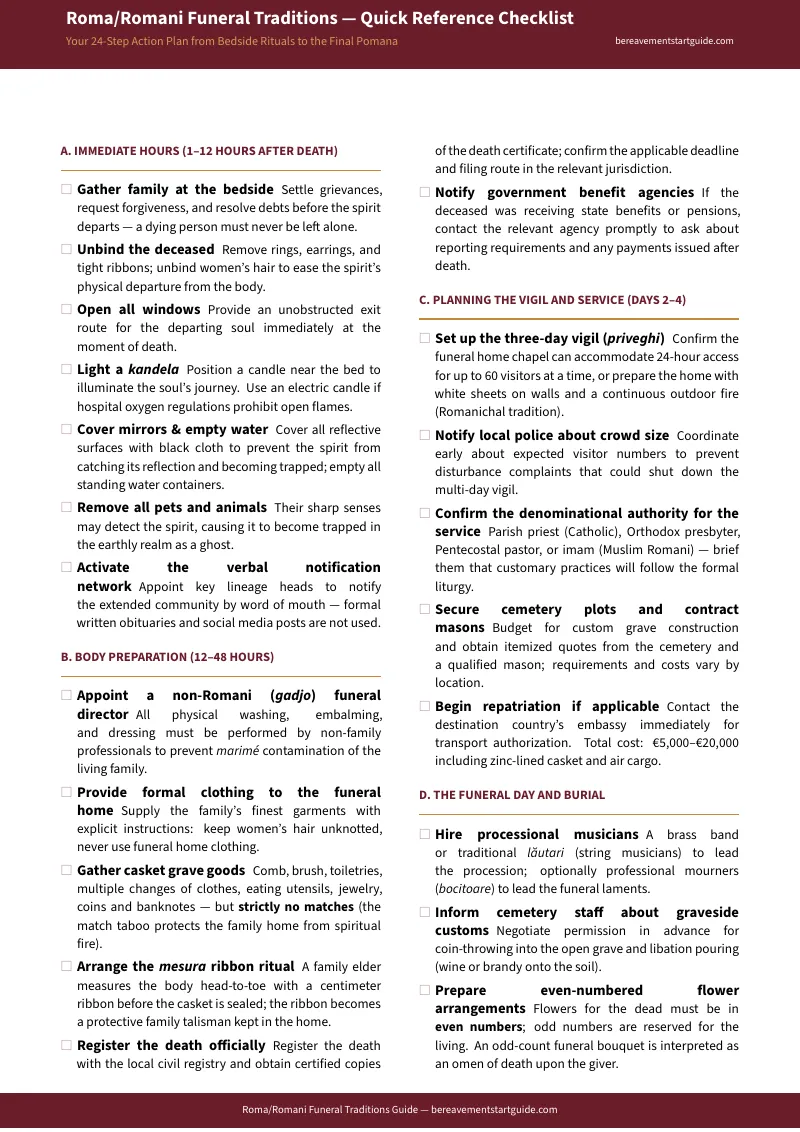
- Master post-mortem timeline — an hour-by-hour framework from bedside rituals through the one-year memorial, so you never wonder what comes next or what you missed
- The complete marimé purity reference — how the wuzho/marimé boundary system works, upper-body versus lower-body washing protocols, why direct family contact with the corpse is avoided, and exactly how to instruct a non-Romani funeral director to handle preparation safely
- Sitting-up logistics checklist — step-by-step preparation for the three-day vigil: white sheets and wildflowers, the ceremonial fire, gender-divided hosting, dietary restrictions, and crowd management with local authorities
- Denominational navigation tables — clear comparisons of traditional, Catholic, Eastern Orthodox, and Pentecostal approaches to casket offerings, mourning expressions, prayer structures, and the muló — plus a mediation framework for families where relatives disagree
- Funeral director negotiation scripts — exact language for securing multi-day open-casket vigils, requesting combustible casket materials, ensuring a non-family professional handles body preparation, and coordinating parking and crowd flow for gatherings exceeding a hundred mourners
- Pomana feast planner — scheduling template for the memorial feasts at 3 days, 9 days, 6 weeks, 6 months, and 1 year, with traditional food lists (coliva, kolach), charity-giving protocols, and an offering ledger
- Repatriation logistics section — international mortuary transport requirements, cost structures, timeline pressures, and how to navigate the social weight of the burial-location decision
- Cemetery obligation tracker — twelve-month visit schedule with grave maintenance tasks, seasonal care notes, and contacts for headstone, curbing, and concrete-chamber upkeep
Who this is built for
- Adult children who grew up in the community but have never managed the full funeral process without an elder directing every step
- Interfaith and inter-ethnic spouses navigating unfamiliar rituals, intense family expectations, and the fear of committing an offensive blunder during the wake
- Diaspora families coordinating funerals across borders — especially when the repatriation question threatens to split the family
- Funeral directors, hospital chaplains, and hospice staff serving Romani families for the first time and needing to understand the cultural protocols they will be asked to accommodate
Why free online information falls short
The free resources that exist serve one audience and ignore the others. Advocacy brochures like the ones from Friends, Families & Travellers are written for healthcare workers, not for grieving families who need to plan. Academic monographs on marimé run to 300 pages of dense scholarly prose — useless when you need to instruct a funeral director in the next hour. Forum posts and social media threads are riddled with inaccuracies, pop-culture stereotypes, and advice that conflates Vlax Roma with Romanichal with Irish Travellers as though they share identical customs.
None of them give you a printable timeline. None of them give you scripts. None of them distinguish between what is structurally shared across all subgroups and what varies by lineage. And none of them address the denominational fault line between traditional and Pentecostal family members that can turn a funeral into a theological battlefield.
The Roma/Romani Funeral Traditions Guide does all of this in a single, organized, printable document — built for a person under pressure, not a researcher with months to read.
A resource that supports your family — it does not replace your elders
This guide is not a substitute for the knowledge held by your family elders, your religious leaders, or the Kris. It is a logistics companion that helps you organize the practical side of the funeral so that your conversations with elders are productive instead of panicked, your negotiations with funeral homes are informed instead of improvised, and your family's traditions are honored with precision instead of approximation.
Full refund, no time limit. If the guide does not serve your family's needs, email hello@bereavementstartguide.com for a complete refund — no questions, no deadline.
The free checklist gives you the 25 action items. The full guide gives you the reasoning, the scripts, and the planning tools to execute every one of them with confidence.