Your family is counting on you to get this right — and you have days, not weeks
Someone you love has died, or will die soon. The family has turned to you to coordinate the Antam Sanskar. You are now responsible for managing a funeral process that spans spiritual rites, Western bureaucracy, and the expectations of elders, Gurdwara staff, and relatives scattered across continents — all within a timeline that traditional Sikh custom compresses to as little as 48 hours.
You cannot afford to guess which customs are required by the Sikh Rehat Maryada and which are Hindu-influenced practices that your orthodox relatives will challenge. You cannot afford to let a well-meaning funeral home embalmer remove the Five Kakaars. You cannot afford to scramble through contradictory Reddit threads and outdated funeral home brochures at 2am while the coroner's office opens in six hours.
The Antam Sanskar Coordination System
This is not another generic overview of Sikh funeral customs. The Sikh Funeral Guide — Universal (Antam Sanskar) is a coordination system built for the person who has to make every decision, in order, under pressure. It walks you from the moment of passing through Ishnaan, the Five Kakaars protocol, the ceremony sequence at home, Gurdwara, and crematorium, the Bhog and Langar, and all the way through ash scattering — with printable worksheets, bilingual scripts, and a worked cost example so you can plan with real numbers.
What's Inside the Full Guide
- Theology you can actually use — the Hukam framework and the Rehat Maryada's explicit prohibitions, explained in plain language so you can resolve family disagreements with authority rather than opinions
- The complete Ishnaan and Five Kakaars protocol — the yogurt bath, the "one leg in" Kachhehra change, and every article of faith handled correctly, with specific instructions you can hand to a non-Sikh funeral director
- A diaspora timeline with real scheduling — how to coordinate the coroner, registrar, Gurdwara booking, and crematorium slot when Western systems make the traditional 48-hour window impossible
- The full ceremony sequence across four locations — home viewing, Gurdwara anteroom (not the Darbar Sahib — the guide explains exactly why), crematorium, and post-funeral return, with transition logistics for each handoff
- Akhand Paath vs Sehaj Paath decision framework — when each option makes sense, scheduling implications, and how to coordinate with the Granthi
- Rasam Pagri and mourning boundaries — what the turban ceremony involves, which mourning customs are permitted and which the Maryada explicitly rejects, and how to handle the Bhog ceremony
- Langar and Karah Prasad coordination — volunteer scheduling, dietary requirements, kitchen logistics, and the spiritual significance behind the communal meal
- Attendee etiquette guide — dress code, head covering protocol, photography rules, and behaviour expectations for non-Sikh guests, formatted as a shareable standalone page
- Ash scattering legal guide for UK, US, Canada, and Australia — Environment Agency rules, EPA three-nautical-mile requirements, designated scattering sites near major Gurdwaras, and a worked example of transporting ashes internationally to Kiratpur Sahib
- Printable worksheets — funeral director communication worksheet, ceremony sequence planner, budget tracker, family task assignment tracker, ash dispersion planner, attendee etiquette guide, agency communication log, and anniversary planning worksheet
- A worked cost example — a realistic £3,800 UK funeral breakdown showing where the money goes, so you can budget without guessing
Who This Guide Is For
- Diaspora families — second and third generation children coordinating a parent's funeral with limited Punjabi fluency and no firsthand experience of orthodox rituals
- Interfaith spouses and non-Sikh executors — partners or family members responsible for arrangements who are anxious about crossing sacred boundaries they don't fully understand
- Funeral directors and celebrants — professionals handling a Sikh service for the first time who need precise physical handling instructions and ceremony logistics
- Geographically separated relatives — families coordinating across countries who need international repatriation protocols and virtual memorial guidance
Why Free Resources Fall Short
Gurdwara websites offer spiritual reassurance but rarely provide step-by-step logistics for non-Punjabi speakers. Funeral directors give you transactional brochures, not instructions for managing family conflicts over non-Sikh customs. The Sikh Rehat Maryada is the authoritative text, but it was written in formal, legalistic language with no guidance on how to comply with Western coroner inquiries or EPA scattering regulations. Reddit threads are unmoderated, contradictory, and regularly conflate Sikh and Hindu traditions.
This guide consolidates everything into a single printable document, anchored to the official Maryada, with clear distinctions between what is required, what is prohibited, and what falls into the cultural-preference zone.
You'll also get the free Quick Reference Checklist
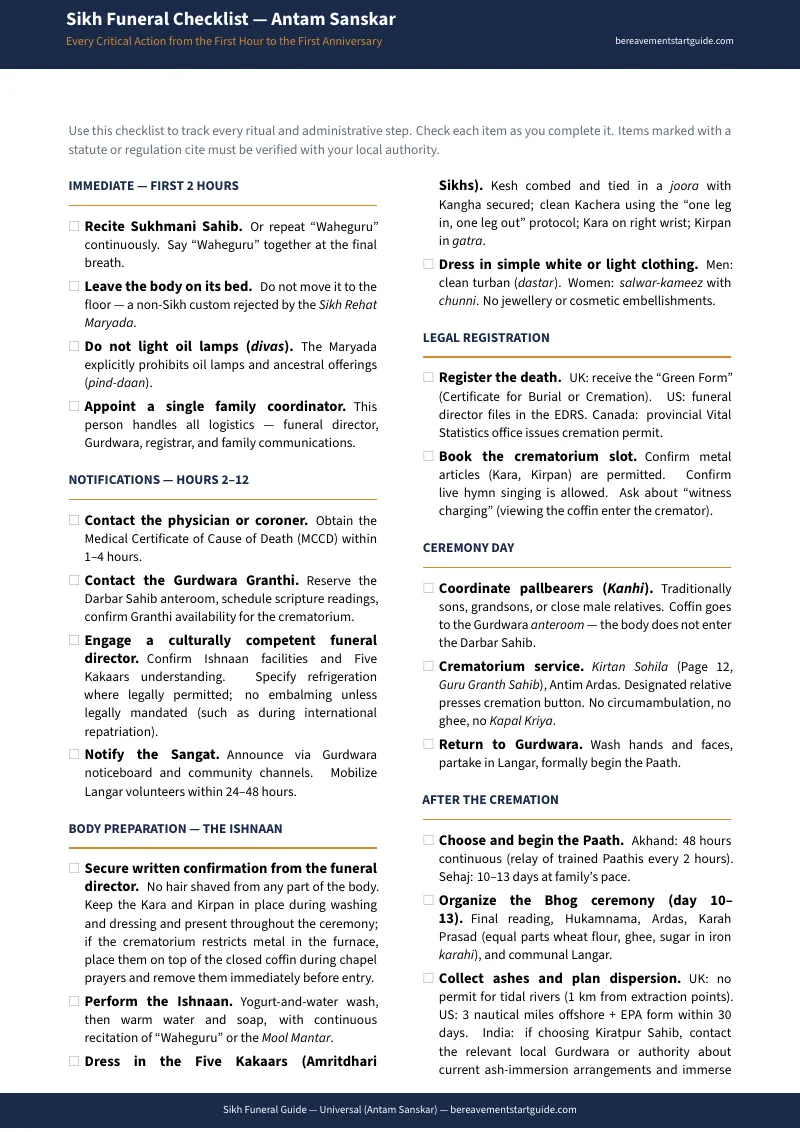
Every purchase includes the 2-page Quick Reference Checklist — a printable sequence of every task from the moment of passing through the Bhog ceremony. It is also available as a standalone free download if you want to start there.
Your family's Antam Sanskar deserves to be handled with both spiritual integrity and practical competence. The guide gives you both — no guesswork, no contradictory advice, no scrambling at 2am.