Your family is counting on you to get this right — and nobody taught you how
A Vietnamese parent dies, and within hours the family machine activates. The monk needs the birth and death coordinates to calculate the auspicious hour. The funeral home wants a decision on embalming by tomorrow morning. Your aunt is insisting on a three-day home wake with incense and a marching band. Your HOA says absolutely not. Your cousin says grandchildren wear yellow-threaded headbands, your uncle says red. And you — the one everyone is looking at — are quietly searching your phone for answers in a language you half-speak, terrified that one wrong move will brand you as unfilial in front of every elder who ever held you as a baby.
Free funeral checklists online were built for Western services. They cover caskets and flower arrangements. They say nothing about the lễ ngậm hàm — placing rice, coins, and a chopstick in the mouth to prevent spiritual hunger — or how to ask a Western mortician to allow it. They do not explain the five ranks of mourning attire, the daily altar offerings that must continue for 100 days, or how to blend Buddhist chanting with a Catholic Funeral Mass when half your family follows each tradition.
The Ritual Navigator System
The Vietnamese Traditional Funeral Guide is not a generic funeral planning checklist stretched to cover Vietnamese customs. It is a structured ritual navigation system built specifically for families who need to execute a multi-day Vietnamese funeral — correctly, respectfully, and without the paralysis that comes from conflicting advice.
Every section is organized around a decision you will actually face: What time does the coffining need to happen? Which headband does my brother-in-law wear? Can we burn paper offerings in a suburban backyard? What do I tell the funeral director who has never handled a Vietnamese service? The guide gives you the culturally grounded answer, the practical workaround for Western environments, and — where customs vary between Northern and Southern families — the exact question to ask your eldest relative so you follow your family's tradition, not a generic template.
What's inside
- Multi-day funeral timeline — hour-by-hour from the moment of death through the Day 3 grave-opening, mapped against Western mortuary schedules so you can coordinate auspicious timing with facilities that close at 5 PM
- First-Hours Emergency Checklist — the four priority notifications, the tang chủ succession, and the immediate legal steps, as a one-page printable
- Body preparation rites + bilingual scripts — the spiritual purpose of every khâm liệm step in the guide, plus verbatim English/Vietnamese negotiation language in the Funeral Director Interview Questions printable for hospital and mortuary staff who may resist placing objects with the body
- Mourning Attire Assignment Chart — a fillable genealogical chart for assigning Ngũ Phục degree, headband color, and thread to every family member, with diaspora substitutions when traditional hemp is unavailable
- Spirit Altar Setup Diagram — labeled placement for the portrait, incense urn, candles, chrysanthemums, Cơm Bông, and coffin-lid candles, with a tick-off list so you can confirm each item is in place
- Regional variation decoder — Northern solemn-dirge customs versus Southern celebratory-wake customs, Central Vietnamese practices, and a structured set of questions to ask your elders so you identify which lineage branch your family follows before making any decisions
- Buddhist–Catholic blending guide — what Catholic households retain from traditional practice (ancestral altar, incense, 49-day memorials) and what they exclude (vàng mã paper burning, certain Taoist elements), with talking points for navigating this boundary with elders
- Memorial Date Calculator — write the death date, then fill the schedule for Day 3, weekly memorials through Day 49, Day 100, Year 1, and Year 2, plus hosting notes for each feast
- Funeral procession logistics — permit questions, noise ordinance navigation, and vehicle lineup coordination for suburban neighborhoods that were never built for a traditional đưa tang
- Funeral Budget Tracker — a line-by-line printable separating spiritually required items from high-markup funeral-home extras
- Elder mediation scripts — bilingual talking points (in Funeral Director Interview Questions) for negotiating between traditional elders who want strict Thọ Mai Gia Lễ adherence and modern realities like HOA rules, fire codes, and mortuary business hours — without triggering accusations of being bất hiếu (unfilial)
Who this is for
- Adult children of Vietnamese immigrants who speak more English than Vietnamese and have never planned a traditional funeral before
- Intercultural spouses supporting a grieving partner through rituals they do not yet understand, where a single misstep can offend an entire extended family
- Designated family executors managing the logistics, finances, and conflicting opinions of a large Vietnamese family under extreme time pressure
- Funeral directors and celebrants serving Vietnamese families in multicultural communities who need an operational reference for multi-day, high-sensory services
Why free information falls short
The internet has fragments of advice scattered across Reddit threads, travel blogs, and single-page funeral home overviews. Here is what those sources consistently get wrong or leave out entirely:
- Regional contradictions go unexplained. One source says the wake is a solemn, dirge-filled vigil. Another says it is a bustling, celebratory gathering with card games and loud music. Both are correct — for different regions. Without the regional framework, you do not know which applies to your family.
- Body preparation rites are missing. Generic funeral sites do not cover the lễ ngậm hàm, the abdominal knife, or the coriander-leaf washing — and they certainly do not explain how to negotiate these practices with a Western mortician.
- The headband hierarchy is oversimplified. "White headbands for the family" skips the entire Ngũ Phục system — the five ranks of mourning attire that signal every person's exact relationship to the deceased. Getting this wrong in front of visiting elders is a public humiliation the family will remember for years.
- Post-funeral obligations are ignored. Most free resources stop at the burial. They say nothing about the 49-day soul transition, the 100-day end-of-tears ceremony, the daily altar offerings, or the multi-year formal mourning period.
- Financial protection is absent. Funeral homes serving Vietnamese communities know that families will overspend out of grief and fear of judgment. No free guide distinguishes spiritually mandatory items from optional high-margin extras.
Full refund, no time limit
If the guide does not give you what you need, email [email protected] for a full refund. No time limit, no questions.
Start with clarity, not chaos
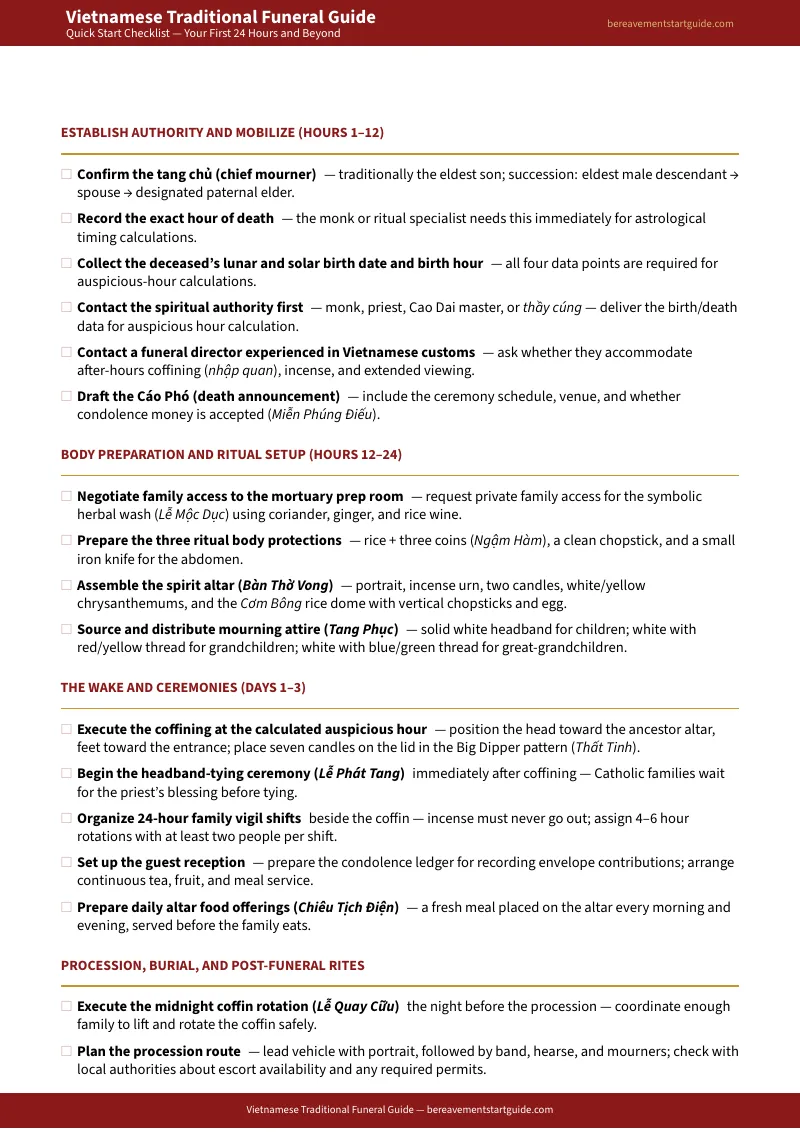
Download the free checklist for a task-level overview of the funeral timeline. When you need the full ritual logic, the regional decoder, the Mourning Attire Assignment Chart, the Spirit Altar Setup Diagram, the bilingual mediation scripts, and the Funeral Budget Tracker — the complete kit is ready for you at .