You Have Twenty-Four Hours. The Rituals Require Precision. Nobody Taught You How.
When a Zoroastrian dies, the clock starts immediately. The body has been claimed by Druj-e-Nasu — the demon of putrefaction — and every ritual that follows exists to contain that contamination while the soul crosses the Chinvad Bridge. The Sachkar body wash requires specific garments, specific prayers, and traditionally, consecrated bull urine. The Sagdid needs a particular kind of dog. The Geh Sarna ceremony demands two priests chanting in a single unbroken breath while maintaining physical contact through a shared handkerchief.
And underneath it all sits a question that has fractured families for decades: does the body go to a Dakhma, a concrete-lined Aramgarh, or an electric crematorium?
If you are reading this, you are probably the family member everyone is looking at to make these decisions. The elders know the theology but not the modern logistics. The funeral director knows Western procedures but has never heard of a Kash circle. Your interfaith spouse has just been told they cannot enter the prayer room. And you have less than a day to get all of it right.
The Bicultural Funeral Navigator — Ancient Rites, Modern Logistics, One Unified Timeline
The Zoroastrian (Parsi) Funeral Guide is not a theological treatise and it is not a replacement for your family's mobed. It is an operational roadmap that translates twenty-five centuries of ritual law into the decisions you actually have to make — in the order you have to make them — whether you are coordinating with the Bombay Parsi Punchayet or calling a funeral home in suburban Toronto.
Where existing resources assume you are either a scholar reading Pahlavi texts or a Mumbai Parsi who grew up walking past Doongerwadi, this guide starts from the position you are actually in: overwhelmed, under time pressure, and responsible for honouring a tradition you may know by heart but have never had to execute.
What's Inside
- 14-Chapter Guide (38 pages) — covers deathbed rituals, Sachkar body preparation, Sagdid, Geh Sarna ceremony, all three disposition options (Dakhma, Aramgarh, cremation), the liturgical calendar from Day 1 through the first annual anniversary, mourning and dietary rules, attendee etiquette, the cremation-vs-burial controversy, real-world cost breakdowns, planning worksheets, and key contacts.
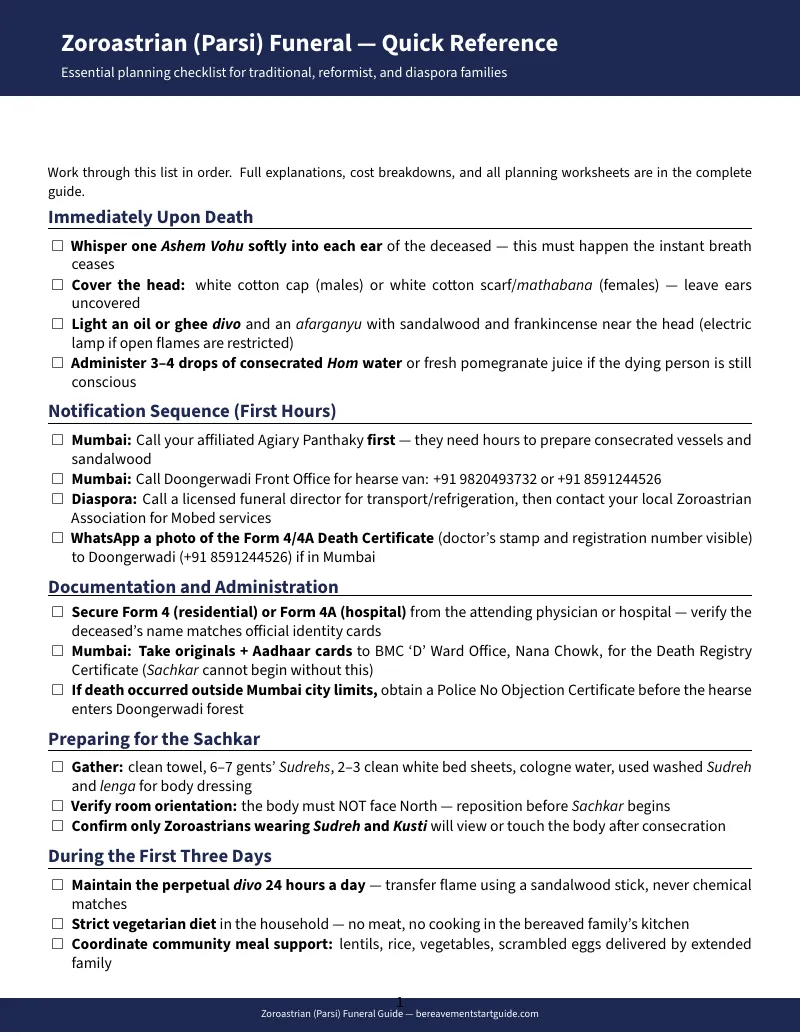
- Quick Start Checklist — 23 critical actions from the instant of death through the Uthamna on Day 3, designed to carry in your pocket to every meeting.
- Immediate Action Checklist — fill-in log for who you called, when, and what they confirmed in the first hours.
- Ceremony Planning Timeline — write the date, time, venue, and officiating mobed from death through Chaharum.
- Funeral Director Briefing Sheet — hand to the mortuary; they initial spatial, embalming, access, and daylight rules.
- Memorial Anniversary Tracker — Dasma, Seeom, Chamsi, Varsi, and 12 monthly roz rows with varis and mobed fields.
- Materials Packing List — Sudrehs, sheets, divo supplies, shiav, and the three-day meal roster.
- Mobed Consultation Script — verbatim questions for daylight Geh Sarna, disposition, Sachkar without nasesalars, and honoraria, with write-in answers.
- Interfaith Conversation Scripts — sentences to say before a non-Zoroastrian spouse, pregnant relative, or intermarried daughter arrives at the bungli.
- Charitable Donation Tracker — Uthamna announcements that replace floral wreaths, with paid/receipt ticks.
Who This Guide Is For
- Second-generation diaspora families in North America, the UK, or Australia coordinating a funeral thousands of miles from the nearest Agiary, without access to nasasalars, consecrated fire temples, or a Dakhma.
- Interfaith spouses and non-Zoroastrian relatives who need to understand purity laws, exclusion boundaries, and where they can meaningfully participate — before the ceremonies begin, not after they have been turned away.
- Culturally identified but non-practising Parsis mediating between orthodox elders who insist on Doongerwadi and progressive siblings who want cremation, with neither side backing down.
- Funeral directors and end-of-life professionals who need clear, print-ready instructions for handling a Zoroastrian decedent — spatial rules (never face the body North), non-invasive preparation requirements, and the items the family will need access to.
- Iranian Zoroastrian families whose customs differ from Parsi practice in naming conventions, dietary mourning rules, and disposition preferences — the guide treats both traditions as parallel tracks.
Why Free Resources Fall Short
Academic sources like Modi's Religious Ceremonies and Customs of the Parsees are exhaustive — and functionally useless at 2 a.m. when the hospital is asking whether you want the body embalmed. Panchayat checklists are designed for Mumbai families with a local Agiary on speed dial and a hearse van 30 minutes away. FEZANA and ZTFE websites offer scattered PDFs and mobed directories, but nothing that walks you through the decisions in sequence.
Community forums are worse. A simple question about cremation on Reddit or Quora turns into an orthodox-versus-reformist argument within three replies. You do not need a theological debate at the bedside — you need a step-by-step procedure that works regardless of which side of the controversy your family lands on.
The guide sits between the scholarship and the logistics. It translates purity law into actionable instructions, documents the real costs families pay (with two fully worked budget examples), and gives you ready-made scripts for every conversation — with the mobed, the funeral director, the hospital staff, and the relatives who disagree.
Satisfaction Guarantee
If the guide does not help you navigate the ceremonies with greater clarity and confidence, email us at [email protected] and we will refund your purchase in full. No time limit, no questions.
Start Planning with Confidence
Download the free checklist to see the structure — or get the full Zoroastrian (Parsi) Funeral Guide with the 14-chapter guide, the eight print-and-fill worksheets, cost breakdowns, and the Quick Start Checklist you can carry to every meeting from the first phone call to the annual memorial.