The bank has frozen the account. The Land Registry will not transfer the house. And the government expects you to know exactly which form to file, in what order, with which department — without a single mistake.
When someone dies without a will in England, the law does not care who organised the funeral or who managed the bills. It has a strict list of who can apply for letters of administration — a statutory priority order set down in Rule 22 of the Non-Contentious Probate Rules 1987 — and everyone else is locked out of the estate until someone on that list steps forward and applies to the Probate Registry.
The free guidance on GOV.UK tells you that you need to apply. It does not tell you how to work out whether you are the right person to apply, how to handle it when two siblings have equal entitlement, what to do when a beneficiary is under 18 and two administrators are generally required, or how to sequence the HMRC tax step so your application does not stall for months. And it does not tell you how the intestacy rules actually divide the estate — not in a way you can sit down and calculate with real numbers.
A solicitor will do all of this for £1,500 to £5,000 or more. For a straightforward, non-contentious estate, that is thousands of pounds for work you can do yourself — if you have the sequence right and every form in front of you.
The Intestacy Administration Framework
The England Letters of Administration Guide turns the scattered official process into one structured workflow — from confirming you are the right applicant through to distributing the estate after the grant is sealed. It is built for personal applicants who want to handle the administration themselves, with every step, every form reference, and every worked example in one document.
This is not legal advice. It is a process manual: it shows you exactly what the law says, in what order to act on it, and when to stop and consult a solicitor.
Who Can Apply — The Full Rule 22 Priority Mapping
The guide maps every class of applicant in the statutory priority order: surviving spouse or civil partner, children, parents, whole-blood siblings, half-blood siblings, grandparents, whole-blood uncles and aunts, then half-blood uncles and aunts. It also covers the issue of a child, sibling, uncle or aunt who died before the deceased. The guide explains what happens when the highest-ranking relative does not want to act (renunciation), when multiple people share the same rank, and what the Probate Registry does when applicants at the same level cannot agree — including the Rule 27(6A) dispute resolution procedure introduced in November 2025.
The Intestacy Rules — Worked Examples, Not Just Summaries
Every free resource on the internet will tell you the surviving spouse gets the statutory legacy of £322,000 and half the remainder. None of them sit down with the actual numbers and show you what that looks like for a £500,000 estate, a £200,000 estate, an estate with no spouse, or an estate where the only relatives are cousins. The guide works through six distribution scenarios step by step, so you can see the calculation — not just the rule.
The Online Application and the PA1A Paper Route
You can apply through the HMCTS digital portal or by posting form PA1A (version 02.25) to the Probate Registry at Harlow. The guide walks through both routes: what each one requires, the fields that commonly trigger rejections, the legal statement, the entitlement declaration, and the specific documents you need to include. It explains that Power Reserved applies when more than one executor is named in a will, not to administrators applying without one, and covers the separate routes for appointing someone to act or permanently giving up the right to administer.
Inheritance Tax — Excepted Estates and the IHT400 Route
Before you can apply for letters of administration, you need to satisfy HMRC. If the estate qualifies as excepted, the tax figures go through the application itself. If it does not, you file Form IHT400 and wait for a unique probate code — usually up to 20 working days from when HMRC receives the form or any tax payment, whichever comes later. The guide explains how to determine which route applies, what the excepted-estate conditions are, and how to avoid submitting your application before the code arrives (which stalls the entire process).
Two Administrators When a Minor Inherits
If any beneficiary is under 18 or a life interest arises, the Probate Registry generally requires two administrators — or a trust corporation — unless the court decides a sole administrator is sufficient. Most families discover this only when their application is rejected. The guide explains the rule, who can serve as the second applicant, and how to handle the joinder paperwork.
Unmarried Partners and the 1975 Act
Unmarried partners have no statutory right to apply for letters of administration and no right to inherit under the intestacy rules. This is true regardless of how long you lived together. The guide explains the position plainly, sets out the route under the Inheritance (Provision for Family and Dependants) Act 1975, and identifies when a solicitor is essential rather than optional.
Post-Grant Duties — From the Sealed Grant to Final Distribution
Once you have the grant, the real work begins. The guide covers presenting it to banks and the Land Registry, publishing a statutory notice to protect against unknown creditors, the administrator's year (the first year during which a personal representative is not bound to distribute), and the distribution sequence that keeps you out of personal liability.
Plus: The Free Checklist
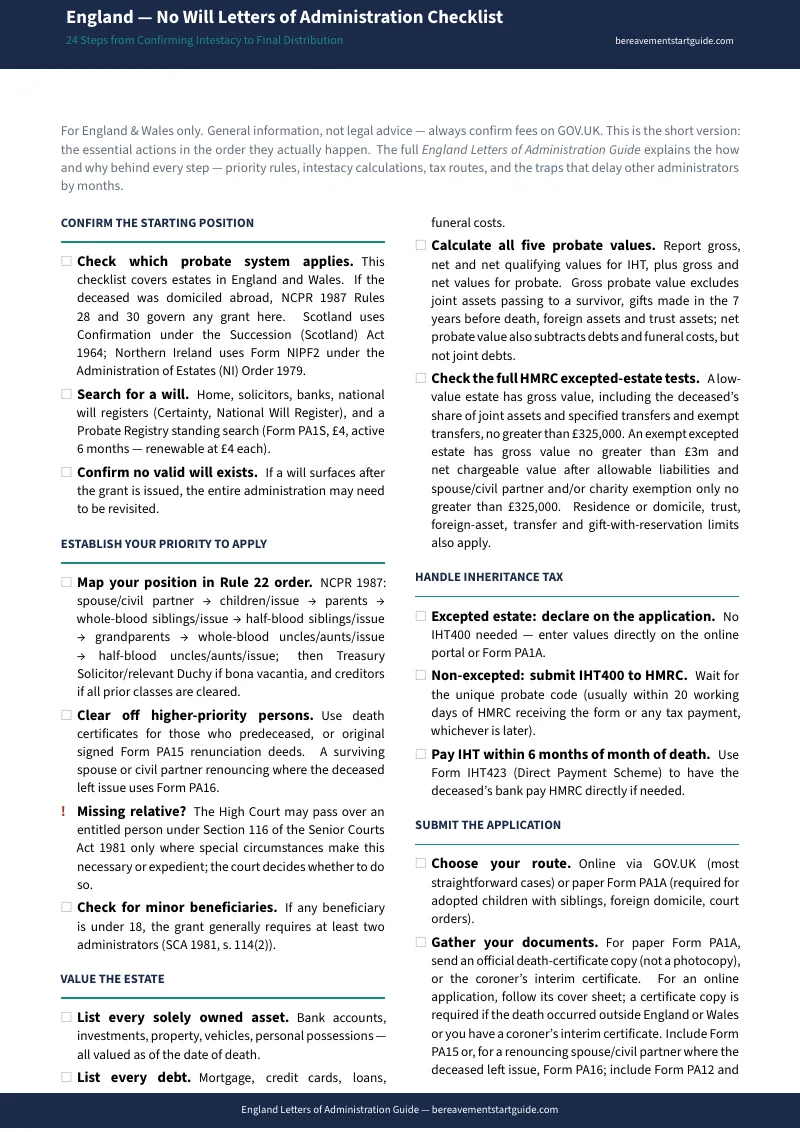
Not sure if you are ready for the full guide? The free England — No Will Letters of Administration Checklist gives you a two-page triage: who can apply, what documents you need, and direct links to every official form and helpline — so you can confirm your situation before committing.
What You Are Not Paying For
This guide is not affiliated with HMCTS, the Probate Registry, HMRC, or the UK Government. It does not replace a solicitor for contested estates, complex trust structures, or cross-border assets. It is an independent process manual — and it always points you to the free official routes first.
If the estate is simple, the applicant is obvious, and you are comfortable navigating GOV.UK on your own — go directly to the free government portal. The guide is for the families who tried that and found themselves stuck: too many forms, too many departments, and no single document that puts the entire process in order.
Satisfaction Guarantee
Full refund, no time limit. If the guide does not help, email hello@bereavementstartguide.com and you will get your money back.
Get the Letters of Administration Guide →
Or download the free checklist first — it is on the same page, no payment required.
Frequently Asked Questions
What if the rules change after I buy?
We update the guide when the rules change. Email us any time, even years later, and we'll send you the current edition free.