The bank froze the account. The attorney quoted $5,000. The estate is worth $45,000.
Your parent died in California two weeks ago. You walked into the bank with a death certificate, expecting to close a checking account with $38,000 in it. The teller froze the account and told you to come back with "Letters Testamentary" from a probate court. You went home, Googled what that meant, and found out it requires filing a petition (Form DE-111, $435 fee), publishing a notice in a newspaper, waiting for a court hearing that is 30 to 90 days out, and paying statutory attorney fees under Probate Code § 10810 — 4% on the first $100,000 — plus the same percentage to yourself as executor.
For a modest checking account.
What nobody told you at the bank: California Probate Code § 13100 lets you collect that money without any court involvement. You sign a sworn declaration, attach a certified death certificate and Judicial Council Form DE-300, present it to the bank after a 40-day waiting period, and the institution is legally required to hand over the funds. If it refuses unreasonably, § 13105(b) requires a court to award reasonable attorney fees when you bring an action to enforce the affidavit.
The problem is that § 13100 is one of three separate instruments for collecting property without full probate in California — and the wrong one gets you rejected. Banks confuse them. Online articles mix them up. Even the California Courts self-help pages use different terminology from one paragraph to the next. And since April 1, 2025, the dollar limits and available routes have changed: Assembly Bill 2016 expanded the existing procedure for determining succession to a primary residence, raising its limit to $750,000; the triennial adjustment raised the § 13100 estate-value threshold to $208,850; and the small real-property affidavit threshold moved to $69,625.
If you are working from information published before those changes, your paperwork may be built on the wrong numbers.
The Small Estate Route Map — Three Instruments, One Clear System
The California Small Estate Affidavit Guide is a complete Small Estate Route Map: a system that walks you through identifying which instrument applies to each asset in the estate, preparing the correct paperwork for each one, and presenting it to every institution and agency you need to deal with — in the right order, with the right waiting periods, using the right statutory language when someone says no.
This is not a form template. It is not a legal document. It is a 41-page process workbook — plus 7 standalone printable worksheets — that organizes California's overlapping small estate procedures into a single linear path, with worked examples at every decision point.
What's Inside
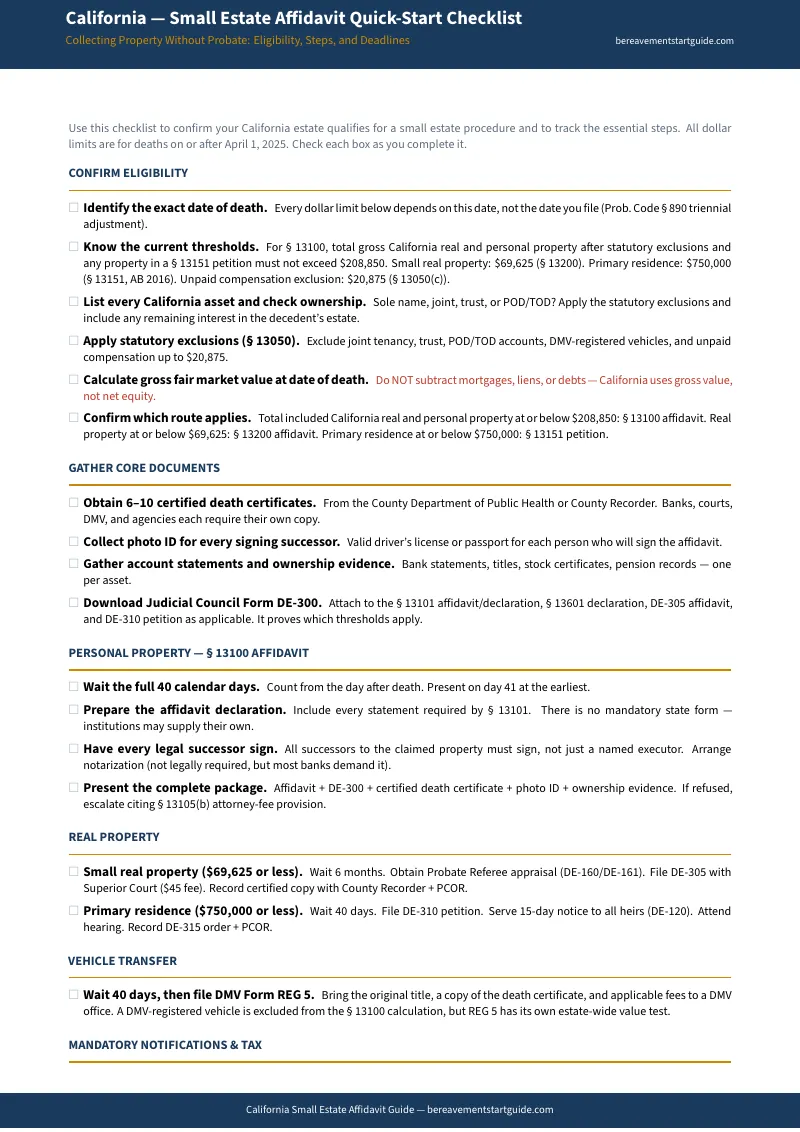
- The Asset-Counting Worksheet — a structured calculation sheet that walks you through Probate Code § 13050's exclusion rules: what gets subtracted (joint tenancy property, trust assets, beneficiary-designated accounts, registered vehicles, unpaid salary up to $20,875), what stays in, and how to calculate gross fair market value without making the most common mistake of subtracting mortgages
- The Three-Instrument Triage Chart — for deaths on or after April 1, 2025, the § 13100 affidavit for personal property when total included California real and personal property is at or below $208,850 (no court filing), the § 13200 affidavit when the combined gross value of all California real property is at or below $69,625 (Form DE-305, court filing required), and the § 13151 petition for a primary residence up to $750,000 (Form DE-310, court hearing required). Which one fits which asset, and what happens when an estate needs more than one
- The 40-Day and 6-Month Timelines — step-by-step instructions for each waiting period: when the clock starts, what to prepare while you wait, and what to present on day 41 or month 7
- The Bank Presentation Reference — the exact statutory language from § 13100–13105 that you need when a bank teller says they can only accept Letters Testamentary. How to request escalation to the institution's legal or compliance department. The § 13105(b) rule requiring reasonable attorney fees if you bring an enforcement action and the court finds that the institution unreasonably refused a valid affidavit
- The Real Property Filing Sequence — how to request a Probate Referee appointment, file Form DE-305 or DE-310 with the Superior Court, record the transfer with the County Recorder, and handle the Preliminary Change of Ownership Report (PCOR)
- The AB 2016 Primary Residence Guide — how the reform allows a decedent's California primary residence to qualify even if they lived in a nursing home or with family for care at death, raised the limit to $750,000 for deaths on or after April 1, 2025, and excluded property in that petition from the § 13100 limit — meaning an estate with a $650,000 house and $150,000 in bank accounts can use both instruments without formal probate
- DMV Vehicle Transfers — Form REG 5, applicable smog rules, and the exclusion that keeps vehicle transfers out of the § 13100 estate-value calculation
- Medi-Cal and Creditor Liability — the 90-day death notice to DHCS under Probate Code § 215 when the decedent received or may have received Medi-Cal, or was a recipient's surviving spouse; estate recovery rules for deaths on or after January 1, 2017; and personal liability for unsecured debts under § 13109 when you collect assets by affidavit
- The "Too Big" Off-Ramp — how to recognize when gross value exceeds the small estate ceilings and formal probate is required, with a hand-off to the California Probate Process Guide
Who It's For
This guide is built for the person who just found out that "simple" does not mean "obvious." You are likely one of these people:
- The surviving spouse who needs to close a bank account and transfer the car, and was told at the bank that they need court documents they have never heard of
- The adult child helping a surviving parent who is too overwhelmed to navigate the system alone
- The named executor who wants to check whether the estate qualifies for a small estate affidavit before committing to formal probate and its statutory fee schedule
- The family inheriting a modest home in California who needs to know whether the § 13151 petition or the § 13200 affidavit is the right route for their property
- Anyone who already tried to present a small estate affidavit to a bank or brokerage and was rejected — and needs the statutory backup to escalate
Why Not Just Use the Free Court Resources?
You should start there. The California Courts Self-Help Center at selfhelp.courts.ca.gov provides free guides on simplified transfer procedures, and the Judicial Council publishes every required form. This guide links to those resources throughout.
What the court website does not provide:
- A unified asset-counting worksheet that applies the § 13050 exclusion rules to your specific estate — the court explains the rules, but does not give you a calculation sheet
- A triage chart that maps each asset to the correct instrument — the court pages describe each procedure in isolation, leaving you to figure out which one applies to a bank account versus a house versus a car
- The structured bank escalation reference — the court advises you to contact a manager or legal department and refer to §§ 13100–13106 if an institution refuses; the guide organizes that response into a presentation sequence
- A consolidated timeline for the 40-day and 6-month waits, the applicable 90-day Medi-Cal notice, petition and hearing notices, creditor limitations, and tax and Prop 19 deadlines — the court pages describe each deadline in a different section with no master calendar
- The AB 2016 changes presented alongside the § 13100 rules in one place — as of late 2026, some court self-help pages still display the previous $184,500 threshold
The guide is a workflow organizer that sits between the free court resources and hiring a probate attorney. For a simple estate, it replaces the attorney. For a complicated one, it helps you understand the process well enough to know when you actually need legal counsel — and what to ask for.
Satisfaction Guarantee
If the guide does not deliver what you expected, email hello@bereavementstartguide.com for a full refund, no time limit. We read every message.
Get Started
Download the free checklist to check whether the estate qualifies. If it does, the full California Small Estate Affidavit Guide () walks you through every step — from the asset-counting worksheet through the bank presentation to the county recorder filing.
Frequently Asked Questions
What if the rules change after I buy?
We update the guide when the rules change. Email us any time, even years later, and we'll send you the current edition free.