Settle an Oregon Simple Estate Without Probate — And Without Stepping Into an Affiant Liability Trap
A loved one has died in Oregon leaving a checking account, a car, or a modest home. You know the estate does not justify full probate, so you search for an Oregon small estate affidavit. You find the free packet on the Oregon Judicial Department website — and immediately hit a wall of statutory rules the blank form never turns into a step-by-step plan.
First, Oregon calls it a Simple Estate Affidavit under ORS 114.505–114.560, not a small estate affidavit, and the court never issues Letters Testamentary. Second, the $75,000 personal property and $200,000 real property caps are measured at gross fair market value — you cannot subtract a mortgage or car loan. Third, filing the affidavit is only the midpoint: within 30 days you must serve heirs, devisees, creditors, and the Oregon Department of Human Services / Oregon Health Authority Estate Administration Unit (even if your loved one never used Medicaid), wait a strict four months before distributing a dollar or recording a Bargain and Sale Deed, and pay claims in exact ORS 115.125 priority order — because under ORS 114.545, you sign as a fiduciary with personal liability if you pay the wrong debt first.
The Oregon Affiant Operating System
The Oregon Small Estate Affidavit Guide — Settling an Estate Without Probate turns Oregon's statutory rules into a single, chronological operating binder. Instead of piecing together court PDFs, county probate pages, DMV bulletins, and ODHS mailing rules while grieving, you get every rule, worked example, agency address, and printable tracking log in the exact order you need them — from Day 1 through the two-year summary review window.
What's Inside the Guide
- Non-Probate Separation & Gross Cap Qualification (Chapters 1–3) — Because counting a joint account, POD balance, or Transfer on Death Deed by mistake can falsely push a qualifying estate into full probate, while subtracting a mortgage by mistake can get your filing rejected. Includes Oregon's $10,000 unpaid wage carve-out (ORS 652.190), small deposit affidavits when total Oregon deposits are $25,000 or less (ORS 708A.430 / ORS 723.466), the pour-over will trust exception (ORS 114.510(1)(b)), and worked examples of mortgaged homes.
- Eligibility, 30-Day Wait, Venue & County Variations (Chapter 4) — Because Oregon splits probate between Circuit Courts and six rural County Courts (Gilliam, Grant, Harney, Malheur, Sherman, and Wheeler), and local courts like Clackamas and Multnomah have specific header and declaration rules that trip up out-of-state and first-time filers.
- Filing Packet, Original Will Lodging & Fee Deferral (Chapter 5) — Because leaving out the mandatory 14-point bold page-1 notice, exposing a full Social Security number, or missing the seven-business-day deadline to lodge an original will after e-filing (UTCR 21.070(3)(h)(i)) stalls your case at the clerk's counter. Covers the $124.00 filing fee (ORS 21.145(4)), low-income deferral/waiver, and ordering court-certified copies.
- Mandatory 30-Day Notice Playbook & ODHS/OHA Compliance (Chapter 6) — Because failing to mail the filed affidavit and death certificate to the ODHS/OHA Estate Administration Unit in Salem — or missing conditional notices to the Oregon Department of Corrections or State Treasurer — creates avoidable fiduciary risk.
- Collecting Accounts, Oregon DMV Transfers & Real Property Deeds (Chapters 7–9) — Because banks, credit unions, Oregon PERS, the Oregon DMV, and county land recorders each require different paperwork. Shows when to use court-certified copies under ORS 114.535, when to use DMV Form 735-6797 versus intestate Form 735-516 (Inheritance Affidavit), and how to execute and record a Bargain and Sale Deed after the four-month hold under ORS 114.555.
- Creditor Priority, Insolvent Estates & Newly Discovered Assets (Chapter 10) — Because paying a credit card bill before funeral expenses or Medicaid recovery can make you personally liable. Walks through all 15 ordered payment levels of ORS 115.125, written 60-day Notices of Disallowance for claims omitted from the affidavit, a worked insolvent-estate calculation, what to do if newly discovered assets cross the cap (ORS 114.515(7)), final income taxes, and the two-year summary review window (ORS 114.550).
- Six Standalone Printable Tracking Worksheets (Chapter 11) — Built to print and drop into a three-ring binder: Asset Valuation Worksheet, Statutory Timeline and Deadline Tracker, Mandatory Notice and Proof-of-Mailing Log, DMV and Institution Asset Collection Tracker, Creditor Claims and ORS 115.125 Priority Schedule, and Affiant Fiduciary Accounting Ledger.
- Verified Official Oregon Agency Directory (Chapter 12) — Direct `.gov` and `.org` links, mailing addresses, and phone numbers for OJD courts, ODHS/OHA Estate Administration Unit, Oregon DMV, Oregon PERS, Oregon Department of Revenue, Oregon State Bar Lawyer Referral Service, and Legal Aid Services of Oregon.
Who This Guide Is For
- Surviving spouses, adult children, and named executors settling an uncontested Oregon estate that falls within the $75,000 personal property and $200,000 real property gross limits.
- Out-of-state family members managing an Oregon simple estate by mail or OJD File & Serve who need county rules, original-will lodging steps, and agency mailing addresses in one place.
- Self-represented affiants who already downloaded the free OJD form packet and want a clear system for the 30-day notices, bank releases, DMV transfers, deed recording, and creditor priority that happen after filing.
- Families checking whether simple estate fits before paying the $124.00 filing fee or booking an attorney consultation.
Scope note: This guide provides plain-language process navigation, not legal, tax, or financial advice, and is not affiliated with the Oregon Judicial Department, ODHS, OHA, or the Oregon DMV. If a will is contested, heirs are in dispute, or the estate exceeds Oregon's caps without a qualifying pour-over trust, consult an Oregon probate attorney or the Oregon State Bar Lawyer Referral Service.
Why Not Just Use Free Forms or Generic National Platforms?
You should always get the official blank affidavit free from the Oregon Judicial Department at courts.oregon.gov — this guide does not resell or replace official court forms. Where free packets, blank paper form sellers, and generic national legal-tech sites fall short is everything that happens around and after the form:
- The free OJD packet gives you the blank affidavit and statutory warnings, but includes zero asset valuation worksheets, zero certified-mail tracking logs, zero DMV-vs-court decision trees, and zero fiduciary accounting ledgers for the two-year summary review window.
- Blank retail form sets hand you static paper without explaining how to measure gross fair market value without subtracting liens, how to prioritize debts across the 15 ordered payment levels of ORS 115.125, or how to record a Bargain and Sale Deed after Month 4.
- Generic national legal platforms use multi-state templates that routinely miss Oregon-specific rules — such as mandatory ODHS/OHA Estate Administration Unit notice in every simple estate, the six rural County Court probate jurisdictions, and Oregon's split between DMV Form 735-516 and Form 735-6797.
Risk-Free Guarantee
Every purchase is backed by a full refund, no time limit. If you download the guide and realize your estate requires full probate, an attorney, or a different route, email hello@bereavementstartguide.com and we will refund your purchase in full.
Start With the Free Checklist — Or Get the Complete Guide Today
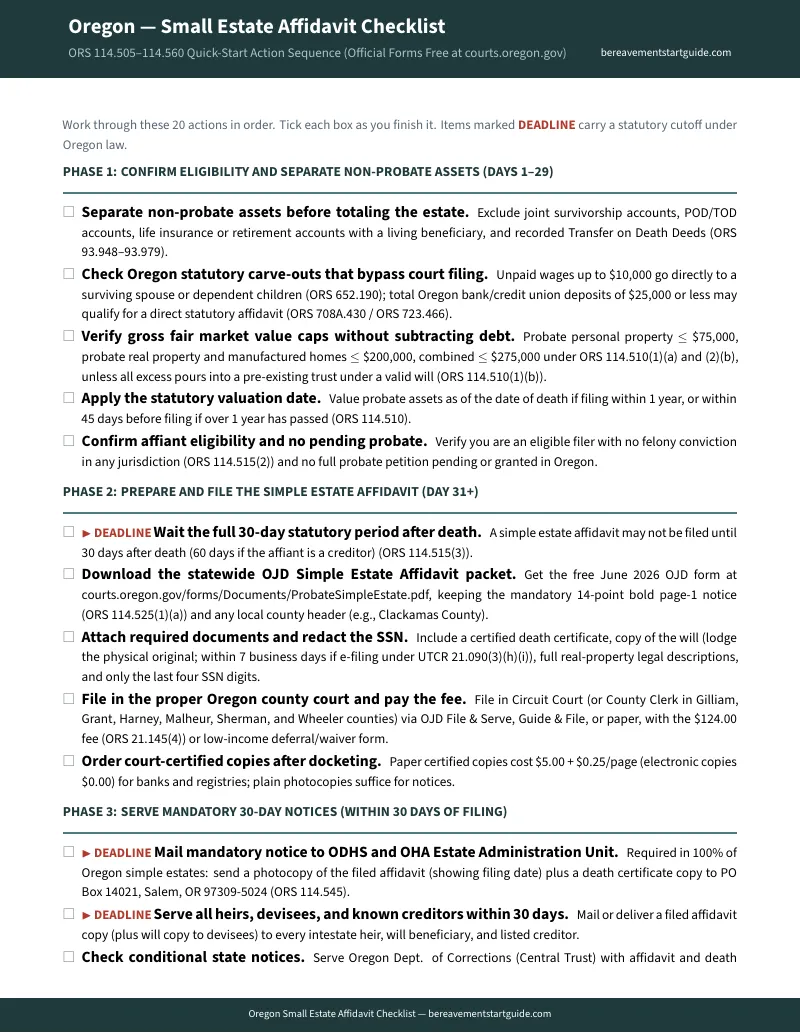
Not sure yet whether the estate qualifies? Download the free two-page Oregon — Small Estate Affidavit Checklist first to run a quick eligibility and deadline check. Ready for the full 60-page manual, four worked examples, and all six printable tracking worksheets? Get instant access today with a single one-time payment — no account, no subscription, and a full refund with no time limit.
Frequently Asked Questions
What if the rules change after I buy?
We update the guide when the rules change. Email us any time, even years later, and we'll send you the current edition free.