You Have 72 Hours Before the First Deadlines Pass
When a German citizen dies in Turkey, the family enters a corridor of overlapping deadlines across two countries. Turkish municipal law requires a medical examination within hours. The death must be registered at the District Population Directorate within 10 days. Your travel insurer will deny the repatriation claim if you hire a local funeral home before calling their emergency line. And if the death was sudden or suspicious, the Turkish public prosecutor will order a forensic hold — the body stays at the Adli Tıp Kurumu until the investigation is complete, and no consular pressure, family urgency, or insurance leverage can accelerate that process.
That's just the logistics. Over the following months, you'll face frozen Turkish bank accounts, an estate that splits in two under the 1929 German-Turkish Consular Treaty, inheritance tax exposure in both countries with no bilateral treaty to simplify it, and — if there's real estate — a Turkish court process that takes 6 to 12 months and invalidates the German Berliner Testament entirely.
Every one of these steps has a deadline. Request the wrong death certificate format, and you spend weeks and hundreds of euros on sworn translations that were never necessary. Call a local funeral director before your insurer, and you absorb the full repatriation bill yourself — up to €12,520.
The Cross-Border Administrative Companion
This guide exists because the information you need is scattered across four types of sources — and none of them covers the full picture.
German consulates explain what they can't do (register the death, pay for repatriation, intervene in forensic holds) but don't walk you through what you should do. Repatriation firms quote the most expensive option without mentioning your ADAC or DITIB coverage. German-Turkish law firms focus on high-fee estate cases and ignore the mortuary logistics entirely. Expat forums offer anecdotes from other families, but every death has its own administrative reality depending on the city, the cause of death, and whether the deceased held dual citizenship.
The Cross-Border Administrative Companion is a single document that integrates both sides — every Turkish procedure and every German notification — into one chronological timeline with exact deadlines, document names, and the specific legal references you need at each step.
What's Inside
- The First 72 Hours Protocol — the exact notification sequence that protects your insurance coverage, how Turkey classifies natural vs. forensic deaths, and what happens when a prosecutor orders a hold at the Adli Tıp Kurumu (including organ retention and the formal petition process to recover them)
- The Formül C Rule — which death certificate format to request from the İlçe Nüfus Müdürlüğü so German banks, Standesämter, and pension offices accept it without translation or apostille, and why e-Devlet digital downloads get rejected by German authorities
- Repatriation vs. Local Burial — objective cost comparisons for Berlin Convention-compliant coffin transport (including the 30 mm outer-coffin thickness that most European countries don't require) vs. local burial in Turkey, including the cremation reality (no operational crematoria in Turkey) and the double-handling workaround
- Insurance Coverage Decoded — ADAC Plus eligibility (the 50 km rule, the 92-day trip limit, the logistics-control requirement that voids coverage if you contract a funeral home first), private travel insurance exclusions (cosmetic surgery deaths, pre-existing conditions), and DITIB ZSU funeral fund limits (€3,000 cap for non-standard routes)
- Nachlassspaltung — The Estate Split — how the 1929 German-Turkish Consular Treaty divides the inheritance (German law for movable assets, Turkish law for real estate), why the Berliner Testament fails for Turkish property, and the Turkish forced-share system that lets children reclaim up to 50% of their intestate share through a Tenkis Davası
- Mirasçılık Belgesi — why the German Erbschein has no force in Turkey, why Turkish notaries are legally prohibited from handling foreign-element estates, and the 6–12 month Sulh Hukuk Mahkemesi court process
- Double Taxation Without a Treaty — the six-month Turkish filing deadline, the Section 21 ErbStG credit for Turkish tax paid, and worked examples showing how the dual-country tax calculation works
- German Pension and Insurance Notifications — stopping the Rente through Deutsche Post AG Renten Service, claiming the Sterbevierteljahr three-month transition payment, canceling the Krankenkasse, and filing life insurance claims with Turkish death documents
- Master Timeline — every deadline from day one through month twelve, organized by week, with the document required at each step
Who This Guide Is For
- Turkish-German families (second and third generation) — navigating a parent's death in the ancestral homeland, coordinating remotely from Germany with limited Turkish language skills
- Spouses and partners of German retirees in Turkey — facing frozen bank accounts and sudden isolation in coastal communities like Alanya, Antalya, and Izmir
- Relatives coordinating remotely from Germany after a tourist death — you don't always need to fly to Turkey, and the guide tells you when you do and when you don't
- Estate executors managing cross-border assets under the 1929 German-Turkish Consular Treaty
- Travel companions and tour operators who need to act in the first hours before the family arrives
- HR departments handling an employee death during a business trip to Turkey
Why Free Information Isn't Enough
The German Embassy website tells you the consulate can "provide a list of local funeral directors." It does not tell you that calling any of them before your travel insurer voids your repatriation coverage.
Expat forums recommend "just get the death certificate from the hospital." That certificate — the standard Ölüm Belgesi — is written entirely in Turkish and will be rejected by every German institution you need to notify. The multilingual Formül C is accepted without translation under ICCS Convention No. 16, but you have to know to ask for it.
A German-Turkish law firm will handle the estate for thousands of euros in fees. This guide covers the same administrative steps families can handle themselves, and tells you exactly which situations genuinely require a cross-border attorney — like the Sulh Hukuk Mahkemesi petition for a Turkish certificate of inheritance, which requires apostilled and translated German civil documents.
The difference between free information and this guide is not completeness — it's integration. Free sources cover fragments. This guide connects the Turkish mortuary process to the German pension system to the estate split to the inheritance tax to the bank freeze, in chronological order, with the deadlines and documents mapped at every step.
The Free Checklist vs. The Full Guide
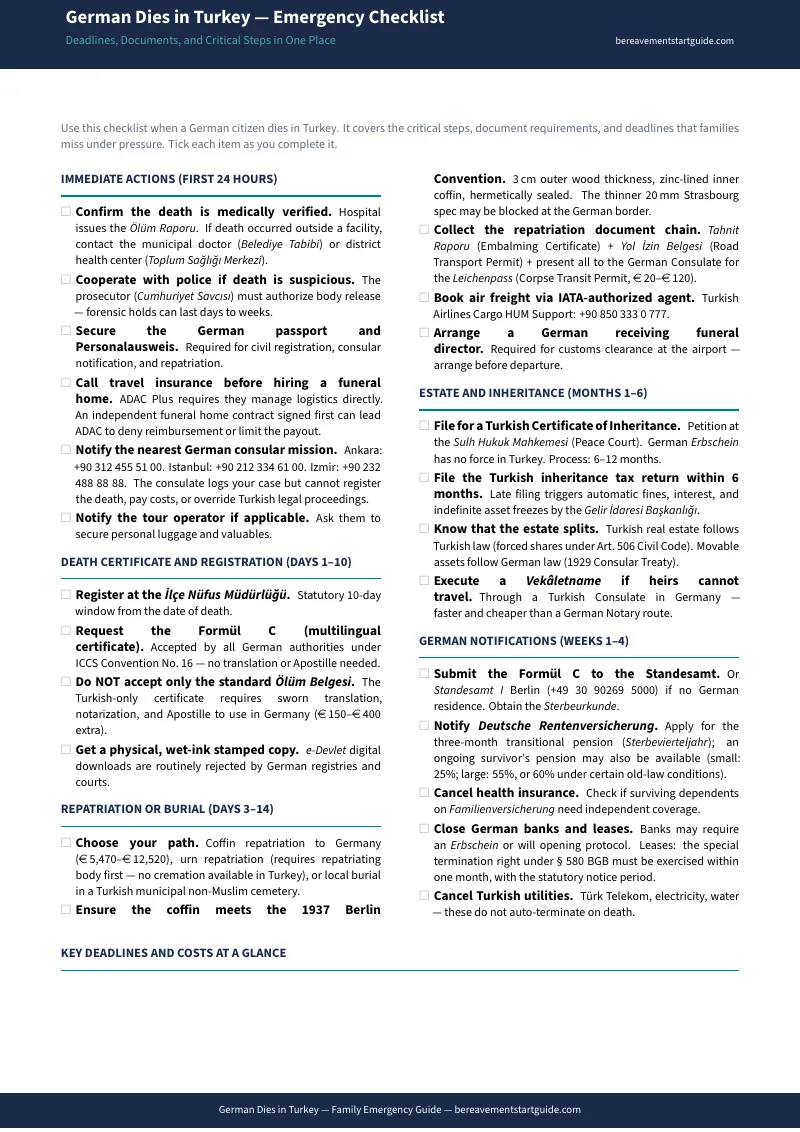
The free emergency checklist gives you the what — every action item you need to complete, in order, with the authority responsible. It's designed to keep you on track during the most disorienting days.
The full guide gives you the how — the detailed procedures, cost comparisons, legal explanations, and worked examples that turn each checklist item from a question mark into a completed step. The checklist tells you to "request the international death certificate." The guide explains which format, from which office, why digital downloads fail, and what to do when the registry hasn't issued it within the 10-day window.
Full Refund, No Time Limit
If the guide doesn't help your situation, email hello@bereavementstartguide.com for a full refund. No time limit, no questions.
The guide is — less than the cost of a single sworn translation you won't need if you request the right certificate format on day one.