You just learned that your family member has died in Cyprus — and you are navigating a system split across two jurisdictions with no guide
A hospital in Paphos says the body is in the mortuary. The police say the death is under investigation. Someone at the British High Commission mentions an autopsy — but the state forensic pathologist is based in Nicosia, and your relative died in Limassol, and you are in the UK trying to understand why nobody can tell you when the remains will be released.
If the death occurred in Northern Cyprus, everything changes again. The registration authority is different. The documents are different. The currency is different. Hospital fees must be settled in Turkish Lira at specific hours or the paperwork does not move. Private clinics withhold the deceased's passport until bills are paid. The death certificate you receive from a northern state hospital may get your loved one onto a cargo flight — but a UK bank or probate court will reject it.
The British High Commission in Nicosia can provide lists of local lawyers, translators, and funeral directors. That is the limit of what they do. They cannot pay for anything, translate documents, register the death, or make decisions on your behalf. Meanwhile, you need to act: the 15-day registration deadline is running, the Cypriot coroner may suspend the inquest for years if criminal proceedings begin, and every option you are weighing — repatriation, local burial, cremation — has irreversible legal and financial consequences you cannot see from where you are standing.
The Dual-Jurisdiction Emergency Navigator — a step-by-step system for the UK-Cyprus corridor
This is not a generic death-abroad checklist. The British Person Dies in Cyprus — Family Emergency Guide was built for the specific administrative reality of managing a death across Cyprus and the United Kingdom — including the parallel legal systems of the Republic of Cyprus and Northern Cyprus that no other resource covers in a single document.
The guide starts at the moment of death and follows you through every decision: which jurisdiction's registration process applies, how to secure documents that UK banks and probate courts will accept, how to choose between repatriation, local burial, and multi-jurisdictional cremation, and how to manage the cross-border estate under Cypriot forced heirship law. Every chapter builds on the previous one, and every step tells you exactly what you need before you can proceed.
What's inside the guide
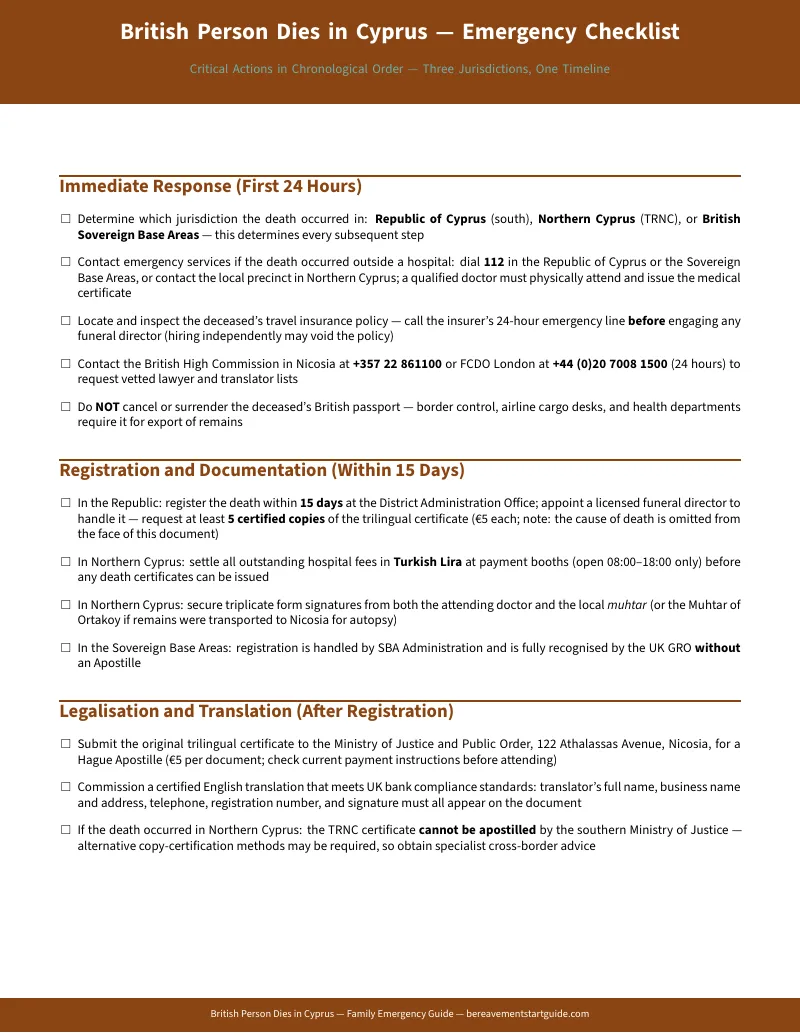
- The immediate emergency sequence — who to call (112, the FCDO consular emergency line, the British High Commission in Nicosia), in what order, and how the cause of death determines whether a hospital physician, the local police, or a state forensic pathologist controls the remains
- Republic of Cyprus death registration — the District Administration Office process, the 15-day statutory deadline, the €5 per certified copy fee, the medical certificate requirements, and the critical fact that the civil death certificate omits the cause of death — a detail that triggers rejection by UK banks and insurers demanding proof of how the person died
- Northern Cyprus death registration — the entirely separate administrative path through District Offices, triplicate forms requiring the attending doctor's and local Muhtar's signatures, state hospital fee settlements in Turkish Lira between 08:00 and 18:00, private clinic passport withholding, and the distinction between the basic photocopied certificate (accepted by airlines, rejected by courts) and the official bilingual death certificate
- The cremation void — Cyprus has no operational crematorium as of 2026, and even when the Golden Leaves facility opens near Paphos, Cypriot law requires the deceased to have signed a formal written declaration of cremation intent during their lifetime; without that document, next-of-kin cannot authorise cremation, forcing families to choose between local burial or repatriation to the UK, Greece, or Bulgaria
- Repatriation vs. local burial cost comparison — side-by-side cost analysis: local Cypriot burial (€2,500–€5,500 total), standard body repatriation to the UK (€3,500–€7,000 Cyprus-side plus £3,000–£6,000 UK-side for the receiving funeral), and multi-jurisdictional cremation via Greece or Bulgaria (€3,500–€7,000)
- Embalming, zinc-lined coffins, and air cargo logistics — mandatory arterial embalming by a Cyprus-government-certified embalmer, hermetically sealed zinc-lined transport coffins, hessian wrapping, departures from Larnaca or Paphos airports, and clearance through UK border health control
- The apostille and certified translation chain — the Ministry of Justice and Public Order apostille process in Nicosia or Limassol, the circular bureaucratic loop created by the Cyprus High Commission in London refusing to verify Cypriot-origin documents, and the translation template requirements (translator's name, registration number, business address, contact details, and signature) that meet UK bank compliance standards
- The Tell Us Once verification loop — how the UK registrar's verification requirement sends families to the Cyprus High Commission, which sends them back to the Ministry of Justice in Nicosia, creating a dead end that delays access to UK government services — and the workaround
- UK bank compliance for foreign death certificates — the strict standards NatWest, Lloyds, and Barclays apply: original documents only (no photocopies, no scans, no laminated certificates), certified translation with full translator credentials, and the solicitor's alternative when apostilled translations are delayed
- Forensic autopsy and investigation delays — the centralised state pathology system that routes deaths from Paphos and Limassol to the Nicosia laboratory, multi-day scheduling delays, confidential investigation files compiled exclusively in Greek, and inquest suspensions under Chapter 153 that can leave families without a final cause-of-death certificate for years
- Forced heirship under Cap. 195 — Cypriot succession law reserves up to 75% of an estate for close family members regardless of the will, the Brussels IV election that allows British nationals to apply English inheritance law instead, and why this election must be expressly stated in the will before death
- Probate resealing under Cap. 189 — how to get a UK Grant of Probate recognised by Cypriot banks and the Land Registry, the requirement that an intestate estate administrator must be a permanent Cyprus resident, and the Power of Attorney implications for UK-based families
- Travel insurance traps — undeclared pre-existing condition exclusions, the documentation sequence that prevents claim refusals, and early insurer notification protocols that protect coverage
- Contact directory — direct details for the British High Commission Nicosia, the Ministry of Justice apostille office, District Administration Offices across both jurisdictions, and key funeral homes and repatriation specialists in the UK–Cyprus corridor
- Six printable planning tools — standalone worksheets you print and use at each stage: an immediate response checklist, a document tracking log, a repatriation cost comparison worksheet, an estate administration timeline, an agency communication log, and a bank notification tracker
Who this guide is built for
- The elderly spouse in Cyprus — you are a retiree in Paphos, Limassol, or Larnaca, your partner has died, and you need to navigate local burial procedures or complex cross-border estate division under Cypriot forced heirship rules while physically isolated and emotionally overwhelmed
- The adult child in the UK — you are coordinating remotely across a two-hour time zone gap with Cypriot authorities, funeral directors, and hospitals, making irreversible decisions about repatriation, burial, or cremation while managing grief, work, and competing advice from expat forums and tour operators
- The executor or probate solicitor — you need the Cyprus-to-UK certified document sequence correct on the first attempt, especially where the deceased held real estate or bank accounts in both countries and the estate falls under Cap. 195 forced heirship rules
- UK funeral directors — you are managing the reception and final disposition of remains repatriated from Cyprus and need families to arrive with the correct transport permits and embalming certificates to avoid delays at the airport
- Travel insurance case managers — you need a structured, corridor-specific protocol for the UK–Cyprus corridor that you can hand directly to families navigating an insured tourist death
Why free information falls short in this corridor
The FCDO publishes separate bereavement guides for the Republic of Cyprus and Northern Cyprus. Neither tells you what to do when you have been bounced between the Cyprus High Commission in London and the Ministry of Justice in Nicosia for a week and still cannot get your death certificate verified for Tell Us Once. A funeral home in Paphos quotes you a repatriation price but does not mention that Cypriot civil death certificates omit the cause of death — a fact you discover when your UK bank freezes the estate account. Expat forums give you advice from someone who handled a simple natural death when you are dealing with a police-held forensic investigation in Northern Cyprus.
The problem is not a lack of information — it is that the information is scattered across two Cypriot jurisdictions, the FCDO, commercial funeral firms, and online forums, and none of it is sequenced. You cannot start UK probate until you have an apostilled, certified-translated death certificate. You cannot get the apostille until the death is registered. You cannot register the death until the forensic investigation releases the remains — and in Cyprus, that investigation is bottlenecked by a shortage of state pathologists that has been publicly criticised by the Paphos mayor. Meanwhile, if the death occurred in Northern Cyprus, you are following an entirely different registration process that most English-language resources do not cover at all.
This guide connects both paths into a single, sequenced system. Every chapter tells you what you need from the previous step before you can proceed, what can go wrong, and how to fix it if it does.
Your purchase is protected
Full refund, no time limit. If the guide does not help your situation, email hello@bereavementstartguide.com and we will refund you — no questions, no deadline.
The free checklist gives you the emergency contact sequence and the critical action items for the first 72 hours. The full guide gives you everything else — the detailed how behind every step across both jurisdictions, the cost comparisons, the certified translation templates, the document sequences that keep UK banks, insurers, and the Probate Registry moving forward instead of stalling, and six printable planning tools you use at each stage of the process.