You just learned that your family member has died in Turkey — and no one is telling you the same thing twice
A hospital administrator says the body is in the mortuary. A tour operator says the police are involved. Someone mentions a prosecutor. You are in the UK, it is the middle of the night in Turkey, and you need to make decisions about the remains — but you do not know who has legal authority over them, what documents you need, or what anything costs.
The Turkish system operates on a three-track model: hospital deaths, municipal deaths, and prosecutor-controlled deaths each follow entirely different administrative pathways. One wrong assumption about which track applies — and the documents you collect, the authorities you contact, and the timeline you expect are all wrong. Meanwhile, the British Consulate can hand you a list of local funeral directors and translators. That is the limit of what they can do. They cannot pay for anything, translate documents, recover seized belongings, or make decisions on your behalf.
Expat forums give you advice from someone who handled a repatriation from Antalya when you are dealing with a forensic autopsy in Istanbul. The FCDO website explains what the government cannot do, but not what you should do instead. And every day you spend sorting this out is a day the ten-day civil registration deadline gets closer, your insurance claim window narrows, and the costs of holding the remains at the mortuary accumulate.
The Cross-Border Emergency Navigator — a step-by-step system built for the UK–Turkey corridor
This is not a generic death-abroad checklist. The British Person Dies in Turkey — Family Emergency Guide was built for the specific legal, logistical, and administrative reality of managing a death across Turkey and the United Kingdom. It maps every Turkish agency you will encounter, every document you need, and every decision you face — in the exact order you will face them.
The guide starts at the moment of death and follows you through three distinct pathways: repatriation of the body to the UK, local burial in Turkey, or the international cremation workaround — because Turkey has no cremation facilities and the practice is illegal. You follow the pathway that applies to your situation, and every subsequent chapter builds on that decision.
What's inside the guide
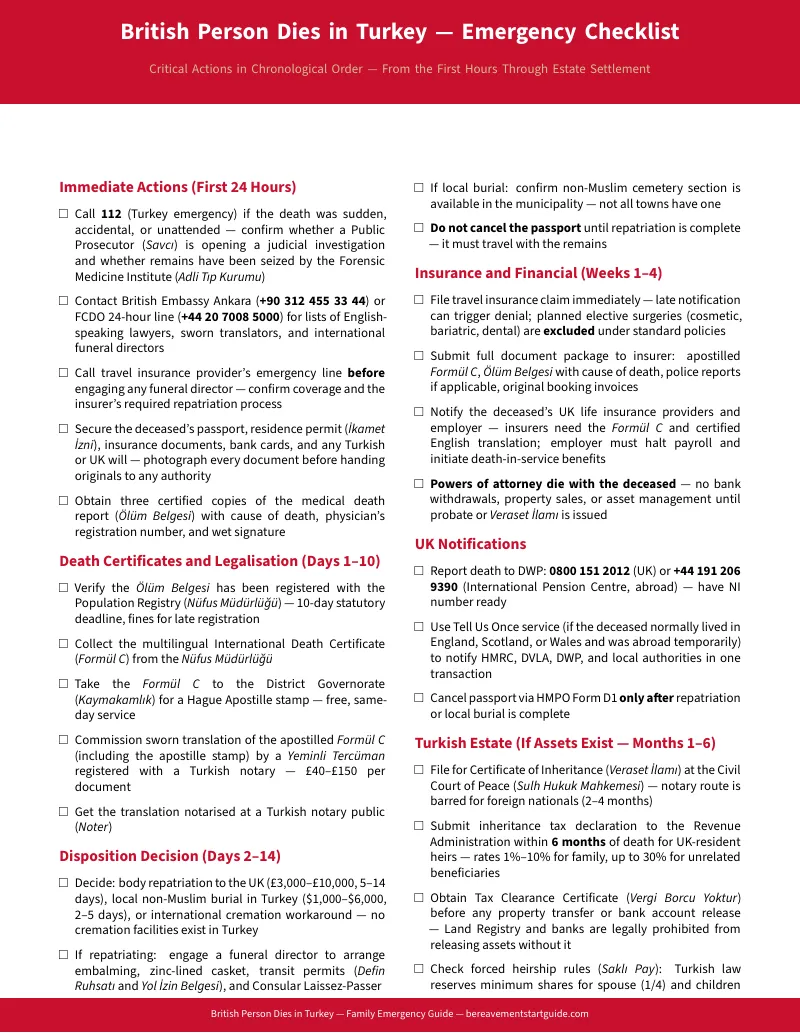
- The immediate emergency sequence — who to call (112, the FCDO consular emergency line, the local Polis or Jandarma), in what order, and how the cause of death determines whether a hospital physician, a municipal doctor, or the Public Prosecutor (Savcı) takes jurisdiction over the remains
- The three-track death certification system — why Turkey issues the medical death report (Ölüm Belgesi) through three completely separate authorities, how each track works, and the specific documents produced by each one
- The Formül C and Hague Apostille sequence — the exact three-step legalisation chain (multilingual death certificate from the Nüfus Müdürlüğü → Hague Apostille at the local Kaymakamlık → sworn translation and notarisation), and why reversing any step causes automatic rejection by UK probate courts, banks, and pension administrators
- The cause-of-death gap — why the multilingual Formül C omits the clinical cause of death entirely, leaving UK insurers and coroners unable to process claims, and how to separately translate and apostille the monolingual Ölüm Belgesi to bridge this gap
- Consular limitations decoded — the specific services the British Embassy in Ankara and the consulates in Istanbul and Izmir are prohibited from providing, so you stop waiting for help that will never come and start taking the steps that actually move the process forward
- Repatriation vs. local burial vs. cremation workaround — a side-by-side cost comparison covering full-body repatriation to the UK (£3,110–£6,000+ for embalming, zinc-lined transport coffin, and HUM air cargo), Turkish municipal burial ($1,000–$6,000), and the specialist international cremation route via firms like Concordia — with the critical legal consequence that choosing local burial permanently blocks a UK coronial inquest
- The cremation impossibility and the workaround — Turkey has no crematoriums. Specialist providers embalm and seal the deceased, transport the casket via air cargo to a receiving crematorium abroad, and ship the ashes back in a sealed urn. The guide covers costs, timelines, and the exact documents required at every stage — plus the airline rules for carrying ashes as hand luggage on TUI, easyJet, and Turkish Airlines
- Forensic autopsy and prosecutor delays — what happens when the Adli Tıp Kurumu takes jurisdiction, why the full post-mortem report can take six to nine months, how to secure interim clinical documentation that satisfies UK coroners for Cremation Form 6, and how to manage the parallel UK coronial process without triggering a secondary post-mortem
- The medical tourism insurance trap — why standard travel insurance excludes planned elective procedures (bariatric, cosmetic, dental surgery) and how families of medical tourism fatalities face immediate out-of-pocket liability for private ICU fees and professional repatriation logistics
- Frozen Turkish bank accounts and the Veraset İlamı — Turkish banks freeze every account held by a deceased foreign national on notification. The funds stay frozen until the heirs file a civil lawsuit at the Sulh Hukuk Mahkemesi (Civil Court of Peace) and secure an Inheritance Certificate — a four-to-twelve-week process that requires apostilled UK birth, marriage, and probate documents translated by a sworn translator
- Cross-border estate under MÖHUK Article 20 — how Turkish private international law determines which country's succession rules apply, why a will with a choice-of-law clause overrides Turkish forced heirship, and the risks for families without one
- UK-side notifications and estate administration — the Tell Us Once service (and why it is unavailable if the deceased was a permanent Turkish resident), HMRC, DWP pension and benefit stops, passport cancellation, and council tax adjustment — sequenced so nothing falls through the gap between the two countries
- Turkish legal glossary and contact directory — every Turkish legal term used in the guide, translated and explained, plus direct contact details for the British Embassy, consulates, and key Turkish agencies
Who this guide is built for
- The spouse or partner in the UK who needs to act today — you are coordinating remotely across a two-to-three-hour time zone gap with Turkish authorities, funeral directors, and hospitals, making irreversible decisions about repatriation or burial, and trying to get documents that will actually work in UK probate court
- The surviving expat companion in Turkey — you may be physically present but linguistically isolated from the bureaucracy, afraid of violating local laws, and unsure whether you have legal standing to make decisions about the remains or the estate
- The adult child managing logistics from abroad — you are juggling grief, work obligations, and travel decisions while fielding competing advice from Turkish hospitals, tour operators, and expat forums that may be years out of date
- The executor or probate solicitor — you need the Turkish-to-UK certified document sequence correct on the first attempt, because a single legalisation error sends you back to the beginning of a process that takes weeks
- The travel companion at the scene — you are at a Turkish hospital or police station, possibly without any Turkish, and you need emergency contact numbers and first-response instructions right now
- Travel insurance case managers and UK funeral directors — you need a structured, corridor-specific protocol for the UK–Turkey corridor that you can hand directly to grieving families
Why free information falls short in this corridor
The FCDO website tells you to contact a local funeral home. Expat forums give you advice from someone who handled a repatriation from Bodrum when the forensic investigation rules are different in Istanbul. A commercial repatriation firm quotes you a price and moves the body — but does not tell you about the Turkish probate lawsuit you need to file within months to unlock the deceased's frozen bank accounts, the apostille sequence that prevents your UK probate application from being rejected, or the insurance exclusions that leave medical tourism families paying out of pocket.
The problem is not a lack of information — it is that the information is scattered across Turkish government offices, the FCDO, commercial funeral firms, and online forums, and none of it is sequenced. You cannot start UK probate until you have an apostilled, sworn-translated death certificate. You cannot get the apostille until the Civil Registry has registered the death. You cannot register the death until the forensic investigation releases the remains — and if the death was sudden or suspicious, that investigation adds weeks or months. A single document error — getting the apostille in the wrong order, requesting the Formül C without also securing the Ölüm Belgesi, missing the Turkish inheritance tax deadline — sends you back to the beginning or triggers penalties you cannot reverse.
This guide connects the entire chain. Every chapter tells you what you need from the previous step before you can proceed, what can go wrong, and how to fix it if it does.
Your purchase is protected
Full refund, no time limit. If the guide does not help your situation, email hello@bereavementstartguide.com and we will refund you — no questions, no deadline.
The free checklist gives you the emergency contact sequence and the critical action items for the first 72 hours. The full guide gives you everything else — the detailed how behind every step, the documents, the decision frameworks, the glossary, and the Turkish-language reference materials that keep the process moving forward instead of stalling.