
Grief Brain Took Your Words. This Toolkit Gives Them Back.
You know you need to send thank-you notes. The guest book is sitting on the counter. The stack of sympathy cards is growing. And every time you pick up a pen, your mind goes blank — because your brain is running on fumes and the words just will not come.
That is not a character flaw. Neuropsychological research shows that acute bereavement measurably impairs your working memory, processing speed, and executive function. Clinicians call it "grief brain." It is the reason a two-sentence note feels like writing a dissertation, why choosing between two card designs takes twenty minutes, and why the whole project keeps sliding to tomorrow.
Meanwhile, the social clock is ticking. Your aunt is asking whether cards went out. The neighbor who brought casseroles for a week has not heard a word. The pallbearers — the ones who carried the person you loved — deserve something, and you know it, and the guilt is compounding.
The Acknowledgment Rescue System
This is not another etiquette book telling you what you already know. The Funeral Thank You Notes & Acknowledgment Templates toolkit is a complete copy-and-customize system designed specifically for a brain that cannot plan, prioritize, or start from a blank page right now.
You open it. You find the template that matches your situation. You fill in a name and one personal detail. You are done. No staring at a blank card. No Googling "what to write in a sympathy thank you" at midnight. No guilt spiral about whether you said enough or said it wrong.
What Is Inside
- Copy-ready templates for every recipient type — clergy and officiants, pallbearers, hospice and nursing staff, flower senders, food providers, charitable donors, coworkers, long-distance travelers, estranged family members, and everyone in between. Each template is two to three sentences, etiquette-verified, and ready to personalize with one detail.
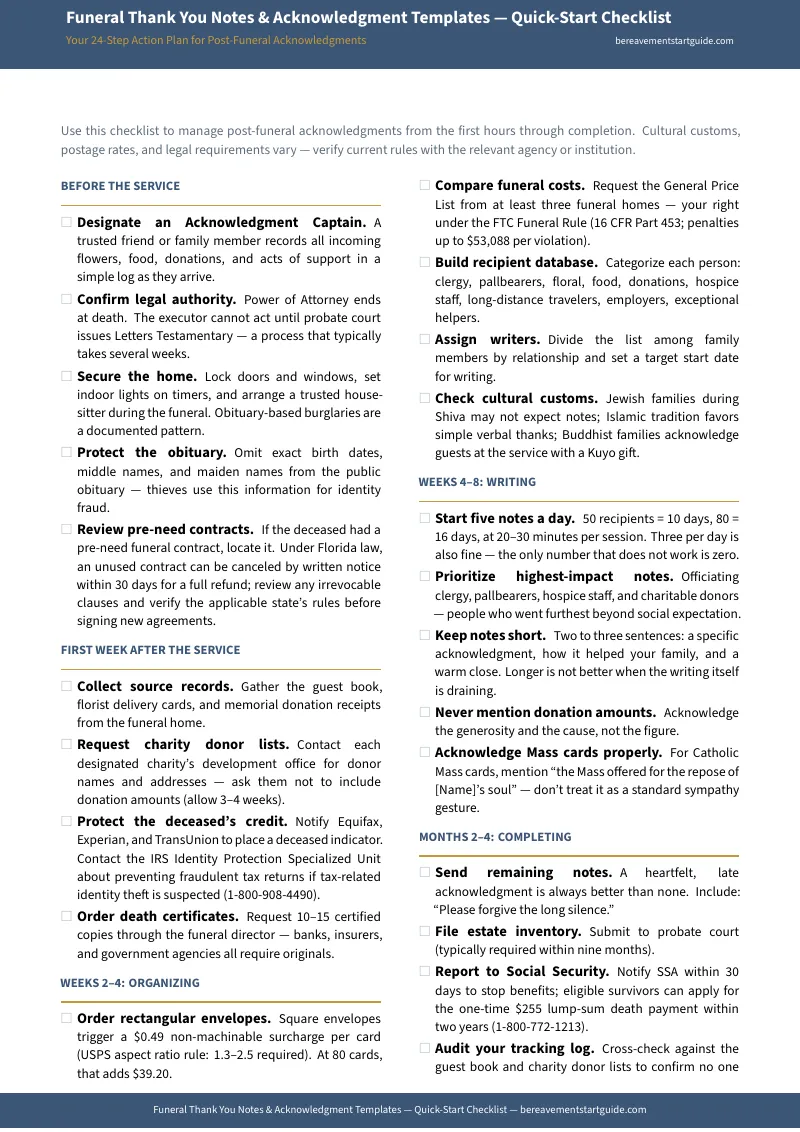
- The Five-Notes-a-Day Pacing Protocol — a sustainable daily rhythm that turns 80 recipients into a 16-day project at 20 to 30 minutes per session, instead of a single overwhelming marathon that never happens.
- Acknowledgment Tracking Log — a structured log to record every person who sent flowers, brought food, made a donation, or traveled to attend. Categorizes by type of support so you can batch your writing and catch gaps before anyone gets missed.
- Cultural and Religious Etiquette Guides — specific expectations for Catholic, Jewish, Muslim, Buddhist, and secular families. Covers Mass cards, Shiva etiquette, in-lieu-of-flowers protocols, and modern digital alternatives so you never accidentally breach a tradition you did not know about.
- Draft sheets for any channel — the same two-to-three-sentence templates, with blanks for a name and one personal detail, whether you send a handwritten card, an email, a text, or a social message.
- Legal Authority Briefing — clear explanation of who can act on behalf of the estate before probate, why Powers of Attorney end at death, and how disposition authority actually works. Prevents the family conflicts that erupt when everyone assumes they are in charge.
- Home Security Checklist — specific steps to protect the deceased's home during the funeral, prevent identity theft from obituary details, and secure mail and financial accounts in the first week.
- Belated Note Templates — warm, unapologetic scripts for notes sent weeks or months late, because a heartfelt late acknowledgment always outperforms silence.
- Funeral Home Comparison Worksheet — a side-by-side cost comparison tool referencing your rights under the FTC Funeral Rule, so you can evaluate itemized prices from at least three funeral homes without getting pressured into overpriced packages.
Who This Is For
- Surviving spouses managing everything alone for the first time
- Adult children handling a parent's affairs across state lines
- Executors juggling probate paperwork alongside social obligations
- The friend or neighbor who volunteered to take over when the family could not function
- Anyone whose thank-you notes are overdue and the guilt is growing heavier than the grief
Why Free Templates Fall Short
Free Canva templates give you a card layout. They do not tell you what to write on it. Free blog posts list etiquette rules. They do not hand you the actual sentences.
And neither free templates nor blog posts address the real problem: you have 60 to 100 recipients across a dozen categories, you cannot remember who sent what, your brain cannot hold more than one task at a time, and the whole project has stalled because you have no system — just a stack of blank cards and a growing knot in your stomach.
This toolkit replaces all of that with a single workflow. Track recipients, write notes by category, pace yourself at five per day, and close the loop on every person who showed up for your family — without burning out what is left of your cognitive reserves.
Your Purchase Is Protected
Full refund, no time limit. If the toolkit does not help you get the notes done, email hello@bereavementstartguide.com and we will refund every penny. No forms, no hoops, no waiting period.
You carried a casket, planned a service, and held your family together through the worst week of your life. Writing thank-you notes should not be the thing that breaks you. Let us handle the words so you can get back to healing.