Your Family Has 72 Hours — and a Thousand Questions No One Taught You to Answer
The parish priest is waiting for your call. The funeral home needs instructions you don't know how to give. Your grandmother is insisting on customs you've never heard of — covering mirrors, breaking pottery, placing coins in the casket — and you can't tell which ones are theologically required, which are village tradition, and which will make the priest refuse to proceed.
Meanwhile, Romania's public health law requires the body to be in an authorized chapel within twenty-four hours. The embalming certificate needs to be arranged. The coliva has to be prepared — and you don't even know where to buy arpacaș wheat berries in your city.
You don't have time to piece this together from Reddit threads, parish bulletins in archaic Romanian, and contradictory forum posts. You need one place that tells you exactly what to do, in what order, and why — so you can honor your family's traditions without the panic.
The Romanian Orthodox Bereavement Navigator
This is the guide that bridges the gap between the priest's spiritual authority and the funeral director's logistical expertise. It translates the full Romanian Orthodox funerary tradition — from canonical liturgical requirements to regional folk customs across Transylvania, Moldova, Oltenia, and Bucovina — into clear, chronological checklists that work in the seventy-two-hour window you actually have.
It's the single reference that tells you what has to happen, when it has to happen, who is responsible, where to source what you need (even from abroad), and how to handle the moments when modern law, family expectations, and church canon pull in three different directions.
What's Inside
- Hour-by-hour first-response timeline — from verifying the death through the chapel transfer, legal documentation sequence, and first priest visit, so nothing falls through the cracks during the most disorienting hours of your life
- Body preparation protocols with funeral director scripts — a printable instruction letter for non-Orthodox funeral homes explaining open-casket requirements, sacred placement rules, icon and candle positioning, and clothing protocols (including the wedding-of-the-dead tradition for young, unmarried individuals)
- Priveghi vigil planning guide — chapel setup checklist, evening Stâlpii reading schedule, visitor hospitality protocols, and the exact phrases guests must use instead of secular greetings (with pronunciation guides for non-Romanian attendees)
- Complete memorial calendar through year seven — every parastas milestone from the 3rd day through the 7-year mark, with the theological significance of each date, material sourcing lists, and a printable timeline calculator that generates your personalized schedule from the date of death
- Coliva and pomană preparation system — simplified recipes with diaspora ingredient substitutions, fasting-day menu templates (de post vs. de dulce), catering quantities by guest count, and guidance on the canonical difference between almsgiving and folk customs like the pomul vieții
- Canon vs. custom reference — every major tradition is clearly marked as either canonically required by the Church or a regional folk practice, so you can make informed decisions without fear of spiritual error when your grandmother's village custom contradicts the priest's instructions
- Diaspora adaptation modules — repatriation logistics (mortuary passport, zinc-lined coffin, consular coordination, cost estimates of €1,300–€4,500), local burial adaptations for securing east-facing plots in Western cemeteries, and material sourcing maps for Romanian communities in Italy, Germany, Spain, the UK, Australia, and North America
- Guest etiquette and taboo guide — dress code rules, photography prohibitions, the Last Kiss ceremony, proper condolence phrases, floral wreath rules (even numbers only), and a printable cheat sheet for non-Orthodox attendees
Who This Guide Serves
- Diaspora families who left Romania a generation ago and now face organizing a funeral in a tradition they understood through osmosis, not study
- Interfaith spouses who are encountering open-casket vigils, three-day wakes, and elaborate alms-giving for the first time
- Urban Romanians managing a funeral in their parents' rural parish, where the village expects customs the city never taught them
- Funeral professionals who need a reliable, authoritative reference for Eastern Orthodox liturgical timing and material requirements
Why Free Information Falls Short
The information exists — scattered across Romanian parish portals in liturgical language, Western funeral home websites that have never heard of coliva, academic anthropology papers about rural folklore, and Reddit threads where strangers argue about whether covering mirrors is canonical or superstition.
The problem isn't finding information. It's that you have seventy-two hours, your brain is in grief, and every source you find contradicts the last one. A parish bulletin assumes you already know the logistics. A funeral home quote assumes you're planning a Western service. A forum post gives you advice from one village when your family is from another region entirely.
This guide doesn't contain secret information. It curates, organizes, and sequences everything into a single chronological system — verified against the canonical standards of the Romanian Orthodox Church, mapped across regional traditions, and built for the compressed timeline you're actually working under. One reference instead of forty browser tabs.
The Free Checklist vs. the Full Guide
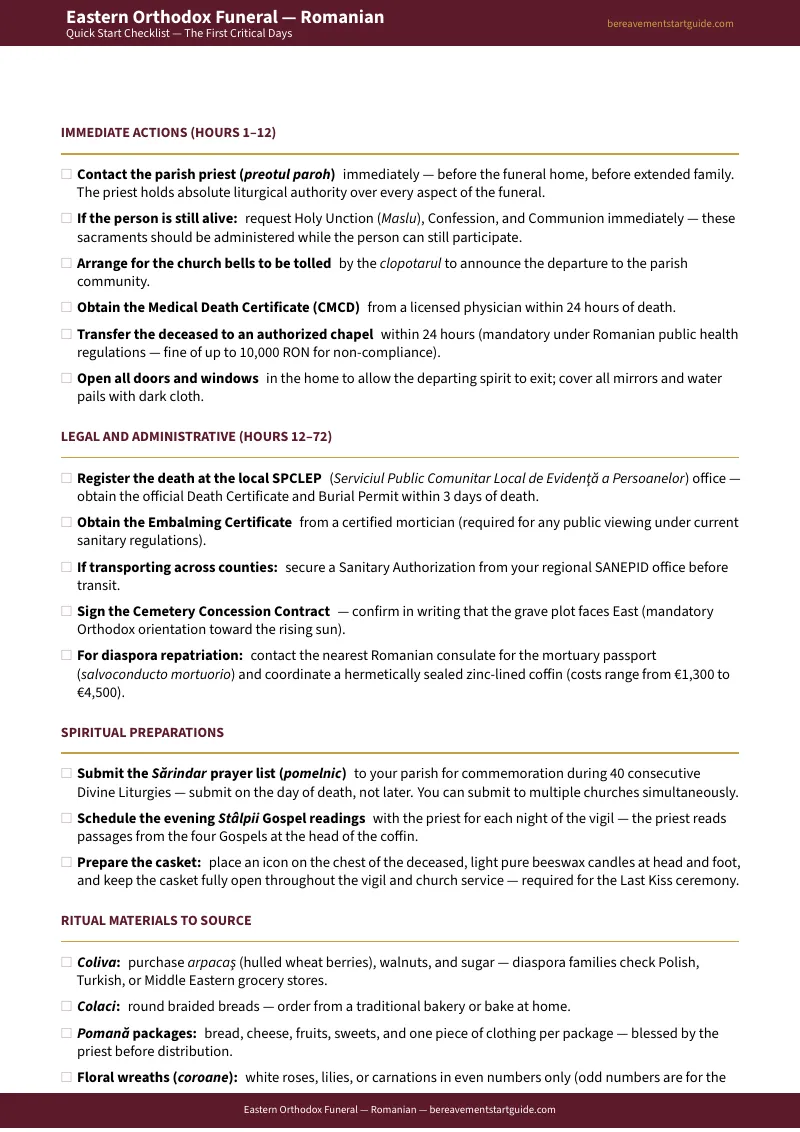
The free checklist gives you a one-page action list — what needs to happen and when. It's enough to keep you from missing critical deadlines in the first forty-eight hours.
The full toolkit gives you a 57-page guide across fourteen chapters plus 8 standalone printable worksheets: a memorial calendar planner, funeral director instruction letter, clergy interview scripts, pomană planning worksheet, financial planning worksheet, repatriation checklist, guest etiquette card, and a canon vs. custom reference card. Together they cover every stage from the first hour through the seventh-year memorial, with regional variation guides, coliva recipes, and the tools that let you make confident decisions even when family members disagree about what tradition requires.
Satisfaction Guarantee
If the guide doesn't help you navigate your family's funeral with more clarity and less stress, email us and we'll refund you — no questions, no conditions. You keep the PDF either way.
This product is a practical reference tool. It does not replace the spiritual, pastoral role of your parish priest, and it does not constitute legal advice. Local municipal sanitary laws, international repatriation treaties, and certified probate legalities always take precedence over traditional customs.
Frequently Asked Questions
What if the rules change after I buy?
We update the guide when the rules change. Email us any time, even years later, and we'll send you the current edition free.