Two Religious Systems Are Running Simultaneously — and Nobody Tells You How to Manage Both
When a death occurs in a Japanese family, Shinto and Buddhism activate at the same time. Shinto demands immediate ritual purification of the home. Buddhism demands a priest, a liturgical schedule, and a soul-guiding ceremony. Both systems have rigid timelines, and the family must satisfy them in parallel — often within hours of the death.
The problem is not grief. It is that no single source explains the full picture. Funeral directors handle logistics but not your home altar. Temple priests handle chanting but not municipal paperwork. Government "okuyami" guides handle death certificates but not incense protocol. You are left stitching together contradictory advice from Japanese-only funeral home websites, anonymous forum posts, and academic texts that assume you already know the difference between kaimyo and homyo.
The Syncretic Ceremony Navigator
This guide is built around the central reality that most families miss: a Japanese funeral is not one ceremony — it is two religious frameworks operating on top of each other, with a narrow municipal timeline running underneath both. The Traditional Japanese Funeral Guide maps all three layers into a single step-by-step sequence, from the moment of death through the 49th-day memorial and beyond.
Every instruction covers what to do, why the tradition requires it, and what happens if you get it wrong — because the consequences of a misstep in a Japanese funeral are not abstract. Using crisp new banknotes in a condolence envelope signals you were waiting for the death. Folding a kimono left-over-right on a corpse causes genuine alarm. Scheduling the funeral on a Tomobiki day can fracture family relationships permanently.
What's Inside
- The 48-Hour Post-Mortem Sequence — the four notifications in strict priority order (temple, shrine, funeral director, ward office), why each one cannot wait, and bilingual scripts for making each call
- Kamidana-Fuji and Kegare Containment — step-by-step instructions for sealing the household Shinto shrine and Buddhist altar with white paper, plus the theology behind why the seal must stay for the full 49 days
- Body Preparation Under Sakasagoto — the reverse-water bathing ritual, the right-over-left kimono fold, the six coins for the Sanzu River crossing, and the north-facing casket placement that modern apartments make difficult
- Makura-Kazari and Pillow Service Setup — exact altar arrangement (vase, incense, candle from left to right), the vertical-chopstick rice bowl, six makura-dango, and the optional defensive blade
- Wake and Funeral Protocols — guest registration, hierarchical seating, oshoko incense offering (both powdered and stick methods), and the moshu's gratitude speech template
- Sect-Specific Reference Table — side-by-side comparison across Soto Zen, Shingon, Tendai, Jodo Shinshu, Nichiren, and Shinto so you use the correct envelope inscription, incense count, and prayer gesture for your family's tradition
- Kaimyo Financial Navigation — transparent breakdown of posthumous name ranks and typical ofuse ranges, with polite scripts for discussing fees with your priest without causing offense
- Kotsuage Bone-Picking Ceremony — the feet-first bone transfer order, the significance of the nodobotoke (throat bone), mismatched chopstick protocol, and Kanto vs. Kansai regional differences in how much bone is collected
- The 49-Day Soul Journey — the seven trials, the temporary and permanent spirit tablets, daily altar rituals, koden return-gift calculation, mourning postcards, and the first Obon (Hatsu-Bon) preparation
- Koden Etiquette from Both Sides — envelope selection by relationship, the creased-bill rule, fukusa wrapping technique, faded-ink calligraphy, and the exact return-gift ratio (one-third to one-half)
- Mofuku Dress Code — men's, women's, and children's funeral attire rules, why double-strand pearls and animal-derived accessories are forbidden, and what international guests can wear instead
- Diaspora Adaptations — holding a traditional funeral abroad, sourcing ritual supplies overseas, TSA scannability rules for transporting ashes, customs documentation checklist, and adapting kotsuage when local crematoria return fine ash
- Printable planning kit — eight fillable PDFs you write on: Immediate Response Checklist, Funeral Timeline Planner, Koden Tracking Register, Ofuse Budget Worksheet, Memorial Service Calendar, Diaspora Logistics Worksheet, Elder and Clergy Questionnaire, and Bilingual Japanese-English Scripts
Who This Guide Is For
- Urban Japanese families who have never organized a funeral and are discovering that their knowledge of traditional practice has gaps they cannot afford
- Diaspora relatives flying to Japan for a funeral or organizing one abroad — facing language barriers, unfamiliar municipal systems, and international logistics
- Interfaith and intercultural spouses suddenly responsible for coordinating a ceremony in a religious tradition they did not grow up in
- Deathcare professionals — funeral planners, celebrants, and multi-faith ministers serving Japanese or multi-cultural families who need a structured reference
Why Not Free Information?
The information exists — scattered across Japanese-language funeral home websites that assume you know the basics, Reddit threads where well-meaning strangers get critical details wrong, sectarian temple manuals that cover one denomination and ignore Shinto entirely, and academic texts that explain the anthropology without giving you a single actionable step.
The cost of assembling this yourself is not money. It is time you do not have. The typical Japanese funeral sequence compresses into two to three days after death. Families who try to Google their way through it in real time discover that the first mistake (wrong envelope inscription, wrong incense count, casket aligned in the wrong direction) creates social friction with relatives and clergy that compounds at every subsequent step.
This guide consolidates it into one structured, bilingual document you can print and carry with you.
Full Refund, No Time Limit
If this guide does not serve your family's needs, email [email protected] for a full refund — no time limit, no questions.
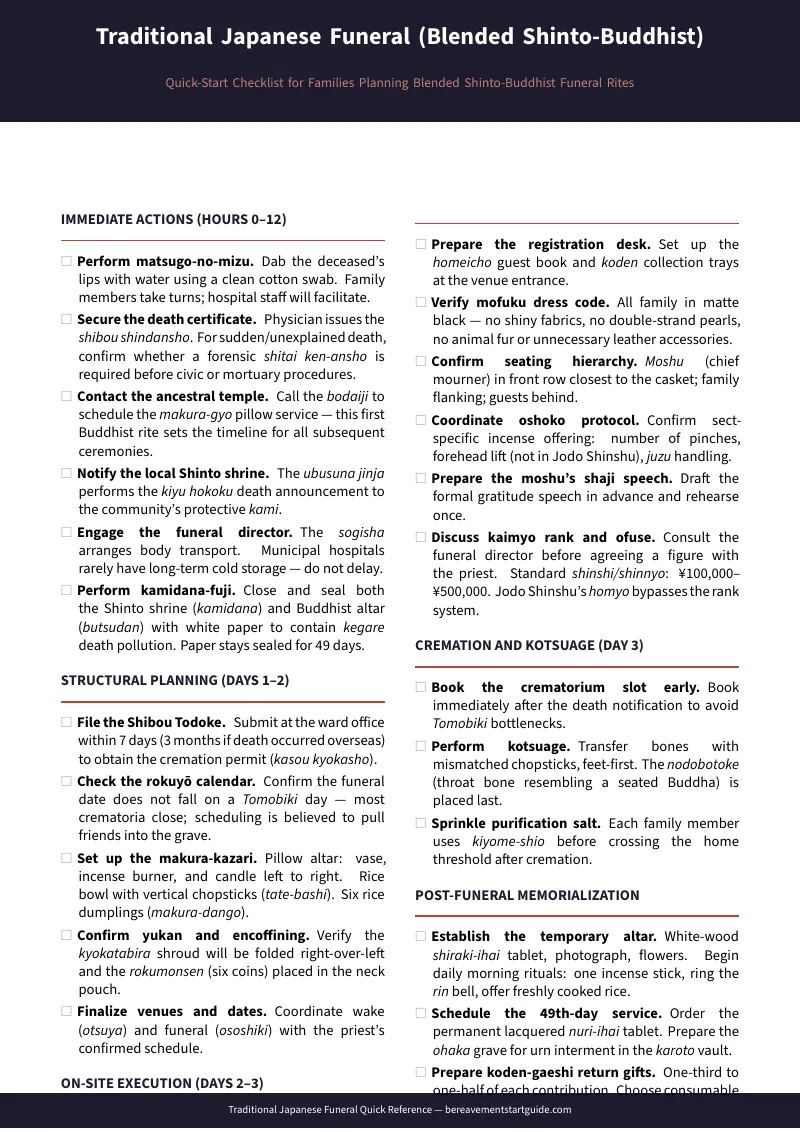
Download the free Quick Reference Checklist to see the structure and decide if the full guide is right for your family. The checklist covers the critical sequence; the complete guide covers everything else — the cultural logic, the scripts, the sect-specific protocols, and the diaspora adaptations that the checklist cannot fit.