The burial must happen within twenty-four hours. The rules are non-negotiable. And the funeral director does not know them.
When an Orthodox Jewish family member dies, the clock starts immediately. The chevra kadisha must be contacted to perform tahara — the ritual washing and purification. A shomer must be arranged to watch over the body until burial. The casket must be plain wood, no metal, holes drilled in the bottom. Embalming is forbidden. Cosmetics are forbidden. Cremation is forbidden. And every detail — from the nine kavim of water poured during purification to which side you tear your clothing on — carries religious weight that secular funeral professionals were never trained to understand.
If you are a less-observant adult child whose Orthodox parent has just died, an interfaith spouse trying to participate without overstepping, or a friend responsible for setting up the shiva house, you are navigating a system designed for people who already know the rules — and every misstep carries social and spiritual consequences.
The Halachic Bridge System
The Jewish Orthodox Funeral & Shiva Guide is a structured intermediary reference — built to sit between the rabbinic authority you defer to and the secular logistics you must manage. It does not replace your rabbi. It coordinates the two worlds so nothing falls through the gap between a funeral director's price list and the chevra kadisha's expectations.
The guide maps the full sequence from the moment of death through yahrzeit observance, with parallel tracks for the halachic process (managed by the rabbi and chevra kadisha) and the civil process (managed by you). Where those tracks intersect — hospital body release, casket sourcing, cemetery requirements, kohen seating logistics — the guide provides the scripts, checklists, and reference tables you need to keep both sides aligned under severe time pressure.
What's Inside
- Bedside-to-Burial Timeline with Hour-by-Hour Benchmarks — the twenty-four-hour window leaves no room for guessing. You know exactly what happens at each stage, who to call, and what the valid halachic grounds are for delaying burial (waiting for immediate family, Shabbat, civil requirements).
- Tahara and Shmirah Protocols Explained Clearly — the ritual washing, the nine kavim of water, the tachrichim (white linen shrouds), the tallit with one fringe cut, the shomer's Psalm-reading duties. Written so a family member who has never witnessed a tahara can understand what is happening and consent with confidence.
- Casket and Burial Requirements Under Halacha — all-wood construction, no metal hinges or handles, no lining, holes drilled in the bottom. Includes the specific language to use when a funeral director pushes a non-compliant casket, grounded in the FTC Funeral Rule's right to provide your own.
- Funeral Service Structure and Kriah Guide — the hesped (eulogy), the kriah (garment tearing) performed standing, left side for a parent and right side for other relatives, and the modesty accommodations for women. Includes the graveside shoveling sequence and cemetery customs.
- Shiva Setup and Management — low chairs under twelve inches, covered mirrors, the seudat havra'ah consolation meal (round foods: eggs, bagels, lentils), daily minyan coordination, and the full list of mourner restrictions (no leather shoes, no shaving, no bathing for pleasure, no business). Ashkenazi and Sephardi variations marked throughout.
- Phonetic Transliteration Cards — print-ready cards for the Mourner's Kaddish, El Malei Rachamim, and Baruch Dayan Ha'emet, so family members who do not read Hebrew can participate fully in the prayers.
- Kohen Proximity Rules — which family relationships override the priestly restriction, how far a kohen must stand from any body or grave, and how to map seating and pathways at the funeral home and cemetery to accommodate a kohen in the family.
- Interfaith Family Etiquette — what non-Jewish relatives and partners can and cannot do at each stage, cemetery burial restrictions for interfaith couples, and how to navigate the gap between Orthodox and Reform practices when different branches of the family want different things.
- Israel Repatriation Logistics — dual funeral home coordination, airline cargo requirements, Israeli cemetery options (Mount of Olives to regional alternatives), cost breakdowns, and the halachic grounds for extending the burial timeline to accommodate international transport.
- Two Worked Cost Examples — a metropolitan U.S. funeral and an Israel repatriation, each itemized line by line (funeral director fees, tahara, shmirah, casket, cemetery plot, grave opening, rabbi honorarium, headstone, repatriation charges) so you can compare funeral home quotes against realistic benchmarks.
- Standalone Worksheets and Reference Cards — first-48-hours checklist, chevra kadisha coordination worksheet, funeral cost tracker, funeral director questions sheet, cemetery comparison worksheet, shiva host instruction card, visitor etiquette door card, FTC Funeral Rule quick-reference, and phonetic transliteration cards for the Mourner's Kaddish and El Malei Rachamim. Designed for letter-size paper.
Who It's For
Less-observant adult children whose Orthodox parent has died or entered hospice. You grew up around these traditions but never learned the mechanics — and now you are the decision-maker. The guide gives you the halachic framework alongside the practical logistics so you can honor your parent's wishes without guessing.
Interfaith spouses and partners navigating strict cemetery restrictions, ritual boundaries, and family expectations. The guide explains clearly what you can and cannot do at every stage — from the funeral service to the shiva house — so you participate with confidence instead of anxiety.
Diaspora relatives coordinating across continents, especially families considering burial in Israel. The guide covers the repatriation timeline, dual funeral home logistics, airline cargo rules, and the full cost range so you are not negotiating blind from another time zone.
Friends and neighbors setting up the shiva house who need to know the protocols: what food to bring (and what absolutely not to bring), how to arrange the low seating, what to post on the front door, and how to behave when every secular social instinct is wrong for this setting.
Why Free Resources Fall Short
The information exists — scattered across synagogue PDFs, Chabad articles, funeral home FAQs, and Reddit threads that contradict each other. The problem is not scarcity. It is fragmentation under impossible time pressure.
Rabbis are authoritative on halacha, but they are managing multiple communal duties and cannot walk you through casket negotiations or hospital paperwork. Funeral directors handle the civil logistics, but they routinely push non-compliant caskets with metal hardware and cosmetic treatments that directly violate Orthodox requirements. Synagogue booklets assume you are a lifelong member, not a secular executor or an interfaith spouse trying to participate without overstepping. Forum threads offer contradictory anecdotes from different communities with no way to verify which custom applies to your situation.
The guide brings all three sources — rabbinic authority, civil logistics, and community protocols — into one structured reference, organized chronologically so you can act decisively instead of searching at the worst possible moment.
Start with the free checklist, or get the full guide
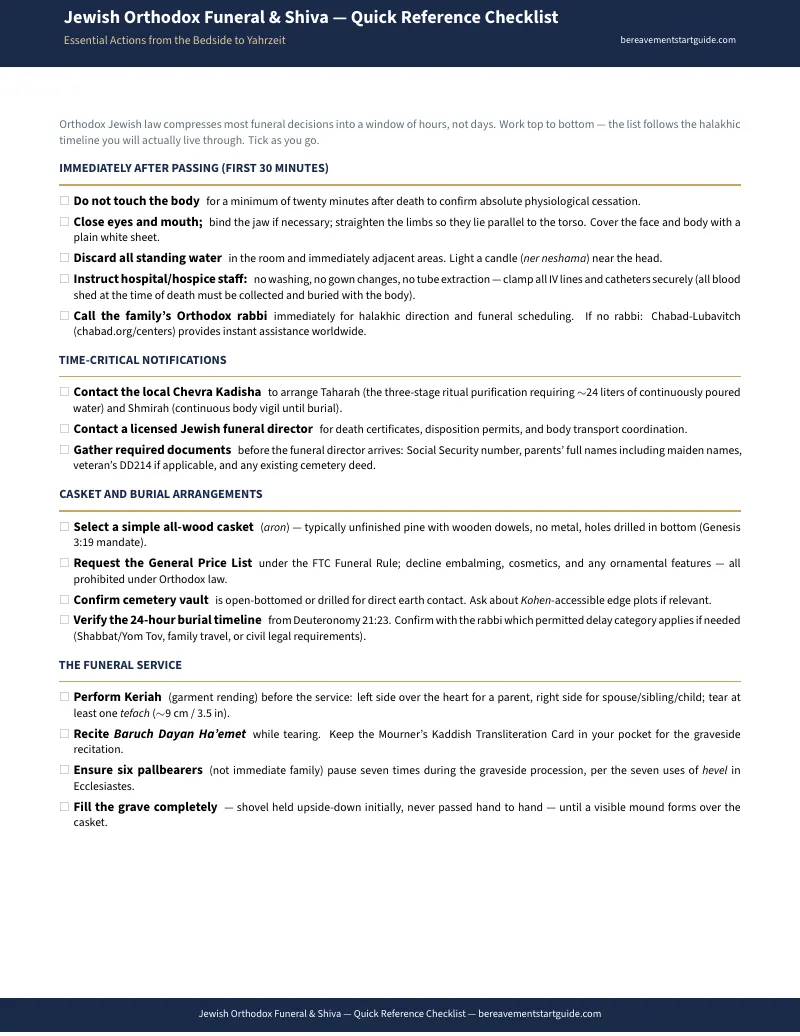
The free checklist covers the essential actions from the moment of death through the end of shiva — the calls to make, the decisions to confirm, the logistics to arrange. It tells you what to do.
The full guide tells you how — with the halachic explanations, the transliteration cards, the cost benchmarks, the interfaith etiquette protocols, the shiva host sheets, and the repatriation logistics that turn a compressed, high-stakes timeline into a sequence you can actually manage. Get the full Jewish Orthodox Funeral & Shiva Guide →
Both options include a satisfaction guarantee. If the guide does not give you the clarity you need, email us and we will make it right.
Frequently Asked Questions
What if the rules change after I buy?
We update the guide when the rules change. Email us any time, even years later, and we'll send you the current edition free.