
The Ceremony They Earned. The Roadmap You Need.
Your veteran served their country. Now you're facing a planning process that involves the Department of Defense, the VA, a funeral home, your clergy, and a family that needs answers — all while grief makes it hard to think straight.
The information is out there. It's scattered across dozens of VA portals, branch-specific regulations, and forums full of conflicting advice. The forms alone — DD-214, SF-180, VA 40-10007, VA 21-530, DD 2656-7 — could fill a binder. And if you miss a deadline or accept the wrong benefit, the consequences are permanent and expensive.
The Military Funeral & Honors Service Coordination System pulls it all into one planning document: the exact notifications, the recovery procedures, the cemetery trade-offs, the financial claims, and the ceremony coordination — organized by timeline so you know what to do first, what can wait, and what will cost you if you get it wrong.
What Families Get Wrong — and What It Costs Them
Most families don't fail because they don't care. They fail because nobody told them the rules before the clock started running.
- Overpayment clawbacks nobody warns you about. Military retired pay stops on the exact date of death — not at the end of the month. Any deposits after that date are automatically clawed back by the bank, even if the surviving spouse already used the money for funeral expenses. One late phone call to DFAS creates a debt that compounds while you grieve.
- The government urn trap. Accepting a free VA commemorative urn or plaque permanently disqualifies the veteran from burial in a national cemetery — and forfeits eligibility for a government headstone, marker, or medallion. This is not reversible. Most families learn about it after it's too late.
- Expecting full honors when only standard honors apply. The single most common source of disappointment: families assume every veteran gets a firing party, a military band, and a horse-drawn caisson. In reality, most veterans receive a dignified but smaller two-person detail. Full honors are reserved for specific ranks and circumstances. Knowing this in advance changes how you plan the ceremony — and prevents the heartbreak of unmet expectations at the graveside.
- The two-year filing cliff. Non-service-connected burial allowance claims must be filed within two years of burial. There is no extension, no hardship exception, no appeal. Families who don't know this deadline forfeit up to $2,004 in combined burial and plot-interment allowances.
What's Inside the Guide
- The five mandatory notifications with exact scripts — who to call, what to say, and what happens if you're late. DFAS, SSA, VA, insurance, and cemetery scheduling — each with the phone number, fax line, and documents you'll need in hand before you dial.
- DD Form 214 emergency recovery — two distinct pathways depending on whether you're choosing a national or private cemetery, with pre-written phone scripts for the NPRC and templates for congressional escalation when the standard process stalls.
- The complete cemetery comparison — VA National Cemeteries (no cost, typically scheduled within three business days), Arlington (two weeks to eleven months depending on remains type and honors level), private and religious cemeteries (full control, full cost, VA plot allowance may apply), and burial at sea (twelve to eighteen months, family cannot attend).
- Standard vs. full honors eligibility — the exact rank, circumstances, and branch-specific criteria that determine whether your veteran receives a two-person flag-folding detail or a full ceremony with a firing party, escort platoon, and military band.
- Faith integration flowcharts — step-by-step coordination protocols for Catholic (flag-to-pall vestibule transition), Jewish (rapid-burial timing with VSO-rendered honors), Islamic (janazah prayer coordination and virtual autopsy requests), Buddhist (incense permissions), and Indigenous ceremonies. Each flowchart shows where the military protocol and your faith's requirements intersect — and how to resolve the collision before the day of the service.
- VA financial benefits with forfeiture warnings — burial allowances, plot-interment allowances, DIC, SBP annuities, Arrears of Pay, SGLI/VGLI claims, and the Presidential Memorial Certificate. Each entry includes the form, the deadline, the maximum amount, and the specific mistakes that cause forfeiture.
- Communication scripts — pre-written questions for your funeral director ("Will the detail include a firing party, or only the two-person flag fold?"), military coordinators, cemetery representatives, and the NPRC. These aren't generic — they're built around the specific coordination failures families report most often.
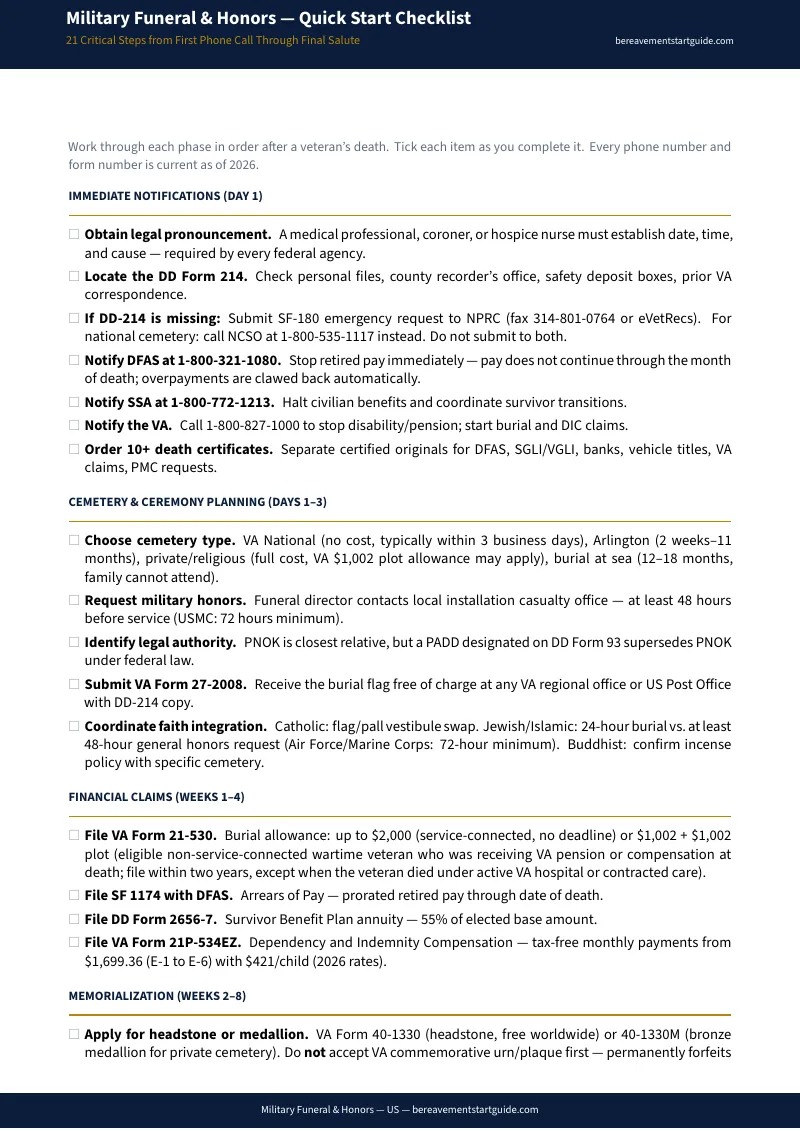
- A 22-item printable checklist — every task, form, phone number, and deadline on a single document your family can split among multiple people. Included as a separate PDF you can print and hand to whoever is handling logistics.
- 9 standalone planning worksheets — fillable trackers for agency notifications, DD-214 recovery, cemetery comparison, honors confirmation, financial claims, ceremony timeline, faith integration coordination, survivor benefit transitions, and communication scripts. Print and fill in as you go.
Who This Is For
This guide is built for the people who are actually doing the planning — not military insiders who already know the system.
- Adult children honoring a parent's service for the first time, facing a wall of military acronyms and branch-specific protocols they've never encountered
- Surviving spouses navigating the financial transition — stopping retired pay before overpayments accumulate, filing for DIC and SBP, and understanding what happens to the household income
- Extended family and friends supporting the primary next of kin by taking on logistics, paperwork, and coordination tasks so the closest relative can grieve
- Executors and estate trustees who need to audit funeral expenses, file VA burial allowance claims, and document which costs are reimbursable
- Funeral directors looking for a reliable, branch-specific reference that goes deeper than the VA website — especially for interfaith ceremonies and honors coordination
Why Free Resources Fall Short
The VA's National Cemetery Administration portal tells you what benefits exist. It does not tell you how to handle a funeral director who overpromises on honors, how to coordinate a Catholic flag-to-pall transition with a military detail that's never done one, or what happens when your Jewish mother-in-law insists on burial within 24 hours and Arlington's wait time is eleven months.
Forum advice is personal and often outdated. One family's experience with their local VFW post doesn't transfer to your branch, your state, or your cemetery. The forms are free — the context that prevents a $2,000 forfeiture is not something the forms themselves explain.
This guide does not replace your funeral director, your clergy, or your Veterans Service Officer. It gives you the specific questions to ask each of them so you can verify what they're telling you — and catch the gaps before they become permanent, expensive mistakes.
The Guarantee
Full refund, no time limit. If the guide doesn't help you plan a service that honors your veteran's legacy, email hello@bereavementstartguide.com and you'll get every penny back. No forms, no waiting period.
Your veteran's service record speaks for itself. Make sure the ceremony does too.
The free checklist gives you the 22 critical tasks with deadlines, phone numbers, and form references — enough to keep you on track in the first week. The full toolkit adds the 44-page guide, 9 fillable planning worksheets, communication scripts, faith integration protocols, and the financial tracking that turns a checklist into a complete coordination system.
Get the toolkit and start planning with confidence — for .