
You Have Hours, Not Days — And the Information You Need Is Scattered Across a Dozen Sources
The phone rings and everything changes. Someone you love is dying, or has already died, and Sunni Islamic practice says burial should happen as soon as possible — ideally within 24 hours. But you are in a Western country, and the clock does not stop while you navigate hospital release forms, death registration offices that close at 5pm on Friday, and a coroner who may want to order an autopsy.
You open your browser and the tabs multiply. A mosque PDF from 2012 covers the ghusl steps but says nothing about the legal paperwork. A government portal explains death certificates but has no idea what an expedited religious release is. A Reddit thread insists you must read Surah Yasin at the graveside — another commenter calls it bid'ah. Your Hanafi uncle says the prayer is done one way; the Shafi'i Imam at the nearest mosque does it differently. Meanwhile, the funeral director is asking questions you do not know how to answer, and your family is looking to you for direction.
The Funeral Confidence System inside this guide exists because no single free resource covers the full picture — from deathbed du'a to legal paperwork to grave geometry — in a way that actually works when you are grieving and time-pressured.
What Makes This Different From Free Mosque Guides
Free mosque guides are good at what they do: they explain ghusl steps and prayer sequences for the community they serve. What they were never designed to handle is the collision between Islamic burial urgency and Western legal systems — the coroner's hold, the weekend registrar closure, the cemetery that requires a concrete vault, the airline that demands embalming before it will transport a body.
This guide bridges both worlds. Every chapter is structured as an operational workflow — not a theological lecture — so you can hand the relevant pages to a non-Muslim funeral director, a hospital chaplain, or a family member who has never attended a Janazah and they will know exactly what needs to happen next.
Everything You Need, in the Order You Need It
- Deathbed and immediate protocols — what to recite, who to call first, and how to handle the body respectfully before the ghusl team arrives
- Death registration across four countries — step-by-step for the UK, US, Canada, and Australia, including how to request out-of-hours registration and expedited religious releases when a coroner is involved
- Ghusl (ritual washing) — complete procedure — materials checklist, the full washing sequence, modesty requirements, handling special cases (stillborn, post-surgery, menstruation), and emergency workarounds when your mosque does not have a ghusl team
- Kafan (shrouding) — men and women — three-layer and five-layer instructions with a last-resort guide to sourcing shroud fabric from a 24-hour retailer when pre-cut kits are not available
- Salat al-Janazah — all four madhhabs side by side — the prayer structure, the du'as after each Takbeer, and where Hanafi, Shafi'i, Maliki, and Hanbali practice diverges (Al-Fatiha vs. Subhanaka, hand-raising, one Tasleem or two) so mixed-madhhab families can follow the prayer together without anxiety
- Burial and grave geometry — Qiblah orientation, the Lahd side-niche, how to work with Western cemeteries that enforce vault requirements, and how to request bottomless liners that satisfy municipal codes while maintaining religious integrity
- Mourning, Iddah, and condolence — what the Sunnah actually requires during the mourning period, the widow's four-month-and-ten-day Iddah, and clear guidance on which post-funeral customs are religious obligations and which are regional traditions
- Repatriation vs. local burial — a cost comparison, timeline analysis, the embalming dilemma, the scholarly position on local burial, and conversation scripts for families where elders want the body sent home
- Two worked cost examples — a mosque-assisted budget burial and a private funeral director scenario, with line-item breakdowns so you know where the money goes and where costs can be reduced
- Common mistakes — the errors that cause the most family conflict and spiritual anxiety, including confusing cultural customs with religious obligations
- Printable worksheets and tools — a funeral planning timeline, ghusl preparation checklist, funeral director question card, cemetery arrangements worksheet, family preference worksheet, and a visitor etiquette cheat sheet for non-Muslim attendees — six standalone PDFs you can print and hand to the people helping you
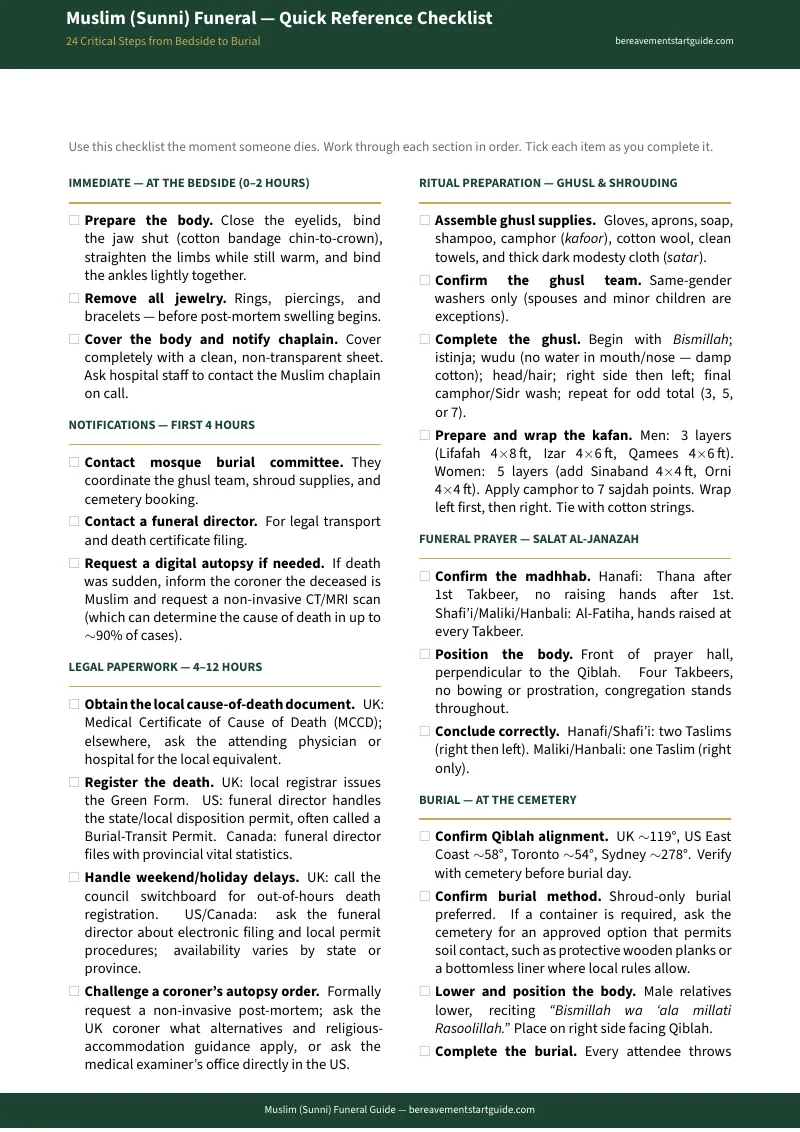
Plus a 24-item checklist covering every task from the moment of death through the end of the mourning period.
Who This Guide Is For
- Diaspora families coordinating a funeral in the UK, US, Canada, or Australia — especially second-generation adult children navigating the process for the first time
- Interfaith family members executing a Muslim relative's wishes — you do not need to be Muslim to use this guide, and it explains every term and concept in plain English
- Reverted or less-observant Muslims who know the obligation but need the practical steps, transliterations, and logistics spelled out
- Funeral professionals — directors, hospital chaplains, and hospice workers who serve Muslim families and need to understand the religious requirements, timeline constraints, and body preparation protocols
Why Not Just Google It?
You can find pieces of this information for free. A mosque PDF will cover the ghusl. A government website will explain death certificates. A YouTube video will demonstrate the prayer. But when you are grieving and the burial timeline is measured in hours, the cost is not the information itself — it is the time and emotional energy spent hunting for it, cross-referencing conflicting sources, and hoping you have not missed something critical.
A mosque-assisted burial in the UK or US costs between £1,500 and £3,550. A funeral director-managed service runs £3,700 to £9,550. An international repatriation can exceed £7,900. The difference between these outcomes often comes down to knowing what to ask, who to call, and what you are legally entitled to — before the funeral director presents their price list to someone who has never done this before.
This guide gives you that knowledge in a single printable document, organized in the order you will need it, so you can make informed decisions instead of panicked ones.
Our Guarantee
If the guide does not give you the clarity and confidence you need to navigate the funeral process, email us and we will refund you — no questions asked. We would rather you have the right information and ask for your money back than struggle through this alone.
Get the Complete Funeral Guide →
A free checklist covering the essential steps is available on the same page — download it now and upgrade to the full guide when you are ready.
Frequently Asked Questions
What if the rules change after I buy?
We update the guide when the rules change. Email us any time, even years later, and we'll send you the current edition free.