
Your family shouldn't have to learn Gulf bureaucracy while they're grieving
When an Indian national dies in the UAE, Saudi Arabia, or Qatar, the family in India inherits a paperwork crisis that spans two countries, three languages, and a dozen government offices — all while processing the worst news of their lives.
The employer says they'll handle it, but they don't know the process. The embassy has a checklist, but it's written for diplomats, not for a grieving spouse sitting in their living room in Chennai at midnight. Community volunteers offer to help, but they can't guide you through the Indian bank freezes, the EPFO death claims, or the court petitions that come next.
Meanwhile, the clock is running. A single name mismatch between the passport and the Arabic death certificate can lock the remains in a Saudi government mortuary for weeks. An unpaid traffic fine the family didn't know about can block the exit visa. An eCARe portal upload with the wrong filename format gets silently rejected.
The Cross-Border Emergency System — every step mapped, country by country
This is not a general "what to do when someone dies abroad" guide. It is a corridor-specific emergency manual built for the India-Gulf pipeline — the exact sequence of offices, documents, and deadlines for the UAE, Saudi Arabia, and Qatar, with the exact Indian-side estate procedures that follow.
Where other resources tell you to "contact the embassy," this guide tells you which embassy desk, which emergency number, what to say, and what documents to have ready before you call.
What's Inside
- Country-specific first 72-hour triage — separate pathways for UAE (Tamm digital death registration, police NOC), Saudi Arabia (activate sponsor, clear Absher fines, Ahwal Al-Madani registration), and Qatar (Humanitarian Services Office single-window system with counter-by-counter instructions)
- The Document Discrepancy Shield — a character-by-character audit checklist that catches the name formatting errors Saudi courts use to reject Legal Heir Certificates and Powers of Attorney, before you submit them
- Death certificate attestation maps — the exact attestation chain for each country (UAE's digital MoFA system, Saudi's Ahwal Al-Madani, Qatar's Ministry of Public Health), including which documents need apostille vs. consular legalization for Indian courts
- Repatriation logistics with real cost baselines — Air India's flat cargo rates from each Gulf country, embalming and zinc casket cost ranges, and the complete ashes-in-cabin checklist for non-Muslim families choosing cremation in the UAE (size limits, urn material rules, 48-hour airport health notice requirement)
- Employer obligation templates — pre-drafted notification letters citing Article 15(3) of UAE Federal Decree-Law No. 33 of 2021 and Saudi sponsor liability provisions, ready to send when an employer drags their feet on repatriation costs
- Indian estate unlocking manual — step-by-step procedures for unfreezing bank accounts under Block Code 8404, filing EPFO death claims (Form 20, 10D, 10C) without Aadhaar seeding, and determining whether you need an administrative Legal Heir Certificate or a court-issued Succession Certificate
- eCARe portal walkthrough — the Indian health ministry's clearance system for incoming remains, including the account creation trap (never use the deceased's passport number), filename restrictions, and the complete infectious disease bar list
- Ready-to-use template vault — Power of Attorney and consent letter formats pre-approved for Indian consulates in Abu Dhabi, Riyadh, and Doha; Saudi court document packs formatted with expanded names; and employer undertaking templates for unpaid wages and end-of-service gratuities
Who It's For
- Family members in India coordinating repatriation remotely — spouses, adult children, siblings, or executors who need to know what to do tonight, not after reading a 200-page legal reference
- Corporate HR departments in the Gulf with a legal obligation to manage and fund worker repatriation — this guide gives you the compliant procedure rather than an improvised one
- Community volunteers and diaspora organizations who coordinate with embassies on behalf of destitute workers — standardized checklists that prevent the document errors that cause the worst delays
Why Not Free Resources?
Free information exists — embassy websites, Reddit threads, diaspora Facebook groups, repatriation company FAQs. Here's the problem: none of it is sequenced.
The Indian Embassy website tells you which documents to bring, but not that Saudi courts will reject your Legal Heir Certificate if it uses abbreviated initials instead of the full expanded name. Reddit threads share real experiences, but the advice is anecdotal, often outdated, and specific to one city in one country. Repatriation companies handle the logistics, but they don't touch the Indian banking unfreezes, the EPFO death claims, or the succession certificate petition — that's all on you.
This guide connects every step in the correct order, flags the traps that actually cause multi-week delays, and covers the entire pipeline through to Indian estate settlement — the part that every other resource leaves out.
Full Refund, No Time Limit
If this guide doesn't help your situation, email hello@bereavementstartguide.com for a full refund. No time limit, no questions, no forms to fill.
What You Get Today
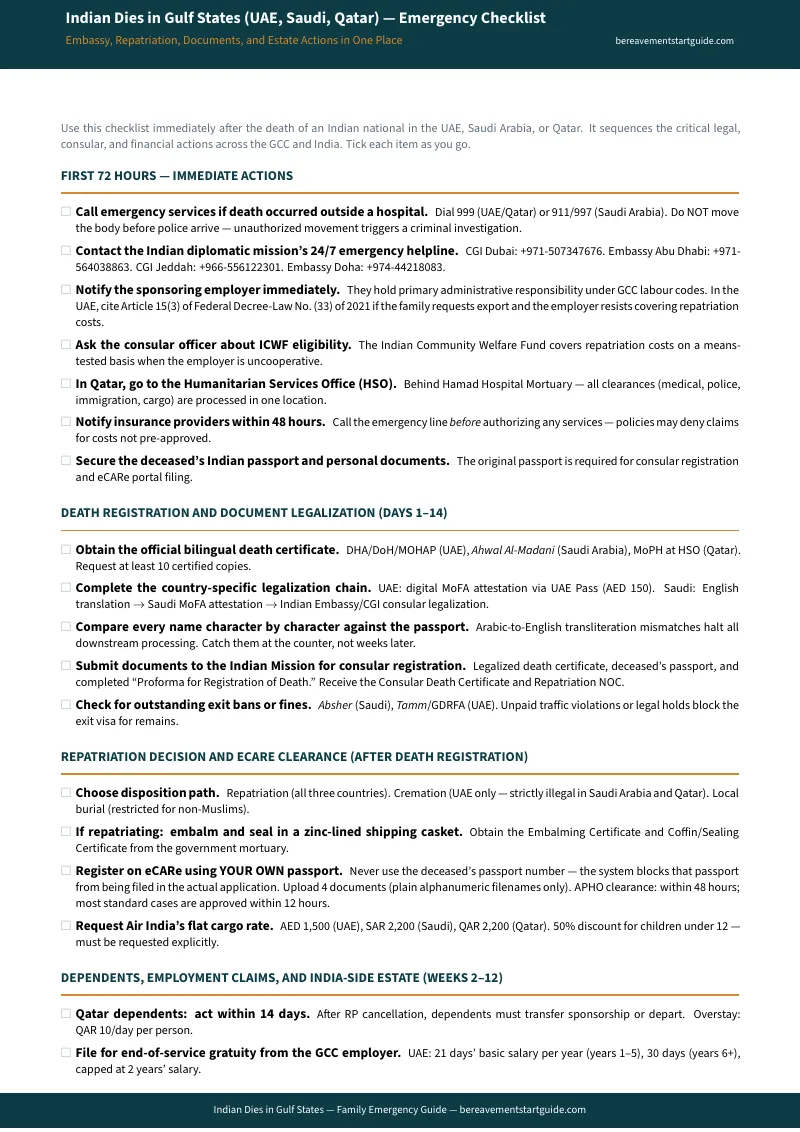
Your purchase includes 8 instant-download PDFs: the complete emergency guide, the printable quick-reference checklist, and 6 standalone planning tools — a document tracking worksheet, a repatriation cost tracker, an agency communication log, an EPFO claims preparation checklist, a cross-border estate asset inventory, and the Document Discrepancy Shield name-audit checklist. No waiting, no shipping, no account to create.
Or download the free emergency checklist first — the essential first-step sequence for the UAE, Saudi Arabia, and Qatar in a one-page printable format.