Stop Piecing Together Ireland's End-of-Life System From Five Different Government Websites
You already know you need a will, an EPA, and some kind of healthcare directive. What nobody tells you is how the pieces connect — or how the system punishes you when they don't.
Register an Enduring Power of Attorney through the MyDSS portal without the right identity verification documents and it bounces. File Form SA.2 on Revenue's system with a single missing PPS number and your probate application stalls for months. Leave a Credit Union nomination untouched after getting married and the funds you earmarked for your partner fall into the general estate and straight through probate.
Citizens Information, the DSS, Revenue, and the Courts Service each explain their own piece. None of them explain how the pieces interact, what order to tackle them in, or where the hidden triggers are that reset your timelines.
The Estate Administration Roadmap — One Sequence That Covers Everything
The Ireland End-of-Life Planning Guide is an Estate Administration Roadmap: a single document that walks Irish families through the complete process in the order it actually needs to happen — from capacity planning through to probate filing and bereavement benefit claims.
Where free government websites give you fragments across dozens of pages, the Roadmap gives you the full sequence with every form reference, deadline, fee, and portal step consolidated into one flow. It's designed for families who want to handle their own planning without paying a solicitor thousands of euros to organize information they could have organized themselves.
What's Inside
- MyDSS EPA Registration Walkthrough — The dual-phase process broken into clear steps: the €30 registration stage while the donor has capacity, the €90 activation stage when the attorney needs to act, and exactly which medical certificates, solicitor statements, and notice party requirements apply at each point. Arrive at your solicitor appointment with everything prepared instead of running up billable hours gathering documents.
- Advance Healthcare Directive Framework — How to create a legally binding directive under the 2015 Act, appoint a designated healthcare representative, and ensure the document is accessible to medical staff when it matters. Includes the specific legal requirements that distinguish a valid directive from a general statement of wishes.
- Form SA.2 Pre-Filing Worksheet — A structured spreadsheet for aggregating sole and joint assets, liabilities, beneficiary PPS numbers, and lifetime gift history back to December 1991 — everything Revenue requires on the digital form, organized so you can populate the ROS portal without backtracking. Errors on SA.2 mean the Probate Office never sees your application.
- Cohabitant Asset Protection Strategies — The Group C threshold is €20,000 with a 33% tax rate above it. The guide maps four distinct strategies to protect a surviving unmarried partner: joint tenancy structures, Dwelling House Exemption qualification, Section 72 whole-of-life insurance policies, and structured annual gifting — each with its specific Revenue compliance requirements.
- Credit Union Nomination Audit — How to use the €27,000 nomination limit to bypass probate entirely, with clear warnings about the marriage auto-revocation rule and the CAT aggregation requirement that nominees frequently miss.
- Regional Probate Registry Map — Processing times vary from 2 weeks (Waterford, personal applicants) to 20 weeks (Clonmel, Castlebar). Know which registry handles your application and what to expect before you join the queue.
- Section 117 Will Contest Risk Assessment — The six-month deadline from the Grant of Probate, the "moral duty" test under the Succession Act 1965, and how to structure provisions for children in blended families to reduce the likelihood of a successful claim.
- Bereavement Benefit Decision Trees — Routing logic for the Bereaved Partner's Contributory Pension, the €8,000 Bereaved Parent Grant, the Additional Needs Payment, Credit Union Death Benefit Insurance, and the Occupational Injuries Funeral Grant. Includes the new cohabitant eligibility rules under the 2025 Social Welfare Act.
- Funeral Cost Planning Template — Average costs broken down by category (funeral director fees, burial plots in Dublin vs. regional areas, cremation, church fees, RIP.ie notices) plus a three-quote comparison worksheet for funeral directors.
- EPA Preparation Checklist — Everything your solicitor and doctor need, organized so you can complete the capacity assessment and legal practitioner statement appointments in one round instead of multiple follow-up visits.
Who This Is For
- Adult children setting up an EPA for an aging parent — the MyDSS portal process requires identity verification, medical certificates, and formal notice to relatives. Most families arrive at their solicitor unprepared and spend hours (at solicitor rates) gathering what they could have compiled beforehand.
- Named executors facing their first probate application — Form SA.2 requires information most executors don't know they need until Revenue's portal rejects the submission. The guide's pre-filing worksheet eliminates the trial-and-error loop.
- Unmarried cohabiting partners — if you share a home and haven't structured the ownership specifically for inheritance tax purposes, the surviving partner could owe Revenue over €100,000 on a property worth €350,000. The guide maps the four strategies that prevent this.
- Retirees organizing their own affairs — you want one folder with a valid will, an EPA, a healthcare directive, current Credit Union nominations, and documented funeral wishes. The guide's planning worksheets provide the structure.
- Social workers and community advocates — a structured reference covering the legal requirements and the practical execution steps, organized to support the families you work with.
Why Free Government Resources Aren't Enough
Citizens Information explains what an EPA is. The DSS portal explains how to register one. Revenue explains Form SA.2. The Courts Service explains probate fees. The Irish Hospice Foundation's Think Ahead pack covers personal wishes and healthcare directives.
Each resource is accurate within its own scope. The problem is that none of them connect to each other, and the real administrative traps live in the gaps between them.
Nobody tells you that your EPA preparation needs to include documents that your SA.2 filing will later require. Nobody explains that a Credit Union nomination you set up five years ago was silently revoked when you got married. Nobody maps out that a single valuation error on the SA.2 form doesn't just delay your probate application — it resets your position in a regional queue that can be 20 weeks long.
The Ireland End-of-Life Planning Guide bridges those gaps. It gives you the complete sequence, with every interaction between the systems mapped and every deadline, fee, and form reference consolidated in one place.
Satisfaction Guarantee
If the guide doesn't save you time, stress, or money compared to piecing the process together yourself, email hello@bereavementstartguide.com and we'll refund you in full.
Get Started
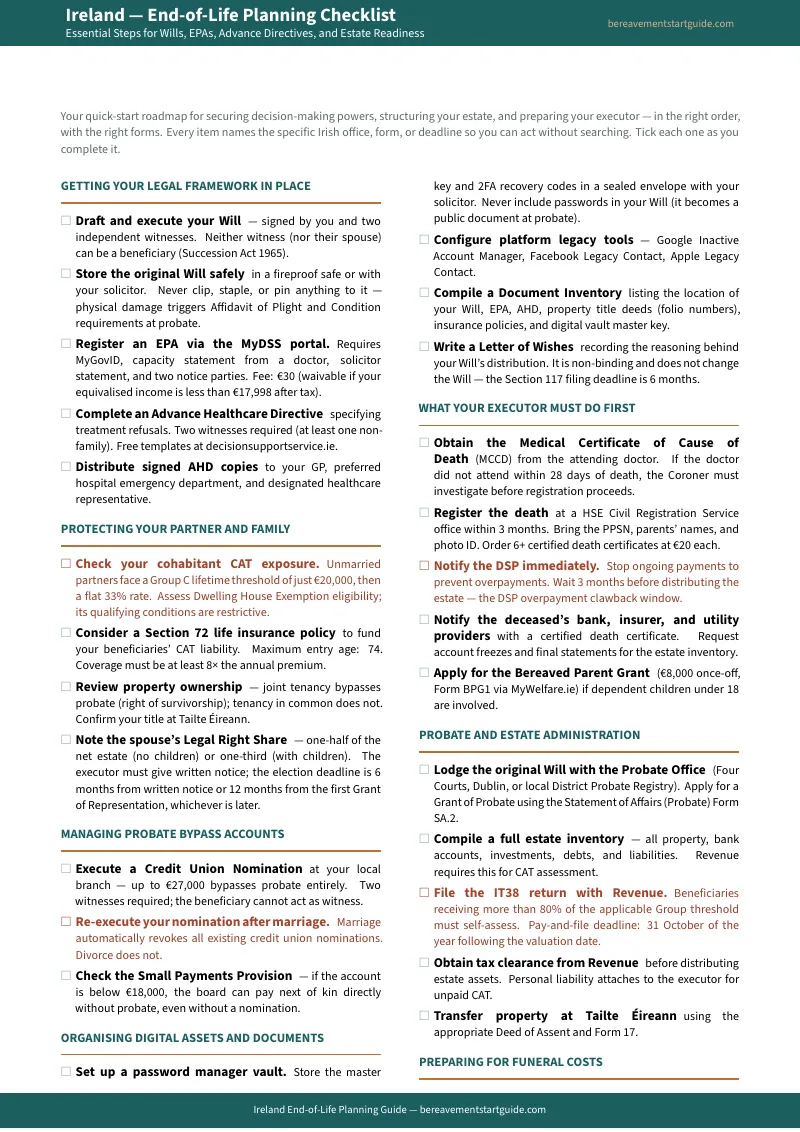
Download the free Ireland End-of-Life Planning Checklist for a one-page overview of every step. When you're ready for the complete 53-page guide plus 8 standalone printable worksheets — including the SA.2 pre-filing spreadsheet, EPA registration checklist, and funeral cost comparison — get the full toolkit for .
Get the Ireland End-of-Life Planning Guide →
Frequently Asked Questions
What if the rules change after I buy?
We update the guide when the rules change. Email us any time, even years later, and we'll send you the current edition free.