The Bank Won't Release the Money. The Solicitor Wants Thousands. The Probate Office Says You Can Do It Yourself.
You rang the bank and they said no — not without a grant. You rang a solicitor and the quote came back at €3,000 to €8,000 plus VAT. And somewhere between those two phone calls, you found out the Probate Office accepts personal applications from executors and administrators.
The problem is not whether you can do it yourself. The Courts Service built the personal application route for exactly this purpose. The problem is that the process is spread across three different government websites, the forms reference legal terms nobody explained to you, and one mistake on a sworn document can send your application back for weeks.
The Personal Application Roadmap
The Ireland Probate Guide is a structured walkthrough of the entire personal application process — the same route thousands of Irish families use each year to avoid solicitor fees on straightforward estates. It takes every step in order, from gathering documents through to collecting your sealed grant, and shows you exactly what happens at each stage.
This is not a legal textbook or a collection of blog posts. It is a single reference document that connects Revenue's Form SA.2, the Probate Office's paper application, and the registry interview into one clear sequence — so you are never guessing which step comes next or which form goes where.
What's Inside the Guide
- Grant types explained in plain English — Probate, Administration Intestate, Administration with Will Annexed: which one applies to your estate and what changes in the application
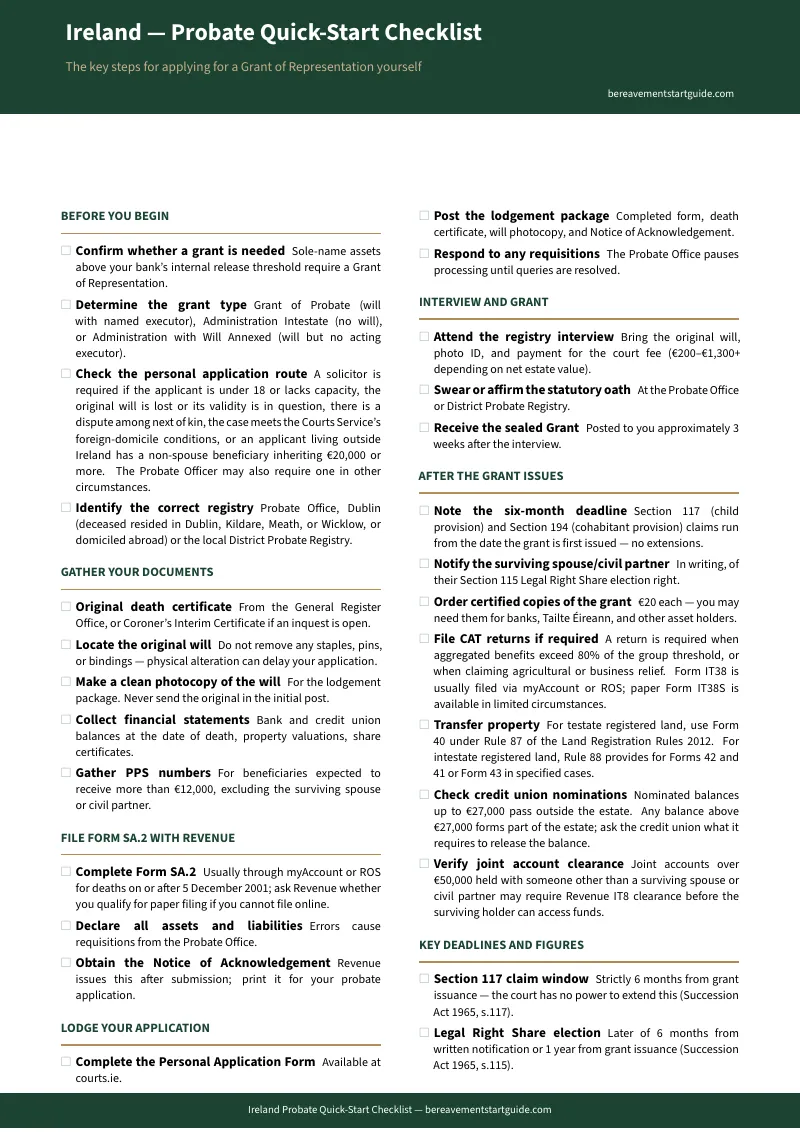
- The document gathering checklist — original will handling rules (never unbind, never remove staples), death certificates, PPS numbers, asset valuations and what the Probate Office actually asks you to bring to the interview
- Revenue Form SA.2 walkthrough — the online Statement of Affairs that replaced the old Inland Revenue Affidavit, filed through myAccount or ROS, with the fields that trip up personal applicants and how to get the Notice of Acknowledgement you need before lodging your application
- Personal application step by step — filling the forms, posting them to the right office (Dublin or your District Registry), booking the interview, what happens at the interview, and collecting the grant
- Fee tables and realistic timescales — current court fees by estate value, the difference between personal and solicitor application fees, and what the Probate Office's published waiting times actually mean for your application
- Intestacy shares with worked examples — who inherits what under the Succession Act 1965: spouse and children, spouse alone, children alone, with the arithmetic done for you
- Legal right share and section 117 claims — the surviving spouse's legal right share (one-half or one-third depending on children), a child's right to claim proper provision when a parent dies with a will, and the six-month deadline from the grant that cannot be extended
- Capital Acquisitions Tax thresholds — the Group A, B, and C tax-free thresholds so you can flag a CAT liability early and advise beneficiaries to get tax advice
- The solicitor boundary — the specific situations where the Courts Service requires you to use a solicitor, so you know before you start whether a personal application is the right path
- Six fillable worksheets — Application Milestone Tracker, Document Gathering Checklist, Estate Asset and Liability Inventory, Registry Requisition Log, Beneficiary Notification Record, and Key Deadline Calendar — print them and write on them as you go
Who This Guide Is For
This guide is for the executor named in an Irish will, or the surviving spouse or adult child of someone who died without one, who wants to apply for a grant through the Probate Office's personal application route.
It is designed for straightforward estates — a family home, bank accounts, a credit union balance, life policies — where the will is uncontested, the beneficiaries are cooperating, and the main question is not whether to apply but how.
If the estate has no assets that require a grant (sole-name balances under the institution's release threshold, joint accounts, nominated credit union funds), the companion guide on small estates without probate covers that path instead.
Why Not Piece It Together for Free?
You could do this with the Courts Service website, the Revenue portal, and Citizens Information. Many people do. But here is what that looks like in practice:
The Courts Service publishes a five-step overview. Revenue publishes a separate set of instructions for Form SA.2. Citizens Information explains the Succession Act in its own section. None of them are written as a single sequence. You end up with 15 browser tabs open, cross-referencing one site against another, unsure whether you have missed a step because the step was on a different website.
The guide puts the entire process in one document, in order, with the connections between Revenue and the Probate Office made explicit. It does not replace the official forms — you still file those yourself. It makes sure you file them correctly, in the right sequence, with the right documents attached.
Satisfaction Guarantee
If the guide does not help you, email hello@bereavementstartguide.com for a full refund, no time limit. No forms, no questions about why.
Start Your Application With Confidence
Download the free quick-start checklist to see if a personal application is right for your estate. When you are ready for the full process, the complete guide is — a fraction of what a solicitor charges for the same straightforward estate.
Get the Ireland Probate Guide →
Frequently Asked Questions
What if the rules change after I buy?
We update the guide when the rules change. Email us any time, even years later, and we'll send you the current edition free.