The Bank Says You Need Probate. The Court's Website Gives You Legalese. This Guide Gives You the Actual Steps.
Someone has died, the bank has frozen the accounts, and LINZ won't transfer the property title until you produce a sealed grant from the High Court. You've looked at the Ministry of Justice website. You've seen the prescribed forms on legislation.govt.nz. You may have called a law firm and been quoted $2,000 to $5,000 for something you're not sure you can't do yourself.
The problem isn't that the information doesn't exist — it's that it exists in pieces. The court's forms are statutory text with no instructions. The Ministry's practical guide gives step-by-step instructions for straightforward probate with a valid will, but it does not cover letters of administration or intestacy applications. And the law firms quoting thousands of dollars have no incentive to tell you which estates are straightforward enough to file without them.
The New Zealand Probate and Letters of Administration Guide is a Registry-Ready Filing System — it translates the High Court's requirements into a step-by-step process you can follow from your kitchen table. Not legal advice. Not forms. A structured method for assembling the right documents, in the right order, with the formatting the Wellington Probate Unit actually expects.
What's Inside
- Grant route decision framework — because filing the wrong type of application wastes the $275 court fee and restarts the clock. The guide walks you through probate in common form, letters of administration with will annexed, letters of administration on intestacy, and the section 65 small-estate release (up to $40,000 per institution), so you know which path fits before you swear a single affidavit.
- Document assembly system — when documents are missing or incorrect, the Wellington registry issues a minute explaining what needs to be fixed. The guide lists every document, every exhibit marking, and every attachment the Probate Unit expects, in the sequence it needs to appear.
- Requisition avoidance checklist — clerical defects cause formal requisitions that add four to eight weeks to processing. The checklist covers the most common triggers: unsigned pages, unverified name discrepancies, missing JP endorsements, and incorrect binding orders.
- Intestacy shares with worked examples — when there's no valid will, the Administration Act 1969 prescribes who inherits and how much. The included calculator applies the formula: personal chattels, the surviving partner's prescribed amount plus statutory interest from death until payment, then the applicable share of the residue, with worked dollar examples so you can see how the numbers fall.
- PRA election explained — the surviving partner can choose between inheriting under the will or intestacy, and applying for a half-share division of relationship property under the Property (Relationships) Act 1976. For most estates, the choice is due within six months after administration is granted in New Zealand; for a small estate, it is due by the later of six months after death or, if administration is granted within that period, six months after the grant. The choice generally cannot be revoked, though a court may set it aside in limited circumstances, and the written notice requires a lawyer's certificate.
- Claims and time limits — Family Protection Act claims (ordinarily 12 months from the grant; 2 years when an administrator applies on behalf of a person not of full age or mental capacity) and testamentary promises claims can delay distribution. The guide explains who can claim, the deadlines, and what an executor should know about the section 47 protection before releasing any funds.
- LINZ title transmission — how to register the property transfer after the grant issues, the difference between executor transmissions and joint tenancy survivorship, and what the Landonline checklist requires.
- Fee and cost map — the $275 court filing fee, what JPs and solicitors charge for witnessing affidavits, what Simply Probate and law firms quote, and how to apply for a fee waiver.
Who This Is For
You're an executor named in a New Zealand will, or the partner or adult child of someone who died without one. You've been told by the bank, KiwiSaver provider, or LINZ that you need a grant from the High Court. You want to understand the process well enough to either file the application yourself or walk into a lawyer's office with everything organised — cutting hours off their billable time.
This is not for contested estates, trust disputes, or situations where family members disagree about who should administer. Those need a solicitor from the start, and the guide says so.
Why Not Just Use the Free Court Guidance?
The Ministry of Justice publishes a practical guide and Word document examples. They're useful — and they're linked in every chapter. The practical guide focuses on straightforward probate with a valid will and does not cover letters of administration or intestacy applications. This full guide adds those grant routes and places the broader filing process in one workflow.
Law firms charge $2,000 to $5,000 for a simple estate — and $8,000 to $15,000 or more for anything complex. Simply Probate's document preparation starts at $699 plus GST. For some services, Public Trust caps its fees at 5% of the total value of the estate's assets plus the income it receives in respect of the estate; special fees such as obtaining probate, managing property, carrying on a business, and legal services fall outside that cap.
This guide sits between the free summaries and the professional services. It gives you the operational detail the Ministry leaves out, in a format you can print and work through, for a fraction of a single hour of a solicitor's time.
What You Get
Your download includes 9 PDFs:
- guide.pdf — 12 chapters covering everything from locating the original will to registering the property transmission with LINZ, plus the intestacy shares, PRA election, and claim time limits.
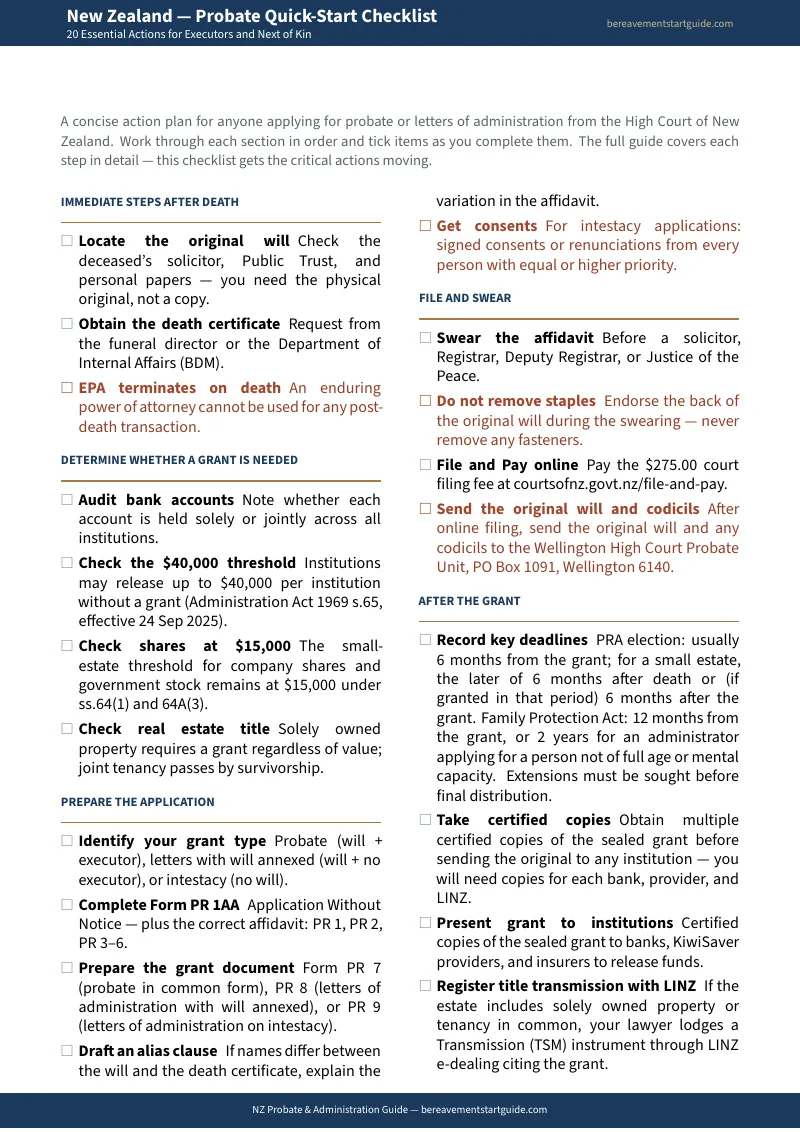
- checklist.pdf — a printable two-page overview of when a grant is needed and what documents the High Court expects.
- grant-route-decision-worksheet.pdf — tick through the section 65 / section 64 thresholds and land on the grant type before you pay the court fee.
- document-gathering-checklist.pdf — every paper the Wellington Probate Unit expects, with a date column as you collect it.
- asset-and-liability-worksheet.pdf — sole vs joint, values, and institution contacts for the affidavit.
- filing-and-correspondence-log.pdf — File and Pay numbers, packets to Wellington, requisition notes, and the PRA / Family Protection Act dates.
- intestacy-distribution-calculator.pdf — the three section 77 layers with blank lines for this estate's figures.
- cost-comparison-worksheet.pdf — side-by-side quote columns for self-filing, document prep, a solicitor, and Public Trust.
- requisition-avoidance-checklist.pdf — the clerical checks to tick before the envelope leaves, so a missed exhibit note does not add four to eight weeks.
Satisfaction Guarantee
If the guide isn't what you expected, email hello@bereavementstartguide.com for a full refund, no time limit. We read every message.
Start With the Free Checklist
Not sure whether the estate needs a grant at all? Download the free Probate Quick-Start Checklist — it covers the small-estate thresholds, the document inventory, and the High Court filing basics. If the estate does need a grant, the full guide picks up where the checklist leaves off.
Frequently Asked Questions
What if the rules change after I buy?
We update the guide when the rules change. Email us any time, even years later, and we'll send you the current edition free.