
The Bank Says Maybe. The Credit Union Says It's Covered. The Solicitor Wants €2,000.
Someone has died, and you've been told the estate is small enough to settle without a court grant. But every institution you contact has a different threshold, a different form, and a different answer about what they'll release. The credit union says the nomination covers it. The bank says they'll release up to their limit — if you sign an indemnity. An Post says you need a grant after all. And nobody has mentioned that Capital Acquisitions Tax still applies whether or not you go through the Probate Office.
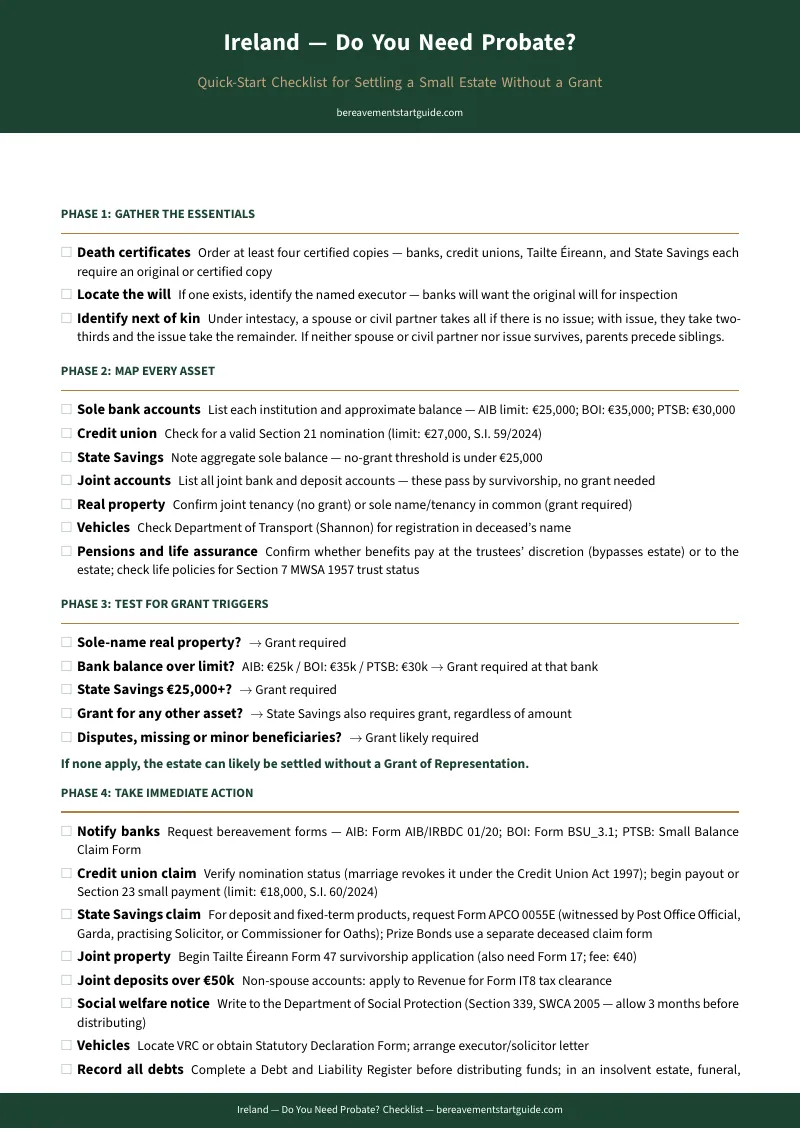
The Ireland Small Estate Settlement Matrix puts every institution's rules, forms and limits in one place, so you can see which assets pass without a grant, which need one, and what each institution expects before it releases a cent.
What's Inside
Bank-by-Bank Release Thresholds
AIB, Bank of Ireland and Permanent TSB each have a no-grant release limit for combined sole-name balances, with a form and institution-specific requirements. The guide puts all three side by side in a dated comparison table so you can see which process to ask about. A balance within a published limit does not guarantee release; the institution may still require a grant.
Credit Union Nominations and Small Payments
A valid credit union nomination directs savings to the named person up to the limit set by S.I. 59 of 2024, outside the estate entirely. Separately, the board of directors can distribute un-nominated savings up to the limit set by S.I. 60 of 2024 without a grant. The guide explains both routes, what happens when a marriage has revoked the nomination, and why a later will does not.
Joint Accounts and Survivorship
Joint bank accounts generally pass to the surviving account holder on proof of death. The guide covers the documents the bank needs, how the Revenue IT8 €50,000 clearance rule applies to qualifying joint bank deposit accounts over that amount — excluding current accounts and accounts held jointly with a surviving spouse or civil partner — and when a joint account does not automatically pass.
Property and Tailte Éireann Form 47
Property registered as a joint tenancy passes to the surviving joint tenant by survivorship, without a grant. The guide walks through the Form 47 process for removing the deceased from the title. If the property is in the deceased's sole name, a grant is needed — and the guide flags that boundary clearly so you don't waste weeks on the wrong path.
Vehicle Transfers
Transferring a deceased person's vehicle involves the Department of Transport at Shannon, an executor's entitlement letter, and sometimes a sworn statutory declaration when the vehicle registration certificate is missing. The guide covers each scenario step by step.
Revenue and Capital Acquisitions Tax
Settling an estate without a grant does not eliminate beneficiary tax duties. Capital Acquisitions Tax applies to gifts and inheritances above the applicable group threshold regardless of whether a court grant was extracted. The guide explains the current group thresholds, the IT38 filing trigger, and walks through two worked examples so you can flag a liability early.
Seven Fillable Worksheets
An asset triage worksheet to categorise every account into its settlement path (A through D), a bank release tracker to log each institution from first contact to payout, a document collection checklist so nothing is left behind, a credit union nomination verification sheet, a debt and liability register to clear before distributing, a revenue and social welfare clearance log, and an institution contacts directory with every bereavement department, government body and free legal service.
Who It's For
This guide is written for the surviving spouse, adult child, or named executor of someone who died in Ireland with a modest estate — bank balances, a credit union account, a pension, a jointly-owned home — who wants to settle what they can without a solicitor or a court grant. It covers the standard, uncontested cases where the beneficiaries are known and cooperating.
If the estate includes sole-name real estate or bank balances above the institution's threshold, you will need a formal grant — the sibling Ireland Probate Guide covers that process. Sole shareholdings may need a grant. For eligible cases where no grant is being sought and total Irish assets do not exceed €20,000, Computershare's Small Estates Service provides a no-grant route. If the estate holds State Savings at or above the threshold, the State Savings after death guide covers that specific claim.
Why Not Piece It Together Yourself?
You could phone each bank's bereavement line, check Citizens Information for general rules, look up statutory instruments for credit union limits, and visit Revenue's website for tax guidance. Each source covers its own piece. None of them tells you how the pieces fit together, or where one institution's rules interact with another's limits. The guide puts the full picture in one document — with the thresholds dated, the forms identified, and the boundaries between no-grant and grant-required drawn clearly.
A solicitor doing this work charges fees that can rival the estate's total value when balances are small. The guide costs a fraction of one hour of legal time and covers exactly the ground a solicitor would map out for a straightforward small estate.
Satisfaction Guarantee
Full refund, no time limit. If the guide isn't what you need, email hello@bereavementstartguide.com and we'll refund you.
Start Settling the Estate
Download the free checklist to see whether the estate needs a grant at all — it walks through the assets one by one. If you're ready for the full process, the Ireland Small Estates guide gives you the institution-by-institution path for every asset that can pass without a court grant, plus the worksheets to track your progress.
Frequently Asked Questions
What if the rules change after I buy?
We update the guide when the rules change. Email us any time, even years later, and we'll send you the current edition free.